
Study the pie chart and answer the question that follows.
The number of people applying for a passport from a city was monitored, and it was found that the numbers (in multiples of hundred) during the first five months of 2019 were as follows: January (M1)-248, February (M2)-134, March (M3)-162, April (M4)-94, May (M5)-72. These have been represented through the given pie chart.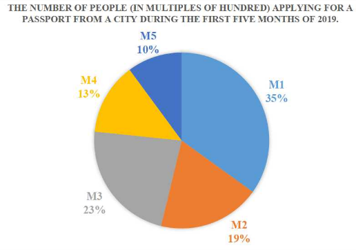
What is the central angle (to the nearest degree) of the sector corresponding to M1?
Study the pie chart and answer the question that follows.
The number of people applying for a passport from a city was monitored, and it was found that the numbers (in multiples of hundred) during the first five months of 2019 were as follows: January (M1)-248, February (M2)-134, March (M3)-162, April (M4)-94, May (M5)-72. These have been represented through the given pie chart.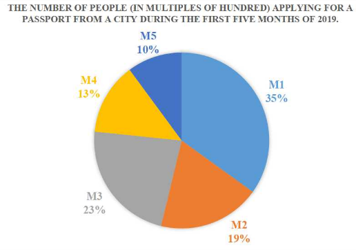
If the number of people during M2 and M5 had, respectively, been 50% less and 50% more than what has been presented in the pie chart, then what would be the central angle (nearest to degrees) of the sector corresponding to M5?
The speed of light is very nearly equal to 3 x 10¹⁷ nanometer per second. How much time (in seconds), approximately, does it take light to travel from the moon to the earth, the average distance between them being 381000 km? (1 nanometre = 10-9 metre)
When a rectangle is divided into three equal parts, each of them turns out to be a square of area 16cm2 . What is the perimeter (in cm) of the rectangle?
Simplify the following expression \(\frac{45 \div 3 \times \tfrac{2}{3} + 1\tfrac{1}{3}\,\text{of}\,6\tfrac{3}{8} - 4\tfrac{1}{8}}{\tfrac{1}{2}\left[(2\tfrac{1}{4} + 1\tfrac{1}{2}) \div \left(\tfrac{1}{15} + \tfrac{1}{3} - \tfrac{9}{10}\right)\right]}\)
\(-\tfrac{4}{9}\)
\(-\tfrac{23}{6}\)
\(\tfrac{68}{5}\)
\(-\tfrac{8}{9}\)