
the value of \(\frac{3 \frac{1}{4} - \frac{4}{5} \text{ of } \frac{5}{6}}{4 \frac{1}{3} \div \frac{1}{5} - \left( \frac{3}{10} + 21 \frac{1}{5} \right)} - \left( 2 \frac{1}{3} \text{ of } 1 \frac{1}{2} \right)\)
Study the given graph and answer the question that follows.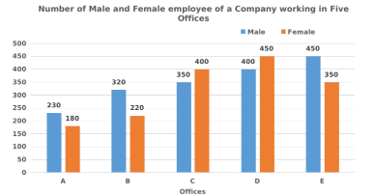
In which office of the company is the number of male employees 25% more than the average number of female employees in all five offices?
If the mean of the distribution is 24.6, then the value of x is:
| Class | 0 to 10 | 10 to 20 | 20 to 30 | 30 to 40 | 40 to 50 |
| Frequency | 6 | 12 | 15 | x | 5 |
A and B can do a certain work in 12 and 18 days, respectively. They work together for 5 days. The remaining work was completed by C alone in \(27\tfrac{1}{2}\) days. What part of the same work can be completed by A, B and C together in 6 days?
\(\frac{5}{6}\)
\(\frac{9}{10}\)
\(\frac{14}{15}\)
\(\frac{29}{30}\)
A sum od ₹4,000 is lent at 10% p.a., interest compounded annually. What is the difference between the compound interest for the 2nd year and the 3rd ?
An artcle is sold at a profit of 25%. If both the cost price and the selling price of the article are increased by ₹200, then the profit percentage is 20%. What is the original cost price of the article?
A dealer sells an article by allowing a 20% discount on its marked price and still gains 12%. If the cost price of the article is ₹750, then its marked price (in ₹) is: