
The average monthly expenditure of a family was ₹10,000 during the first three months, ₹12,500 during the next four months, and ₹13,500 during the last five months of a year. If the total savings during the year were ₹32,500, then the average monthly income (in ₹) of the family was:
'A' alone can do a piece of work in 10 days and 'B' alone can do it in 15 days. 'A' and 'B' undertook to do the work for ₹42,000. With the help of 'C', they completed the work in 5 days. How much (in ₹) is to be paid to C?
Study the following graph and answer the question that follows.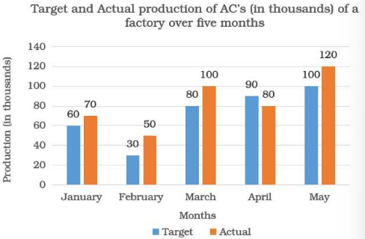
The actual production of AC's in March is what percentage more than the average target production of AC's over the period of 5 months (correct to the nearest integer)?
A sells an article to B at 12% profit. B sells it to C at 9% loss. If C pays ₹15,288 for it, then at what price (in ₹) is the article purchased by A?
The selling price of an article is \(\frac{7}{6}\) times the cost price. What is the loss/gain percentage (correct up to two decimal places)?