
Quantitative Aptitude
study the given pie chat, and answer the question that follows.
The given chart represents the percentage-wise distribution of the total number of vanilla cakes and chocolate cakes sold on each day of the week. The total number of cakes sold in a week = 10500.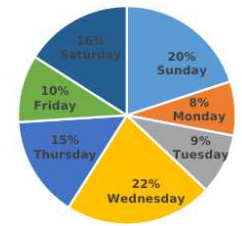
If the ratio of vanilla cakes sold to chocolate cakes sold on Wednesday is 13: 8, then how many vanilla cakes are sold on that day?
An article was bought for ₹14,000 and sold at \(\tfrac{4}{7}\) of its cost price. The loss percentage is:
\(42\tfrac{3}{7}\%\)
\(42\tfrac{5}{7}\%\)
\(42\tfrac{6}{7}\%\)
\(41\tfrac{6}{7}\%\)
A can do a work in \(7\tfrac{1}{2}\) days, whereas B can do the same work in \(10\tfrac{1}{2}\) days. If they worked together, then the same work would be completed in
\(4\tfrac{3}{8}\,\text{days}\)
\(4\,\text{days}\)
\(4\tfrac{1}{2}\,\text{days}\)
\(4\tfrac{1}{8}\,\text{days}\)
If a certain sum amounts ₹27,450 in 5 years at simple interest at the rate \(10\tfrac{1}{2}\)% p.a., then the sum is:
The value of
is:
A loss of \(12\tfrac{1}{2}\)% gets converted into a profit of \(11\tfrac{1}{5}\)% when the selling price is increased by ₹118.5. The cost price of the article is:
The average speed of a train is 160% of the average speed of a car. The car covers a distance of 880 km in 16 hours. The time taken by the train to cover a distance of 484 km is:
\(7\tfrac{1}{2}\,\text{hours}\)
\(4\tfrac{1}{2}\,\text{hours}\)
\(5\tfrac{1}{2}\,\text{hours}\)
5 hours