
A piece of work can be complete by P and Q together in 24 days, and the same piece of work can be completed by R alone in 60 days. If P and R together can do the same work in 36 days, then find the time taken by Q to complete this piece of work alone.
\(8\,\frac{4}{5}\ \text{days}\)
\(29\,\frac{9}{13}\ \text{days}\)
\(3\,\frac{6}{7}\ \text{days}\)
\(32\,\frac{8}{11}\ \text{days}\)
The following bar chart shows the runs given and overs bowled by a bowler in 6 different matches.
\(\text{Economy rate} = \frac{\text{Runs given}}{\text{Overs bowled}}\)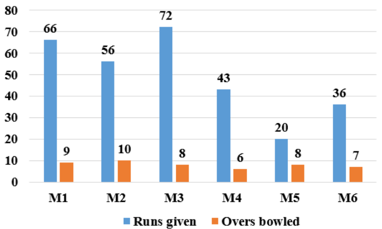
What will be the economy rate of the bowler for all the 6 matches taken together? [Give your answer correct to 2 decimal places.]
The difference of two numbers is 24 while the sum of those two numbers is 120. Which of the options below can be the ratio of those two numbers?
In a camp, there are tents of the same shape and size. Each tent is cylindrical up to a height of 4 m and conical above it. The diameters of the bases of the cylinder and the cone are both 10.5 m and the slant height of the conical part is 10 m. If a total of 3861cm2. canvas is used in making all the tents, then how many tents are there in the camp?\(\text{(use } \pi = \frac{22}{7}\text{)}\)
The simple interest on a certain sum of money for 2 years at 7% per annum is double the compound interest on ₹1,000 for 2 years at 10% per annum, compounded annually. What is the sum placed on simple interest?
The price of kerosene increases by 10% every year. If the current price of kerosene is ₹50 per litre, then what will be the price of kerosene per litre after 2 years?
The volume of a cube is 512cm2 What is the length of each side of this cube?