
Quantitative Aptitude
Z is increased successively by \(11\tfrac{1}{9}\%\) and 10% to get R. If R = 165, then what is the value of Z?
If the sum of the diagonals of a rhombus is L and the perimeter is 4P, find the area of the rhombus?
\( \frac{1}{4}(L^2 - P^2) \)
\( \frac{1}{2}(L^2 - 4P^2) \)
\( \frac{1}{4}(L^2 + 3P^2) \)
\( \frac{1}{4}(L^2 - 4P^2) \)
Study the given table and answer the question that follows.
The table shows the population of three cities P, Q and R, as percentages of the total population of these three cities taken together. It also shows the percentage of the population above 60 years of age in each of these cities, and also the ratio of males to females below 60 years of age, in each of these cities. The total population of all the three cities taken together is 3,00,000.
| CITY | POPULATION | ABOVE 60 | M:F (BELOW 60 YEARS) |
| P | 45% | 30% | 3 : 7 |
| Q | 30% | 70% | 3 : 1 |
| R | 25% | 40% | 12 : 13 |
Find the male population of city R that is below 60 years.
What is the difference between a discount of 35% and two successive discounts of 30% and 5% on a bill on ₹10,00,000?
The following bar chart shows the number of bottles of green and red colours sold by 5 different shops.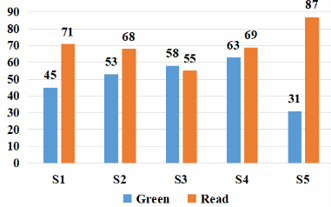
What is the ratio of the total number of green bottles sold by the 5 shops taken together to the total number of red bottles sold by the 5 shops taken together?
The profit earned when a painting is sold for ₹1,200 is 15 times the loss incurred when it is sold for ₹240. At what price should the painting be sold to make a profit of 40%?