
A wire of length L, area of cross section A is hanging from a fixed support. The length of the wire changes to L1 when mass M is suspended from its free end. The expression for Young’s modulus is :
\(\dfrac{Mg(L_1 - L)}{AL}\)
\(\dfrac{MgL}{AL_1}\)
\(\dfrac{MgL}{A(L_1 - L)}\)
\(\dfrac{MgL_1}{AL}\)
A cylinder contains hydrogen gas at pressure of 249 kPa and temperature 27°C. Its density is : (R = 8.3 J mol–1 K–1)
Light with an average flux of 20 W/cm2 falls on a non-reflecting surface at normal incidence having surface area 20 cm2. The energy received by the surface during time span of 1 minute is :
Two bodies of mass 4 kg and 6 kg are tied to the ends of a massless string. The string passes over a pulley which is frictionless (see figure). The acceleration of the system in terms of acceleration due to gravity (g) is :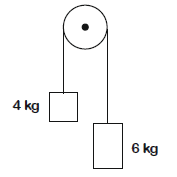
The mean free path for a gas, with molecular diameter d and number density n can be expressed as :
\(\dfrac{1}{\sqrt{2}\,n\pi d^2}\)
\(\dfrac{1}{\sqrt{2}\,n^2\pi d^2}\)
\(\dfrac{1}{\sqrt{2}\,n^2\pi^2 d^2}\)
\(\dfrac{1}{\sqrt{2}\,n\pi d}\)
A ball is thrown vertically downward with a velocity of 20 m/s from the top of a tower. It hits the ground after some time with a velocity of 80 m/s. The height of the tower is : (g = 10 m/s2)
The color code of a resistance is given below 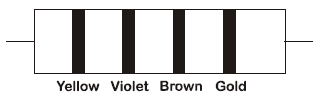
The values of resistance and tolerance, respectively, are
When a uranium isotope \({}^{235}_{92}\mathrm{U}\) is bombarded with a neutron, it generates \({}^{89}_{36}\mathrm{Kr}\), three neutrons and :
\({}^{91}_{40}\mathrm{Zr}\)
\({}^{101}_{36}\mathrm{Kr}\)
\({}^{103}_{36}\mathrm{Kr}\)
\({}^{144}_{56}\mathrm{Ba}\)
A spherical conductor of radius 10 cm has a charge of 3.2 × 10⁻⁷ C distributed uniformly. What is the magnitude of electric field at a point 15 cm from the centre of the sphere?
\(\left(\frac{1}{4\pi\varepsilon_0}=9\times10^9\ \mathrm{Nm^2/C^2}\right)\)
A ray is incident at an angle of incidence i on one surface of a small angle prism (with angle of prism A) and emerges normally from the opposite surface. If the refractive index of the material of the prism is μ, then the angle of incidence is nearly equal to :
\(\dfrac{2A}{\mu}\)
\(\mu A\)
\(\dfrac{\mu A}{2}\)
\(\dfrac{A}{2\mu}\)