
What was the venue of the 19th annual meeting of the Secretaries of the Security Councils of the Shanghai Cooperation Organization (SCO)?
Astana, Kazakhstan
Dhaka, Bangladesh
New Delhi, India
Kathmandu, Nepal
The question asks for the venue of a specific international meeting: the 19th annual meeting of the Secretaries of the Security Councils of the Shanghai Cooperation Organization (SCO). This requires knowledge of recent international events and the activities of organizations like the SCO.
Correct Option: A) Astana, Kazakhstan
This problem involves calculating time taken for travel under different conditions (walking and driving) over the same distance. We can set up equations based on the given information and solve for the unknown time taken to walk the distance one way.
Let the distance from the starting point to the viewpoint be \(D\).
Let the walking speed be \(V_w\) and the car speed be \(V_c\).
Time taken to walk one way is \(\frac{D}{V_w}\). Let's denote this as \(T_w\).
Time taken to drive one way is \(\frac{D}{V_c}\). Let's denote this as \(T_c\).
According to the first statement, the man walks to the viewpoint and returns by car. The total time taken is 9 hours 15 minutes.
\[ T_w + T_c = 9 \text{ hours } 15 \text{ minutes} \]\[ T_w + T_c = 9.25 \text{ hours} \quad \ldots(1) \]According to the second statement, he would have gained 2 hours by driving both ways. This means if he drove both ways, the time taken would be \(2T_c\). The gain of 2 hours is compared to the first scenario (walk one way, drive back). So, the time taken if he drove both ways is \(9.25 - 2 = 7.25\) hours.
\[ 2T_c = 7.25 \text{ hours} \quad \ldots(2) \]From equation (2), we can find \(T_c\):
\[ T_c = \frac{7.25}{2} = 3.625 \text{ hours} \]Now substitute the value of \(T_c\) into equation (1) to find \(T_w\):
\[ T_w + 3.625 = 9.25 \]\[ T_w = 9.25 - 3.625 \]\[ T_w = 5.625 \text{ hours} \]The question asks for the time it would have taken for him to walk both ways. This would be \(2T_w\).
\[ 2T_w = 2 \times 5.625 = 11.25 \text{ hours} \]Convert 11.25 hours into hours and minutes:
\[ 11.25 \text{ hours} = 11 \text{ hours} + 0.25 \times 60 \text{ minutes} \]\[ 11.25 \text{ hours} = 11 \text{ hours} + 15 \text{ minutes} \]B) 11 hours 15 minutes
The question asks for the specific term used to describe the band of colors formed when light is separated into its constituent colors. This phenomenon is known as dispersion of light, and the resulting band has a particular scientific name.
Correct Option: C) Spectrum — When white light is dispersed, it separates into its constituent colors (red, orange, yellow, green, blue, indigo, violet), forming an ordered band. This band of colors is known as a spectrum.
The question asks for the chemical name of 'Plaster of Paris'. This requires knowledge of common chemical compounds and their common names.
Correct Option: C) calcium sulphate hemihydrate
This problem relies on a fundamental property of circles: angles subtended by the same chord on the same side of the circumference are equal. We are given one such angle and asked to find twice the measure of another angle subtended by the same chord on the same side.
Identify the given information: We are given a chord AC of a circle. X and Y are two points on the circumference on the same side of the chord AC. We are given that \(\angle AXC = 58^\circ\).
Apply the circle theorem: The angles subtended by the same chord on the same segment (i.e., on the same side of the circumference) of a circle are equal.
Relate the angles: Since points X and Y are on the same side of the chord AC, the angles \(\angle AXC\) and \(\angle AYC\) are subtended by the same chord AC in the same segment of the circle. Therefore, according to the theorem:
\[ \angle AYC = \angle AXC \]Substitute the given value: We are given \(\angle AXC = 58^\circ\). So,
\[ \angle AYC = 58^\circ \]Calculate the required value: The question asks for the measure of \(2\angle AYC\). So,
\[ 2\angle AYC = 2 \times 58^\circ \]\[ 2\angle AYC = 116^\circ \]D) \(116^\circ\) is the correct answer because angles subtended by the same chord on the same side of the circumference are equal, making \(\angle AYC = 58^\circ\), and thus \(2\angle AYC = 116^\circ\).
A) \(58^\circ\) — This is the measure of \(\angle AYC\) itself, not \(2\angle AYC\).
B) \(60^\circ\) — This value has no direct relation to the given information or the properties of circles in this context.
C) \(120^\circ\) — This value is incorrect. It might be confused with a scenario where the angle at the center is twice the angle at the circumference, but that's not what's being asked here, nor does it apply directly to two angles on the circumference.
Study the given diagram carefully and answer the question that follows. The numbers in different sections indicate the number of persons.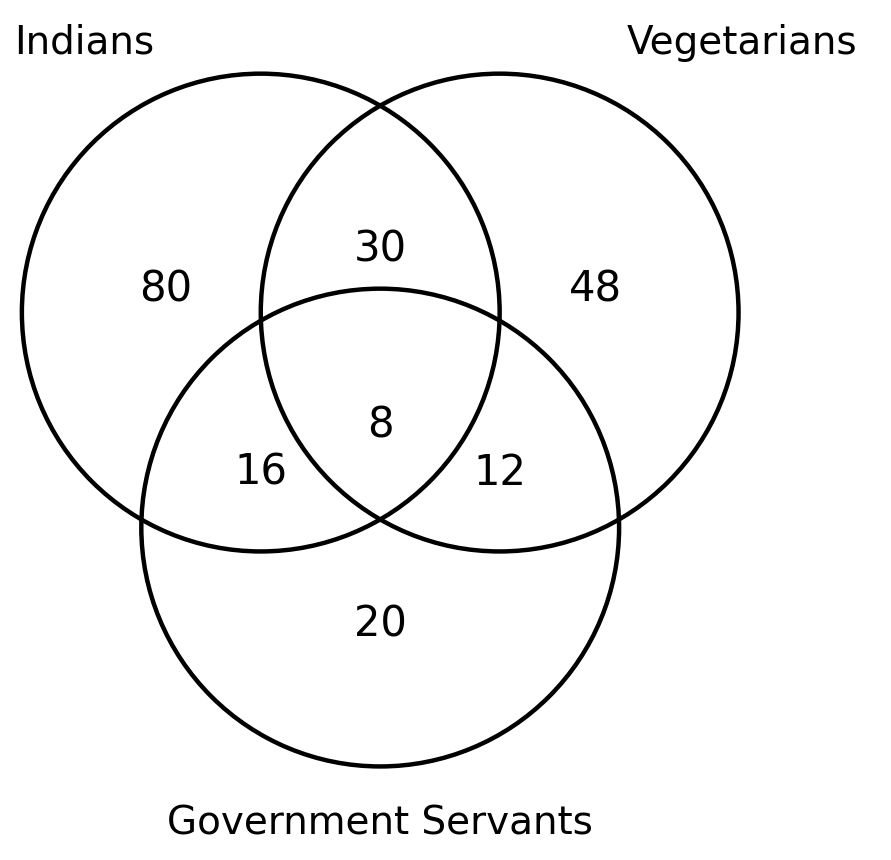
How many such government servants are there who are Indians but not vegetarians?
To find the number of government servants who are Indians but not vegetarians, we need to analyze the Venn diagram provided.
Correct Option: B) 16
The problem asks us to find the missing letter clusters, # and %, based on the pattern and relationship observed in the given analogy. We need to analyze the positional values of the letters in the English alphabet to identify the rule governing the transformation from one cluster to another.
D) # = EHJ, % = TWY
The pattern is to add 18 to the numerical position of each letter in the cluster, considering the alphabet as circular (A=1, B=2, ..., Z=26).
For # = EHJ:
E (5) + 18 = 23 (W)
H (8) + 18 = 26 (Z)
J (10) + 18 = 28 \(\equiv\) 2 (B)
So, EHJ : WZB is correct.
For BEG : %:
B (2) + 18 = 20 (T)
E (5) + 18 = 23 (W)
G (7) + 18 = 25 (Y)
So, BEG : TWY is correct.
The question asks to identify which of the given options is NOT a function of the Prime Minister of India. We need to analyze each option based on the constitutional powers and roles of the Prime Minister.
Based on this analysis, the appointment of Supreme Court judges is not a direct function of the Prime Minister.
Correct Option: B) Appointment of Supreme Court judges
When dealing with an arithmetic progression (like consecutive odd numbers), the average of the numbers is equal to the middle number. For an odd number of terms, there is a distinct middle term. Since there are seven consecutive odd numbers, the average will be the 4th number in the sequence. Once we find the middle number, we can work backward to find the smallest number.
Identify the middle number: We are given that there are seven consecutive odd numbers. For an odd number of terms in an arithmetic progression, the average is the middle term. In this case, with 7 numbers, the middle term is the \((7+1)/2 = 4^{\text{th}}\) number.
Assign the average to the middle number: The average of these seven consecutive odd numbers is 41. Therefore, the 4th number in the sequence is 41.
Determine the sequence: Since the numbers are consecutive odd numbers, the difference between any two consecutive terms is 2.
Alternatively, we can represent the numbers algebraically. Let the smallest odd number be \(x\). Then the seven consecutive odd numbers are:
\[ x, x+2, x+4, x+6, x+8, x+10, x+12 \]The average is the sum of these numbers divided by 7:
\[ \frac{x + (x+2) + (x+4) + (x+6) + (x+8) + (x+10) + (x+12)}{7} = 41 \]\[ \frac{7x + (2+4+6+8+10+12)}{7} = 41 \]\[ \frac{7x + 42}{7} = 41 \]\[ 7x + 42 = 41 \times 7 \]\[ 7x + 42 = 287 \]\[ 7x = 287 - 42 \]\[ 7x = 245 \]\[ x = \frac{245}{7} \]\[ x = 35 \]Thus, the smallest number is 35.
Correct Option: D) 35
The smallest of the seven consecutive odd numbers is 35. The sequence is 35, 37, 39, 41, 43, 45, 47. The average of these numbers is indeed 41.
This question tests knowledge of redox reactions, specifically the reaction between hydrogen gas and copper(II) oxide. We need to identify the products formed and the type of reaction (oxidation or reduction) that hydrogen undergoes.
Correct Option: D) reduces to form brownish copper metal
When hydrogen gas is passed through heated black copper(II) oxide, hydrogen acts as a reducing agent. It removes oxygen from copper(II) oxide, reducing it to elemental copper metal, which is brownish in color. The hydrogen itself gets oxidized to water.