
What would be the symbol on the opposite side of '@' if the given sheet is folded to form a cube?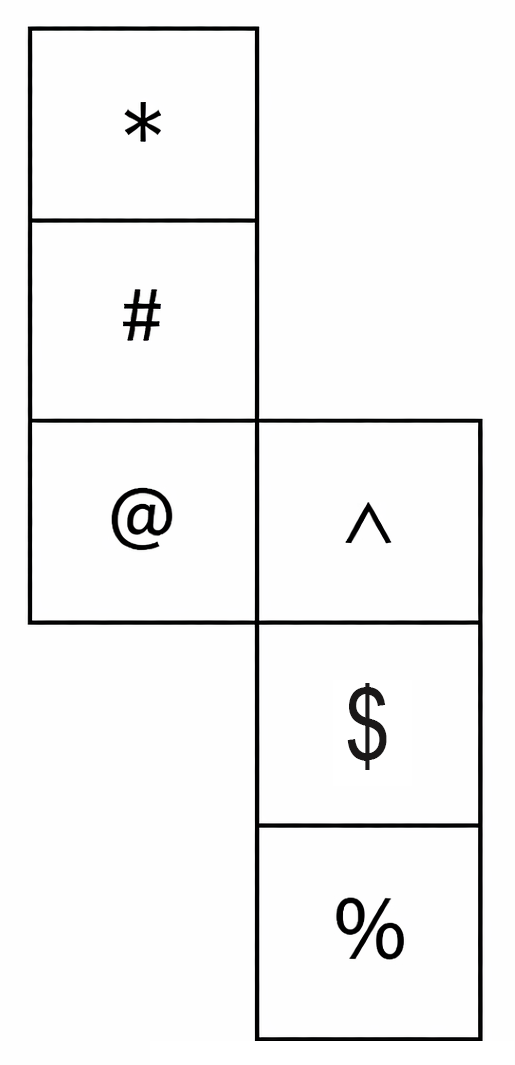
If ‘A’ stands for ‘÷’, ‘B’ stands for ‘×’, ‘C’ stands for ‘+’ and ‘D’ stands for ‘–’, then the resultant of which of the following will be 233?
21 C 11 D 33 A 11 B 5
21 A 11 D 33 B 11 C 5
21 B 11 D 33 A 11 C 5
21 B 11 A 33 D 11 C 5
\(\left[\frac{17}{41}\right]\) is related to \(\left[\frac{34}{41}\right]\) following a certain logic. Following the same logic, \(\left[\frac{11}{85}\right]\) is related to \(\left[\frac{22}{85}\right]\). To which of the following is \(\left[\frac{13}{77}\right]\) related, following the same logic?
(NOTE: Operations should be performed on the whole numbers, without breaking down the numbers into its constituent digits. E.g. 13 – Operations on 13 such as adding/subtracting/multiplying etc. to 13 can be performed. Breaking down 13 into 1 and 3 and then performing mathematical operations on 1 and 3 is not allowed.)
\(\left[\frac{24}{75}\right]\)
\(\left[\frac{29}{77}\right]\)
\(\left[\frac{23}{77}\right]\)
\(\left[\frac{26}{77}\right]\)
Which of the following numbers will replace the question mark (?) in the given series:
\(\left[\frac{37}{5}\right],\ \left[\frac{32}{5}\right],\ \left[\frac{27}{5}\right],\ \left[\frac{22}{5}\right],\ \left[\frac{17}{5}\right],\ ?\)
\(\left[\frac{12}{5}\right]\)
\(\left[\frac{9}{5}\right]\)
\(\left[\frac{16}{5}\right]\)
\(\left[\frac{14}{5}\right]\)