
To simplify the expression \(9991 \times 10009\), we can use the algebraic identity \((a-b)(a+b) = a^2 - b^2\). This method is often quicker and less prone to calculation errors than direct multiplication, especially in competitive exams.
Identify the numbers in a form suitable for the identity. Both numbers are close to 10000. We can write:
\[ 9991 = 10000 - 9 \] \[ 10009 = 10000 + 9 \]Substitute these into the original expression:
\[ 9991 \times 10009 = (10000 - 9) \times (10000 + 9) \]Apply the algebraic identity \((a-b)(a+b) = a^2 - b^2\), where \(a = 10000\) and \(b = 9\):
\[ (10000 - 9) \times (10000 + 9) = (10000)^2 - (9)^2 \]Calculate the squares:
\[ (10000)^2 = 10000 \times 10000 = 100000000 \] \[ (9)^2 = 9 \times 9 = 81 \]Subtract the second result from the first:
\[ 100000000 - 81 = 99999919 \]Thus, the simplified expression is \(99999919\).
D) 99999919 is the correct result obtained by applying the difference of squares identity.
In two triangles ABC and DEF, if \(\overline{AB}\) = \(\overline{EF}\), \(\overline{BC}\) = \(\overline{DF}\) and \(\overline{CA}\) = \(\overline{DE}\), then:
To determine the correct congruence statement between two triangles, we need to match corresponding vertices based on the equality of their sides. The Side-Side-Side (SSS) congruence criterion states that if three sides of one triangle are congruent to three sides of another triangle, then the triangles are congruent. The order of the vertices in the congruence statement is crucial and must reflect the correspondence of equal sides.
The correspondence is A \(\leftrightarrow\) E, B \(\leftrightarrow\) F, C \(\leftrightarrow\) D. Therefore, if we write the first triangle as \(\triangle CBA\), the corresponding vertices in the second triangle would be D, F, E in that order. So, \(\triangle CBA \cong \triangle DFE\).
Study the following graph and answer the given question.
The graph shows the height of five students in a class.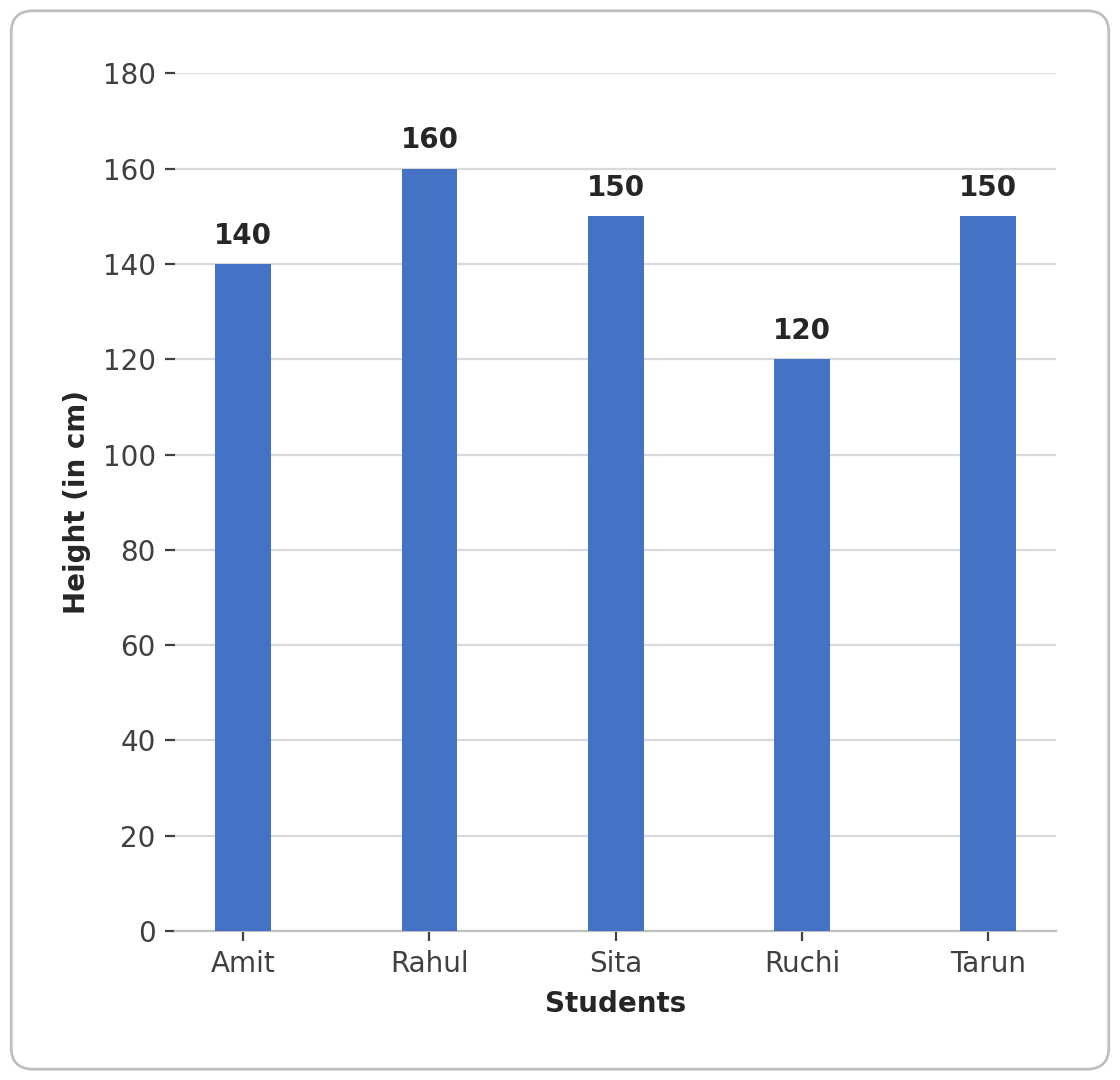
What is the respective ratio between the height of Amit and height of Rahul?
To find the ratio between the heights of Amit and Rahul, we need to extract their respective heights from the graph and then calculate the ratio.
\[ \text{Ratio} = \frac{\text{Height of Amit}}{\text{Height of Rahul}} = \frac{140}{160} \]
\[ \frac{140 \div 20}{160 \div 20} = \frac{7}{8} \]
Thus, the respective ratio between the height of Amit and Rahul is \(7 : 8\).
Correct Option: C) 7 : 8
The problem requires us to find which two numbers, when interchanged in the given equation, will make the equation correct. We need to evaluate the equation after each interchange option using the BODMAS/PEMDAS rule (Brackets, Orders, Division, Multiplication, Addition, Subtraction).
The original equation is:
\[ 75 \div 5 + 15 \times 4 - 17 \times 3 + (60 \div 6) \times 10 = 100 \]If we interchange 5 and 3, the equation becomes:
\[ 75 \div 3 + 15 \times 4 - 17 \times 5 + (60 \div 6) \times 10 \]Since the result is 100, which matches the right-hand side of the equation, interchanging 5 and 3 makes the equation correct.
A) 5 and 3
As shown in the step-by-step evaluation, interchanging 5 and 3 results in the equation \(25 + 60 - 85 + 100 = 100\), which is correct.
To find the shortest distance and direction from Point Z to Point Y, we need to determine Sharad's final position relative to his starting point. This can be done by tracking his movements along the East-West and North-South axes separately. We will calculate the net displacement in each direction and then use these to find the final position of Z relative to Y.
After all movements, Sharad is 0 km East/West of Point Y and 21 km South of Point Y.
So, Point Z is 21 km South of Point Y.
To reach Point Y from Point Z, Sharad needs to drive 21 km towards the North.
C) 21 km towards the north. This is the correct distance and direction to return to Point Y from Point Z.
The question asks us to identify which of the given reasons could explain the observed rise in tomato prices. We need to evaluate each reason's plausibility in affecting supply and demand dynamics for tomatoes.
Correct Option: A) Both I and II are possible reasons.
P is 30% more efficient than Q. How much time will they, working together, take to complete a job that P alone could have done in 23 days?
This problem involves concepts of time and work. We are given the efficiency relationship between two individuals, P and Q, and the time P takes to complete a job alone. We need to find the time they take to complete the job together. We will use the inverse relationship between efficiency and time, and the formula for combined work rate.
Determine the efficiency ratio:
P is 30% more efficient than Q. If Q's efficiency is 100 units, then P's efficiency is 130 units.
Calculate P's daily work rate:
P can complete the job alone in 23 days. This means P completes \(\frac{1}{23}\) of the job per day.
Calculate Q's daily work rate:
Since efficiency is directly proportional to the work done per day, we can use the efficiency ratio to find Q's daily work rate.
Calculate their combined daily work rate:
When P and Q work together, their daily work rates add up.
To add these fractions, find a common denominator, which is 299 (since \(23 \times 13 = 299\)).
\[ \text{Combined daily work} = \frac{1 \times 13}{23 \times 13} + \frac{10}{299} \]\[ \text{Combined daily work} = \frac{13}{299} + \frac{10}{299} = \frac{13+10}{299} = \frac{23}{299} \text{ of the job} \]Calculate the total time taken together:
The total time taken to complete the job is the reciprocal of their combined daily work rate.
B) 13 days
This is a question on syllogism, which involves drawing logical conclusions from given statements. We will use Venn diagrams to represent the relationships described in the statements and then evaluate each conclusion based on these diagrams.
D) Only conclusion (II) follows.
The question asks to identify the current Governor of the Reserve Bank of India (RBI) as of 2024. This requires knowledge of current affairs and important appointments in India.
Correct Option: A) Shaktikanta Das is currently the Governor of the Reserve Bank of India (RBI). He was appointed as the 25th Governor of the RBI in December 2018 and has continued in the position.
This question asks to identify which household item among the given options does NOT operate based on the heating effect of electric current. The heating effect of current, also known as Joule heating, states that when current flows through a conductor, heat is produced. This heat generated is directly proportional to the square of the current, the resistance of the conductor, and the time for which the current flows, given by Joule's Law: \(H = I^2Rt\).
Correct Option: D) Electric motor. An electric motor converts electrical energy into mechanical energy based on the principle of electromagnetism, not primarily the heating effect of current. Although some heat is produced due to resistance, it is an undesirable byproduct, not the intended function.