
This question tests fundamental concepts in thermodynamics, specifically the classification of systems. Understanding the definitions of different types of thermodynamic systems (open, closed, isolated, adiabatic) is crucial to correctly answer this question.
B) An isolated system — An isolated system is one that does not exchange either matter or energy with its surroundings. When a system and its environment are considered together, they form a complete entity (often referred to as the universe in a thermodynamic context) that, by definition, has no external surroundings with which to exchange matter or energy. Hence, the combination of a system and its environment constitutes an isolated system.
Slope of constant volume line on temperature entropy diagram is given by
\( \frac{Cp}{T} \)
\( \frac{T}{Cp} \)
\( \frac{Cv}{T} \)
\( \frac{T}{Cv} \)
To determine the slope of a constant volume line on a temperature-entropy (T-s) diagram, we need to use the fundamental thermodynamic relation and the definition of specific heat at constant volume. The slope is given by \( \left( \frac{\partial T}{\partial s} \right)_v \).
First and Second Law Combination: The combined first and second law of thermodynamics for a closed system undergoing a reversible process is given by:
\[ dU = TdS - PdV \]Specific Internal Energy: For a unit mass, this can be written in terms of specific internal energy (\(u\)), specific entropy (\(s\)), and specific volume (\(v\)):
\[ du = Tds - Pdv \]Constant Volume Process: For a constant volume process, \(dv = 0\). Therefore, the equation simplifies to:
\[ du = Tds \]Rearranging for Slope: From this, we can express the temperature change with respect to entropy at constant volume:
\[ \left( \frac{\partial u}{\partial s} \right)_v = T \]Definition of Specific Heat at Constant Volume (\(C_v\)): The specific heat at constant volume is defined as the rate of change of specific internal energy with respect to temperature at constant volume:
\[ C_v = \left( \frac{\partial u}{\partial T} \right)_v \]Applying Chain Rule: We want to find \( \left( \frac{\partial T}{\partial s} \right)_v \). We can use the chain rule:
\[ \left( \frac{\partial T}{\partial s} \right)_v = \left( \frac{\partial T}{\partial u} \right)_v \left( \frac{\partial u}{\partial s} \right)_v \]Substituting Known Relations: Substitute the expressions from steps 4 and 5 into the chain rule equation:
So, we get:
\[ \left( \frac{\partial T}{\partial s} \right)_v = \frac{1}{C_v} \cdot T = \frac{T}{C_v} \]D) \( \frac{T}{Cv} \). As derived, the slope of a constant volume line on a T-s diagram is \( \frac{T}{C_v} \).
The question asks about the applicability of the Stefan-Boltzmann law. This law quantifies the total energy radiated per unit surface area of a black body across all wavelengths per unit time. Understanding the definition of a black body and its ideal radiation properties is key to answering this question.
Correct Option: C) Black body
The question asks to identify a scenario where heat transfer occurs through all three primary modes: conduction, convection, and radiation. We need to analyze each option to determine if all three modes are significantly present.
Correct Option: D) Boiler furnaces. In a boiler furnace, the intense heat from combustion is transferred to the boiler tubes and water through all three mechanisms: radiation from the flames and hot gases, convection from the hot gases flowing over the tubes, and conduction through the tube walls.
The question asks about the number of valves in a four-stroke diesel engine. To answer this, we need to recall the basic components and working principle of a four-stroke internal combustion engine, specifically focusing on the intake and exhaust processes.
B) A four-stroke diesel engine, like any four-stroke internal combustion engine, requires at least two valves per cylinder: one intake valve to allow fresh air (or air-fuel mixture) into the cylinder and one exhaust valve to expel the burnt gases. This is the standard configuration.
This problem involves calculating the frictional power of an engine given its indicated power and mechanical efficiency. We will use the fundamental definitions of mechanical efficiency and the relationship between indicated power, brake power, and frictional power.
Mechanical efficiency is the ratio of brake power to indicated power.
\[ \eta_m = \frac{\text{Brake Power (P_b)}}{\text{Indicated Power (P_i)}} \]Rearrange the efficiency formula to find brake power:
\[ P_b = \eta_m \times P_i \]\[ P_b = 0.70 \times 10 \text{ kW} \]\[ P_b = 7 \text{ kW} \]Indicated power is the total power produced inside the engine cylinders. A part of this power is lost due to friction, and the remaining part is available at the crankshaft as brake power.
\[ P_i = P_b + P_f \]where \(P_f\) is the frictional power.Rearrange the formula to find frictional power:
\[ P_f = P_i - P_b \]\[ P_f = 10 \text{ kW} - 7 \text{ kW} \]\[ P_f = 3 \text{ kW} \]C) 3 kW is the correct answer. The frictional power is the difference between the indicated power and the brake power, which is 3 kW.
The Morse test is a method used to determine the indicated power of an internal combustion engine. The principle involves cutting off the ignition or fuel supply to one cylinder at a time while the engine is running, and observing the drop in engine speed or power output. This method is particularly useful for multi-cylinder engines because it allows for the individual contribution of each cylinder to be assessed.
D) Multi-cylinder SI and CI engines — The Morse test is designed for multi-cylinder engines because it relies on the engine continuing to run while one cylinder is temporarily deactivated. This allows the indicated power of the deactivated cylinder to be determined by the drop in brake power. This method is applicable to both Spark Ignition (SI) and Compression Ignition (CI) engines.
The question asks to identify the welding process that uses a consumable electrode. We need to recall the characteristics of various welding methods to determine which one fits this description.
D) MIG Welding (Metal Inert Gas Welding), also known as Gas Metal Arc Welding (GMAW), uses a continuously fed consumable wire electrode. This wire melts under the heat of the electric arc and becomes the filler material for the weld joint. An inert gas (like argon or helium) or an active gas (like CO₂) shields the arc and the molten weld pool from atmospheric contamination.
The question asks about the material in which weld decay typically occurs. Weld decay is a specific type of corrosion that affects certain alloys, particularly those containing chromium, when subjected to welding processes. Understanding the characteristics of each option helps identify the correct material.
D) Stainless steel is the correct answer. Weld decay is a common problem associated with the welding of certain grades of stainless steel, particularly unstabilized austenitic stainless steels, due to chromium carbide precipitation in the heat-affected zone.
The given figure represents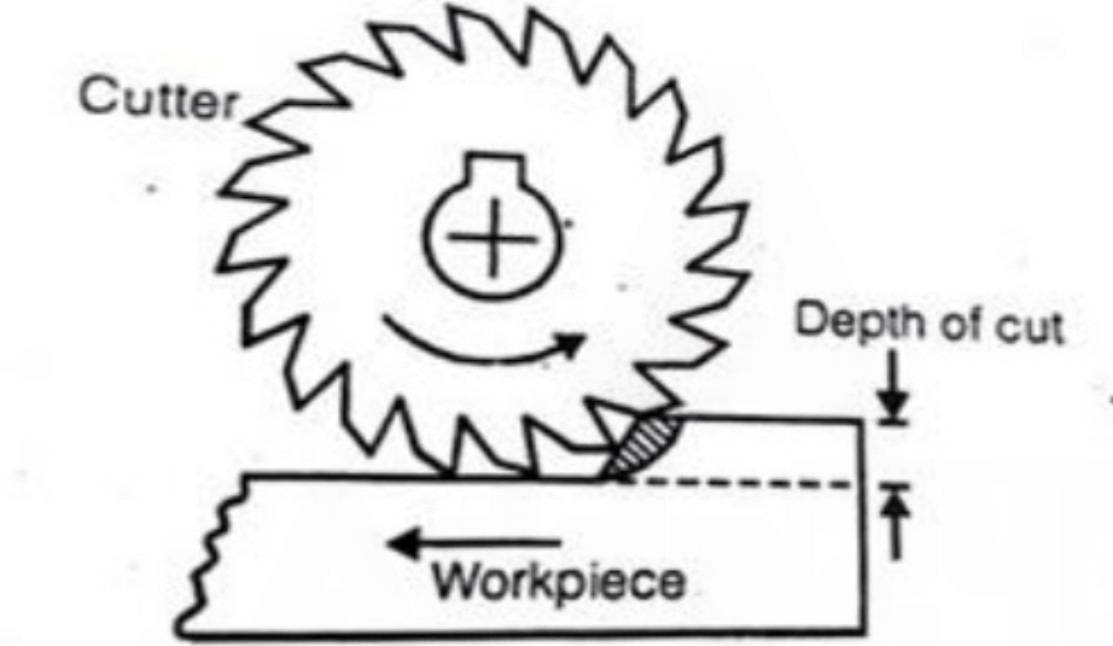
Up milling
Down milling
Climb milling
Angular milling
The diagram shows a milling operation where the cutter rotates in one direction while the workpiece moves in the opposite direction. This setup is characteristic of up milling.
Since the cutter rotates against the direction of the workpiece feed, this is a classic example of up milling.
Correct Option: A) Up milling