
The question asks about the fundamental concept that the Zeroth Law of Thermodynamics establishes. Understanding the statement of the Zeroth Law is key to identifying its practical application.
Correct Option: B) Temperature
The question asks which law of thermodynamics defines internal energy. We need to recall the fundamental principles of each law of thermodynamics and how they relate to the concept of internal energy.
B) First law of thermodynamics defines internal energy. It establishes the relationship between heat, work, and the change in the internal energy of a system, thereby defining internal energy as a state function whose change depends only on the initial and final states of the system.
The concept of overall heat transfer coefficient (U) is used to simplify heat transfer calculations when multiple modes of heat transfer occur in series. This is particularly relevant when heat is transferred from one fluid to another through a solid wall, involving convection on both sides and conduction through the wall.
D) Combined mode of heat transfer of conduction and convection. The overall heat transfer coefficient is specifically designed to handle situations where heat transfer involves both conduction (e.g., through a solid wall) and convection (e.g., between a fluid and a solid surface) acting in series.
To determine the S.I. unit of thermal conductivity, we need to recall Fourier's Law of Heat Conduction, which relates heat transfer rate to thermal conductivity, area, temperature gradient, and thickness. By rearranging this formula, we can isolate thermal conductivity and derive its units from the units of the other quantities.
Correct Option: A) W/mK is the S.I. unit of thermal conductivity, derived directly from Fourier's Law of Heat Conduction.
The question asks about the fundamental property of a black body concerning radiation. A black body is an idealized physical body that absorbs all incident electromagnetic radiation, regardless of frequency or angle of incidence.
Correct Option: D) Absorbed
A black body is defined by its ability to absorb all incident electromagnetic radiation. Therefore, all radiations falling on a black body are absorbed.
The given P-V diagram indicates following cycle 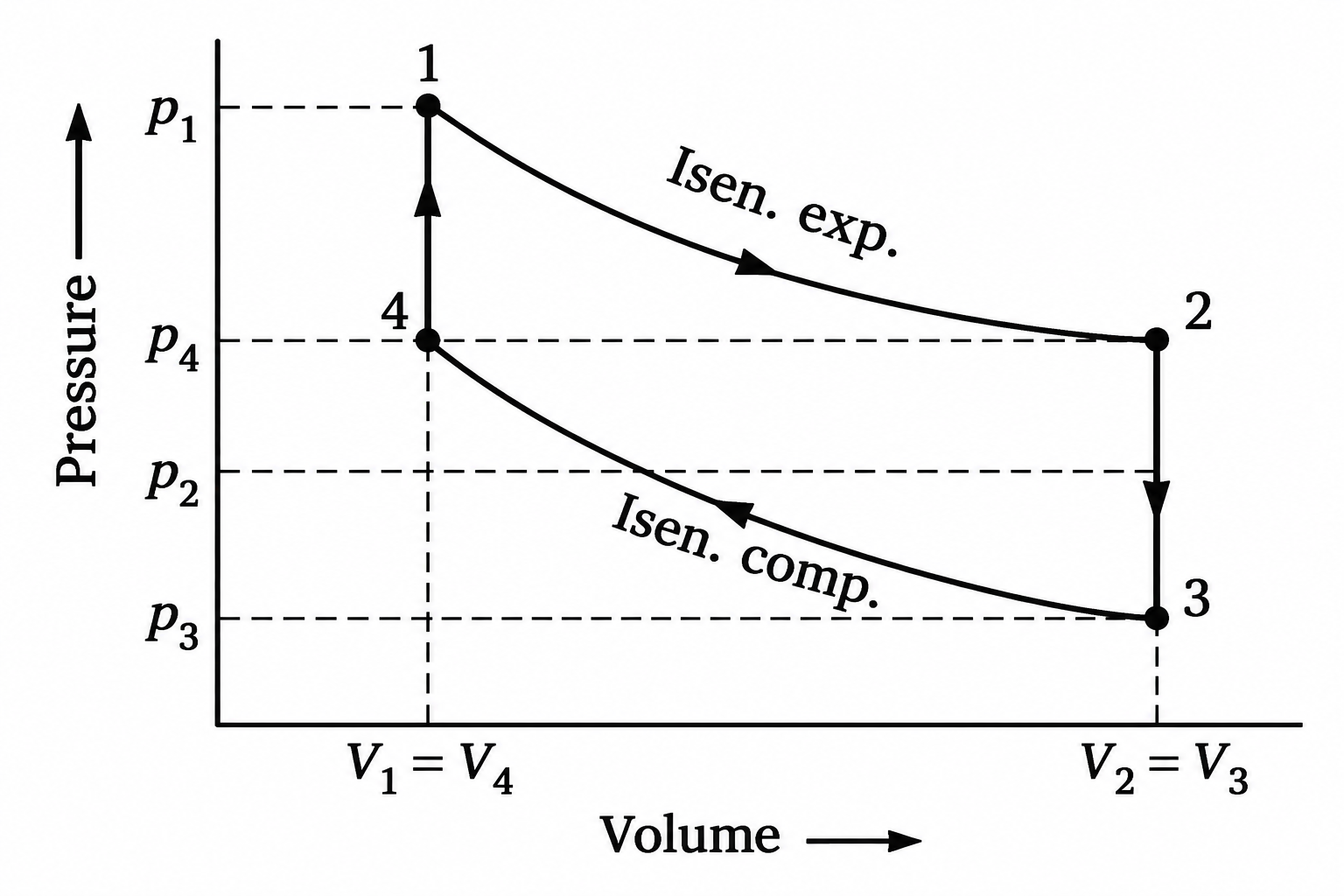
The given P-V diagram represents a thermodynamic cycle. To identify the cycle, we need to analyze the processes involved and their sequence.
Correct Option: B) Otto cycle
To determine the effect of decreasing the cut-off ratio on the efficiency of a diesel cycle, we need to recall the formula for diesel cycle efficiency and analyze how the cut-off ratio influences it.
Recall the formula for Diesel Cycle Efficiency: The thermal efficiency of an ideal diesel cycle is given by:
\[ \eta_{\text{diesel}} = 1 - \frac{1}{r^{\gamma-1}} \left[ \frac{\rho^{\gamma} - 1}{\gamma(\rho - 1)} \right] \]Where:
Analyze the effect of the cut-off ratio (\(\rho\)): Let's examine the term involving the cut-off ratio:
\[ f(\rho) = \frac{\rho^{\gamma} - 1}{\gamma(\rho - 1)} \]For typical values of \(\gamma\) (e.g., 1.4 for air), as \(\rho\) increases, the value of \(f(\rho)\) also increases. Conversely, as \(\rho\) decreases, the value of \(f(\rho)\) decreases.
Relate to efficiency: The efficiency formula is \[\eta_{\text{diesel}} = 1 - \frac{1}{r^{\gamma-1}} f(\rho)\]. Since \(f(\rho)\) is a positive term, a decrease in \(f(\rho)\) will lead to a smaller value being subtracted from 1. Therefore, if \(f(\rho)\) decreases, the overall efficiency \(\eta_{\text{diesel}}\) will increase.
Conclusion: When the cut-off ratio (\(\rho\)) is decreased, the term \[\left[ \frac{\rho^{\gamma} - 1}{\gamma(\rho - 1)} \right]\] decreases. This results in a smaller value being subtracted from 1, thereby increasing the overall efficiency of the diesel cycle.
A) Increases — As derived from the efficiency formula, a decrease in the cut-off ratio leads to a higher thermal efficiency for the diesel cycle.
The question asks about the standard method for specifying the size of a shaper machine. Shapers are machine tools primarily used for producing flat surfaces, and their capacity is defined by the maximum dimensions of the workpiece they can handle or the maximum cut they can make.
B) Length of stroke - This is the standard and most important parameter used to specify the size of a shaper machine. It indicates the maximum length of the cut that the machine can make.
The question asks to identify an example of orthogonal cutting from the given options. Orthogonal cutting is a type of metal cutting where the cutting edge of the tool is perpendicular to the direction of tool travel. This creates a two-dimensional cutting condition, simplifying analysis.
Correct Option: B) Turning — In turning, especially when the cutting edge is perpendicular to the direction of feed and the depth of cut is uniform, the cutting action can be approximated as orthogonal cutting. This is a common simplification used in metal cutting theory for analysis.
The question asks about the most common welding method for grey cast iron. Grey cast iron is known for its high carbon content and brittle nature, which makes it challenging to weld. The welding process must account for its poor ductility and tendency to crack due to thermal stresses.
Correct Option: A) Gas welding is usually preferred for welding grey cast iron because it allows for slower heating and cooling rates, which helps to minimize thermal stresses and prevent cracking in the brittle material. Special cast iron filler rods and fluxes are used to achieve a sound weld.