
The question asks to identify which component is NOT found on a transformer. We need to recall the common auxiliary components associated with power transformers and their functions.
A) Commutator — A commutator is a component found in DC machines (motors and generators) to reverse current direction. Transformers are static devices and do not have commutators.
The open-circuit test (or no-load test) on a transformer is performed to determine the no-load losses, which are primarily core losses, and the no-load current. This test is conducted by applying rated voltage to the low-voltage side while keeping the high-voltage side open.
C) core losses. The open-circuit test is specifically designed to measure the power consumed by the transformer when no load is connected, which is almost entirely due to the core losses (hysteresis and eddy current losses).
The given figure is the Torque-Current characteristics of 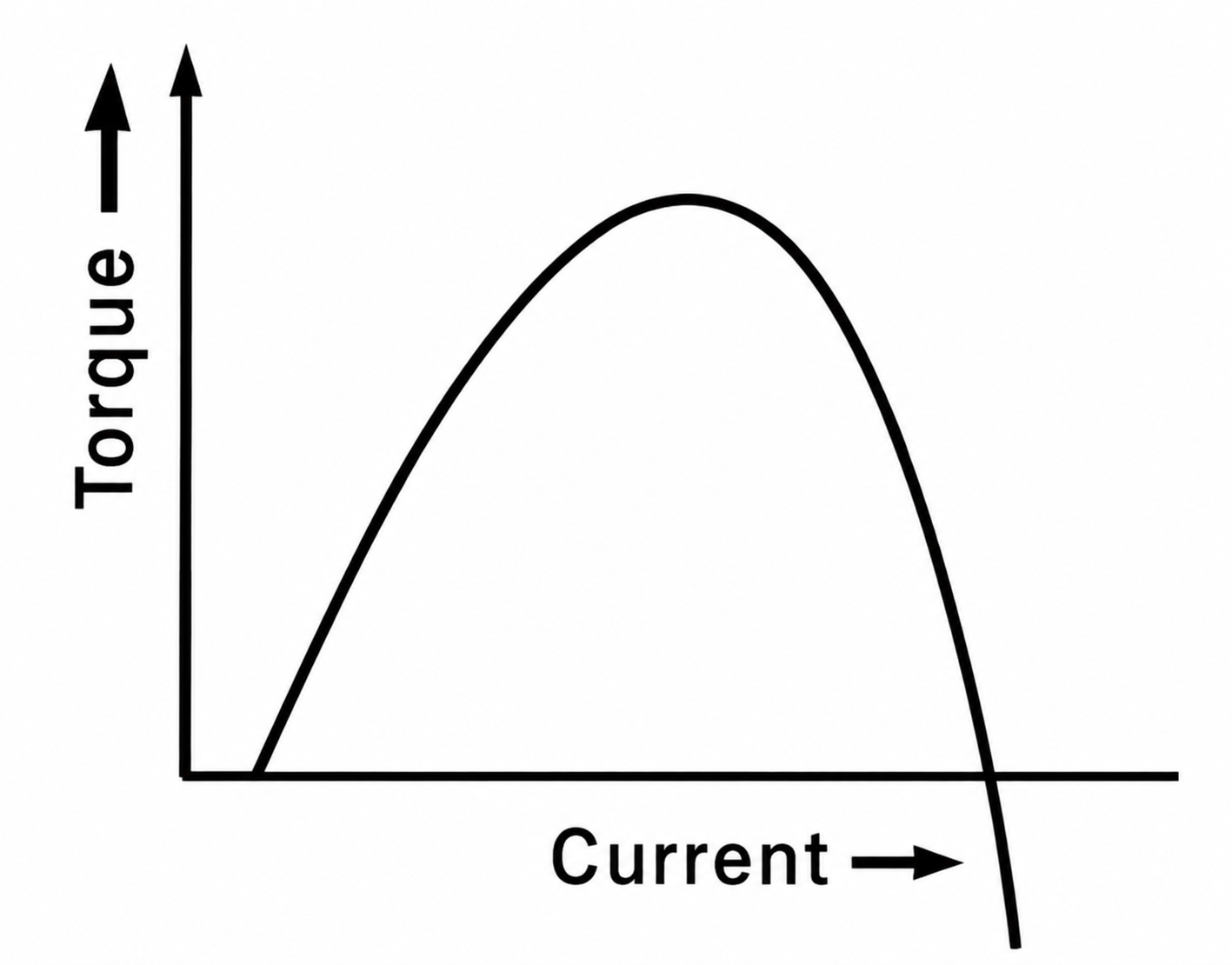
Cumulative Compound motor
Shunt motor
Series motor
Differential Compound motor
The question requires identifying the type of motor based on its Torque-Current characteristics. The diagram shows a curve where torque initially increases with current, reaches a peak, and then decreases, eventually becoming negative.
Correct Option: D) Differential Compound motor
The question asks to identify the element that is NOT non-linear. A non-linear element is one whose voltage-current (V-I) characteristic is not a straight line passing through the origin. In other words, its resistance is not constant but varies with voltage or current. A linear element, on the other hand, obeys Ohm's Law, meaning its resistance is constant, and its V-I characteristic is a straight line.
B) Heater coil
A heater coil is essentially a resistive element, typically made of nichrome wire. While its resistance does increase slightly with temperature (and thus with current/voltage due to heating), for most practical purposes and in the context of distinguishing from highly non-linear devices, it is considered a linear element. Its V-I characteristic is approximately a straight line, obeying Ohm's Law. The change in resistance due to temperature is a secondary effect, and its primary function relies on its constant resistive property to generate heat. Therefore, it is the element that is NOT non-linear among the given options.
The question asks to identify which of the given options is known as a metal rectifier. Metal rectifiers are a type of rectifier that uses a junction between a metal and a semiconductor material (often a metal oxide) to achieve rectification. We need to evaluate each option based on this definition.
Given that both A and B are correct examples of metal rectifiers, and assuming this is a single-choice question, there might be an ambiguity. However, in many historical contexts and textbooks, copper oxide rectifiers are frequently cited as a primary example of early metal rectifiers. If a single best answer is required, and both are valid, the question might be flawed or seeking a specific common example. Let's assume the question expects one of the classic examples.
Correct Option: B) Copper oxide rectifier is a classic example of a metal rectifier, utilizing the junction between copper and copper oxide for rectification. Selenium disc rectifiers (Option A) are also metal rectifiers. If only one answer is correct, and both A and B are types of metal rectifiers, there might be an issue with the question itself or it's looking for a specific historical context. However, both are valid examples.
The form factor of a waveform is a ratio that indicates how closely the waveform resembles a pure sine wave. It is defined as the ratio of the RMS (Root Mean Square) value to the average value of the waveform. For a full-wave rectified sine wave, we need to calculate its RMS and average values.
Define Form Factor:
The form factor (\(K_f\)) is given by the formula:
\[ K_f = \frac{\text{RMS value}}{\text{Average value}} \]Determine RMS value for a full-wave rectified sine wave:
A full-wave rectified sine wave has the same RMS value as a pure sine wave because the squaring operation in RMS calculation makes both positive and negative half-cycles contribute identically. If the peak voltage is \(V_m\), the RMS value of a sine wave (and thus a full-wave rectified sine wave) is:
\[ V_{\text{RMS}} = \frac{V_m}{\sqrt{2}} \]Determine Average value for a full-wave rectified sine wave:
The average value of a full-wave rectified sine wave is twice the average value of a half-wave rectified sine wave over a full cycle, or the average of one half-cycle of a sine wave. For a peak voltage \(V_m\), the average value is:
\[ V_{\text{avg}} = \frac{2V_m}{\pi} \]Calculate the Form Factor:
Now, substitute the RMS and average values into the form factor formula:
\[ K_f = \frac{V_{\text{RMS}}}{V_{\text{avg}}} = \frac{\frac{V_m}{\sqrt{2}}}{\frac{2V_m}{\pi}} \]\[ K_f = \frac{V_m}{\sqrt{2}} \times \frac{\pi}{2V_m} \]\[ K_f = \frac{\pi}{2\sqrt{2}} \]Compute the numerical value:
Using the approximate values \(\pi \approx 3.14159\) and \(\sqrt{2} \approx 1.41421\):
\[ K_f = \frac{3.14159}{2 \times 1.41421} = \frac{3.14159}{2.82842} \approx 1.1107 \]B) 1.11 — The calculated form factor for a full-wave rectified sine wave is approximately 1.11.
The question asks about the condition under which electron pair bonding occurs. This refers to covalent bonding, a fundamental concept in chemistry where atoms achieve stability by sharing electrons.
Correct Option: C) share electrons
This question asks about minority carriers in a p-type semiconductor. To answer this, we need to understand the basic principles of semiconductor doping and how it affects the concentration of charge carriers (electrons and holes).
B) electrons are the minority carriers in a p-type semiconductor. While holes are the majority carriers due to the addition of trivalent impurities, a small number of electrons are still generated thermally and constitute the minority charge carriers.
This question asks to identify a pentavalent material from the given options. A pentavalent material is one whose atoms have five valence electrons. These materials are commonly used as dopants in semiconductors to create n-type semiconductors.
Correct Option: C) phosphorus
The question asks for another name for a unity gain amplifier. We need to understand the characteristics of a unity gain amplifier and identify which of the given options matches this description.
Correct Option: D) voltage follower