
Simplify: (\(\sqrt{6}\) - 2\(\sqrt{3}\))²
18 + 2\(\sqrt{12}\)
18 - 2\(\sqrt{12}\)
18 + 12\(\sqrt{2}\)
18 - 12\(\sqrt{2}\)
To simplify the given expression \((\sqrt{6} - 2\sqrt{3})^2\), we will use the algebraic identity \((a - b)^2 = a^2 - 2ab + b^2\). We will substitute the values of \(a\) and \(b\) from the expression and then simplify the terms involving square roots.
Identify \(a\) and \(b\) in the expression \((\sqrt{6} - 2\sqrt{3})^2\).
Here, \(a = \sqrt{6}\) and \(b = 2\sqrt{3}\).
Apply the identity \((a - b)^2 = a^2 - 2ab + b^2\).
\[ (\sqrt{6} - 2\sqrt{3})^2 = (\sqrt{6})^2 - 2(\sqrt{6})(2\sqrt{3}) + (2\sqrt{3})^2 \]
Calculate each term:
First term: \((\sqrt{6})^2\)
\[ (\sqrt{6})^2 = 6 \]
Second term: \(-2(\sqrt{6})(2\sqrt{3})\)
\[ -2(\sqrt{6})(2\sqrt{3}) = -2 \cdot 2 \cdot (\sqrt{6 \cdot 3}) \]
\[ = -4\sqrt{18} \]
To simplify \(\sqrt{18}\), we find its prime factors: \(18 = 9 \cdot 2 = 3^2 \cdot 2\).
\[ -4\sqrt{18} = -4\sqrt{9 \cdot 2} = -4 \cdot 3\sqrt{2} = -12\sqrt{2} \]
Third term: \((2\sqrt{3})^2\)
\[ (2\sqrt{3})^2 = 2^2 \cdot (\sqrt{3})^2 = 4 \cdot 3 = 12 \]
Combine the simplified terms:
\[ (\sqrt{6} - 2\sqrt{3})^2 = 6 - 12\sqrt{2} + 12 \]
\[ = (6 + 12) - 12\sqrt{2} \]
\[ = 18 - 12\sqrt{2} \]
D) \(18 - 12\sqrt{2}\)
A) \(18 + 2\sqrt{12}\)
This option incorrectly adds the middle term and does not simplify \(\sqrt{12}\) completely, nor does it correctly calculate the coefficient of the middle term. The middle term should be \(-12\sqrt{2}\), not \(+2\sqrt{12}\).
B) \(18 - 2\sqrt{12}\)
This option correctly subtracts but incorrectly calculates the coefficient of the middle term as \(2\) instead of \(12\) and does not simplify \(\sqrt{12}\) to \(2\sqrt{3}\) to match the form of \(\sqrt{2}\) in the correct answer. The middle term should be \(-12\sqrt{2}\), not \(-2\sqrt{12}\).
C) \(18 + 12\sqrt{2}\)
This option incorrectly adds the middle term instead of subtracting it. The middle term \(-2ab\) should be negative.
The question asks to identify the agent responsible for producing a local or general loss of sensation. This requires knowledge of basic medical terminology and the functions of common substances or agents used in medicine.
Correct Option: A) Anaesthetic — An anaesthetic is a substance that causes a temporary loss of sensation, either locally in a specific area or generally throughout the body, often leading to unconsciousness. This is precisely what the question describes.
The question asks about the basis of Mendeleev's periodic law. To answer this, recall the fundamental principle Mendeleev used to arrange elements in his periodic table.
Correct Option: A) Increasing atomic masses. Mendeleev's periodic law explicitly stated that the properties of elements are a periodic function of their atomic masses, and he arranged elements in his table based on this principle.
In the given figure, the circle represents educated, rectangle represents unemployed, and square represents villagers.
Which region represents villagers and educated but not an unemployed?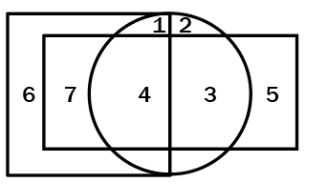
To solve this problem, we need to identify the region in the Venn diagram that represents villagers who are educated but not unemployed. This involves understanding the overlapping areas of the circle, rectangle, and square.
Correct Option: D) 1
The question asks about the composition of lactose. Lactose is a disaccharide, meaning it is formed from two monosaccharide units joined together. We need to identify which specific monosaccharide combines with glucose to form lactose.
C) Galactose is the correct answer. Lactose is a disaccharide composed of one molecule of glucose and one molecule of galactose.
To find the Least Common Multiple (LCM) of algebraic expressions, we first factorize each expression completely into its prime factors and algebraic terms. Then, we take the highest power of each unique prime factor and algebraic term present in any of the expressions and multiply them together.
A) \(24 xy (x^3 - 1)\) is the correct LCM as derived in the step-by-step explanation.
To find the smallest three-digit number exactly divisible by 12, 15, and 24, we need to find the Least Common Multiple (LCM) of these three numbers. The smallest three-digit number is 100. We will find the LCM and then determine the smallest multiple of the LCM that is a three-digit number.
The LCM is found by taking the highest power of all prime factors present in the numbers.
\[ \text{LCM}(12, 15, 24) = 2^3 \times 3^1 \times 5^1 \]\[ \text{LCM}(12, 15, 24) = 8 \times 3 \times 5 \]\[ \text{LCM}(12, 15, 24) = 120 \]The smallest three-digit number is 100. The LCM we found is 120. Since 120 is a three-digit number and is a multiple of 12, 15, and 24, it is the smallest three-digit number that satisfies the condition.
Correct Option: B) 120
Simplify: cos(30° - A) - cos(30° + A)
To simplify the given expression, we will use the trigonometric sum-to-product formula for the difference of two cosines, which is \[\cos C - \cos D = -2 \sin \left(\frac{C+D}{2}\right) \sin \left(\frac{C-D}{2}\right)\]. Alternatively, we can use the individual cosine expansion formulas for \(\cos(X-Y)\) and \(\cos(X+Y)\) and then subtract them.
Correct Option: C) sin A
The question asks about the nature of sound propagation in a medium. Sound is a mechanical wave, meaning it requires a medium to travel. We need to understand how this wave propagates through the particles of the medium.
B) Series of compressions and rarefactions. This accurately describes how sound, as a longitudinal wave, propagates through a medium by creating alternating regions of high pressure (compressions) and low pressure (rarefactions).
The question asks to identify the type of chemical reaction that occurs when sodium sulfate solution reacts with barium chloride solution. We need to recall the definitions of different types of chemical reactions, particularly focusing on displacement reactions and energy changes.
A) Double displacement reaction: As explained in the step-by-step analysis, the reaction involves the exchange of ions between two reactant compounds, forming two new compounds. This perfectly fits the definition of a double displacement reaction.