The question asks to identify the city that hosts the longest beach in India. This requires knowledge of prominent beaches in India and their relative lengths.
Correct Option: B) Chennai is home to the Marina Beach, which stretches for approximately 13 km (8.1 miles) along the Bay of Bengal. It is the longest natural urban beach in India and the second-longest in the world.
The weight of an object is the force exerted on it due to gravity. It depends on both the mass of the object and the gravitational acceleration of the celestial body it is on. The gravitational acceleration on the Moon is approximately one-sixth of that on Earth. We will use this relationship to calculate the weight on the Moon.
Correct Option: B) 11 kg
This problem involves work and time. We need to find the combined work rate of P, Q, and R. We can do this by first finding the individual work rates of the pairs (P+Q), (Q+R), and (P+R), then summing them up to find twice the combined work rate of P, Q, and R, and finally calculating the time taken for all three to complete the job.
Calculate the one-day work for each pair:
Sum the one-day work of all pairs:
Adding the one-day work of all three pairs gives us:
\[ (P+Q) + (Q+R) + (P+R) = \frac{1}{15} + \frac{1}{12} + \frac{1}{20} \] \[ 2(P+Q+R) = \frac{4+5+3}{60} \](The LCM of 15, 12, and 20 is 60)
\[ 2(P+Q+R) = \frac{12}{60} \] \[ 2(P+Q+R) = \frac{1}{5} \]Calculate the one-day work of P, Q, and R together:
To find the one-day work of P, Q, and R together, divide the result from step 2 by 2:
\[ (P+Q+R)\text{'s one day work} = \frac{1}{5} \times \frac{1}{2} \] \[ (P+Q+R)\text{'s one day work} = \frac{1}{10} \]Calculate the total time taken by P, Q, and R together:
If P, Q, and R together can complete \(\frac{1}{10}\) of the job in one day, then they will complete the entire job in the reciprocal of this fraction:
\[ \text{Time taken} = \frac{1}{\text{one day work}} = \frac{1}{1/10} = 10 \text{ days} \]C) 10 days
This question tests basic terminology related to spherical mirrors in optics. Understanding the definitions of key terms like pole, principal focus, and focal length is crucial.
Correct Option: B) Focal length (f) — The distance between the pole (P) and the principal focus (F) of a spherical mirror is precisely defined as its focal length, denoted by \(f\).
The problem asks us to complete a letter series. We need to identify the pattern in the given sequence of letter groups: SHG, RIF, QJE, PKD. We will analyze the progression of each letter's position in the alphabet across the terms.
Based on the patterns, the next group in the series should be OLC.
Correct Option: B) OLC is the correct completion of the series, following the established patterns for each letter's position.
The question asks to identify the specific harmful effect caused by increased carbon dioxide in the atmosphere due to fossil fuel burning. This is a direct question about a well-known environmental phenomenon.
Correct Option: C) Greenhouse effect
The burning of fossil fuels releases large amounts of carbon dioxide into the atmosphere. Carbon dioxide is a greenhouse gas, meaning it absorbs and emits radiant energy within the thermal infrared range, causing the greenhouse effect. An increase in atmospheric carbon dioxide enhances this natural effect, leading to global warming and climate change. Therefore, the harmful effect caused by increased carbon dioxide due to fossil fuel burning is the greenhouse effect.
The question asks to identify the cricketer who scored the first-ever triple century in a Test match. This requires knowledge of historical cricket records.
The first triple century in Test cricket was scored by Andy Sandham of England. He achieved this feat against West Indies in Kingston, Jamaica, in April 1930. He scored 325 runs.
Correct Option: B) Andy Sandham — Andy Sandham holds the record for scoring the first triple century in Test cricket history. He scored 325 runs against West Indies in 1930.
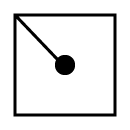
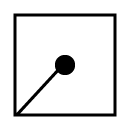
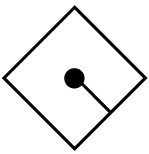
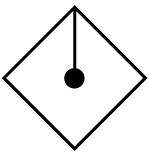
Find the ODD one out from the given options.
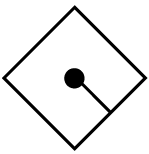
(Image-based question)
The task is to identify the diagram that is different from the others. We will examine the orientation and positioning of elements within each diagram.
Options A, B, and D have a consistent pattern of orientation and line placement, either in a standard square or diamond shape. Option C is different because the square is rotated, but the line orientation does not match the typical diagonal or vertical placement seen in the other options.
Correct Option: C) Option C is the odd one out due to its unique orientation and line placement.
If tan(A + B) = 0, then-
tan A + tan B = 0
tan A = tan B
\(\frac{\tan A+\tan B}{1-\tan A\tan B}=1\)
\(\frac{\tan A-\tan B}{1+\tan A\tan B}=0\)
The problem provides an equation involving the tangent function, \(\tan(A+B)=0\). We need to use the tangent addition formula to expand \(\tan(A+B)\) and then solve for the relationship between \(\tan A\) and \(\tan B\).
Recall the tangent addition formula:
\[ \tan(A+B) = \frac{\tan A + \tan B}{1 - \tan A \tan B} \]The given condition is \(\tan(A+B) = 0\). Substitute this into the formula:
\[ 0 = \frac{\tan A + \tan B}{1 - \tan A \tan B} \]For a fraction to be equal to zero, its numerator must be zero, provided the denominator is not zero. So, we set the numerator to zero:
\[ \tan A + \tan B = 0 \]This directly gives us the relationship between \(\tan A\) and \(\tan B\).
A) \(\tan A + \tan B = 0\)
As derived in the step-by-step explanation, if \(\tan(A+B) = 0\), then the numerator of the tangent addition formula must be zero, leading to \(\tan A + \tan B = 0\).
The question asks us to determine the percentage change in the area of a rectangle when its length is halved and its breadth is tripled. Since the area of a rectangle is the product of its length and breadth, we can calculate the new area and compare it with the original area to find the percentage change.
Identify the original area of the rectangle:
Let the original length be \(l\) and the original breadth be \(b\).
The area of a rectangle is:
\[ A=l\times b \]Therefore, the original area is \(lb\).
Calculate the new dimensions:
According to the question:
Calculate the new area:
Using the area formula:
\[ A_{\text{new}}=\frac{l}{2}\times3b \] \[ A_{\text{new}}=\frac{3lb}{2} \] \[ A_{\text{new}}=1.5lb \]Therefore, the new area is 1.5 times the original area.
Calculate the percentage change:
The percentage change in area is:
\[ \text{Percentage change}=\frac{\text{New area}-\text{Original area}}{\text{Original area}}\times100 \]Substituting the values:
\[ =\frac{1.5lb-lb}{lb}\times100 \] \[ =\frac{0.5lb}{lb}\times100 \] \[ =0.5\times100 \] \[ \boxed{50\%\text{ increase}} \]Therefore, the area of the rectangle increases by 50%.
Correct Option: A) 50% increase — When the length of a rectangle is halved and its breadth is tripled, the new area becomes \(\frac{1}{2}\times3=\frac{3}{2}\) times the original area. This means the new area is 150% of the original area, resulting in a 50% increase. Hence, Option A is the correct answer.
B) 50% decrease: This is incorrect because halving the length alone would decrease the area by 50% if the breadth remained unchanged. However, tripling the breadth causes the overall area to increase by 50%.
C) 75% decrease: This is incorrect because the combined effect of halving the length and tripling the breadth makes the new area 150% of the original area, rather than reducing it to 25%.
D) 25% increase: This is incorrect because the new area is 1.5 times the original area, corresponding to a 50% increase, not a 25% increase.