
The question asks to identify the longest bone in the human body. This is a factual recall question from human anatomy.
Correct Option: A) Femur
The question asks about the presiding officer of the inaugural meeting of the Constituent Assembly of India. This is a factual question related to the formation of the Indian Constitution and its initial proceedings.
Correct Option: C) Sachchidananda Sinha presided over the inaugural meeting of the Constituent Assembly of India as the temporary President.
The problem is a coding-decoding type where we need to identify the pattern or rule used to transform 'LANDMINE' into 'PYRBQGRC' and then apply the same rule to 'HOMEMADE'. We will analyze the position of each letter in the alphabet to find the transformation rule.
The pattern observed is: \(+4, -2, +4, -2, +4, -2, +4, -2\). This means for every alternate letter, we add 4 to its positional value, and for the other alternate letters, we subtract 2 from its positional value (cyclically, if needed).
Combining the transformed letters, 'HOMEMADE' becomes 'LMQCQYHC'.
Correct Option: D) LMQCQYHC
The question asks to identify the correct description for the valence shell of an atom. Understanding the basic structure of an atom, particularly its electron shells, is key to answering this question.
D) Outermost. The valence shell is indeed the outermost electron shell of an atom, containing the valence electrons that participate in chemical reactions.
How many triangles are there in the given figure?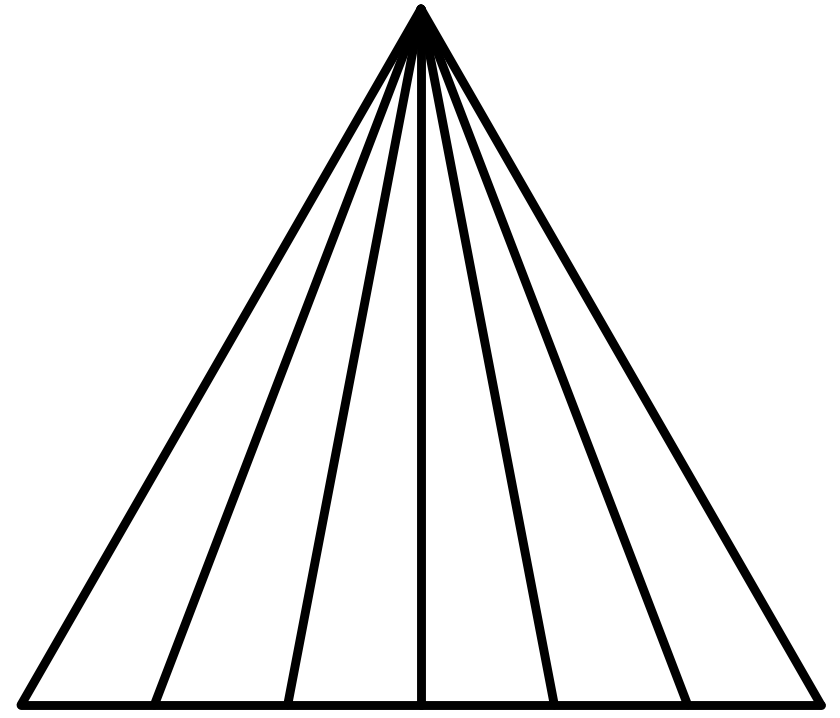
To determine the total number of triangles in the given figure, we need to systematically count all possible triangles formed by the intersecting lines.
Correct Option: B) 15
The problem is a coding-decoding question. We need to identify the pattern used to transform 'ELCSUM' into 'MUSCLE' and then apply the same pattern to 'LATIPAC' to find the coded word.
Analyze the given code:
Compare the letters and their positions:
Let's write the letters of the original word with their positions:
E L C S U M
1 2 3 4 5 6
Now, let's write the letters of the coded word and see where they came from:
M U S C L E
The letter 'M' from position 6 of ELCSUM is at position 1 of MUSCLE.
The letter 'U' from position 5 of ELCSUM is at position 2 of MUSCLE.
The letter 'S' from position 4 of ELCSUM is at position 3 of MUSCLE.
The letter 'C' from position 3 of ELCSUM is at position 4 of MUSCLE.
The letter 'L' from position 2 of ELCSUM is at position 5 of MUSCLE.
The letter 'E' from position 1 of ELCSUM is at position 6 of MUSCLE.
This shows that the coded word is simply the reverse of the original word.
Apply the pattern to 'LATIPAC':
The word to be coded is LATIPAC.
To code it, we need to reverse the order of its letters.
L A T I P A C
Reversing the letters gives:
C A P I T A L
D) CAPITAL is the word obtained by reversing 'LATIPAC'. This matches the identified coding pattern.
To solve this problem, we need to apply the divisibility rules for 5 and 8. A number is divisible by 5 if its last digit is 0 or 5. A number is divisible by 8 if the number formed by its last three digits is divisible by 8. We will use these rules to check each given option.
Divisibility by 5: For the number \(21022ab\) to be divisible by 5, its last digit, \(b\), must be either 0 or 5. Looking at the options, all options have \(b=0\), which satisfies this condition.
Divisibility by 8: For the number \(21022ab\) to be divisible by 8, the number formed by its last three digits, \(2ab\), must be divisible by 8.
Let's check each option by substituting the values of \(a\) and \(b\) into \(2ab\) and checking for divisibility by 8.
Option A: \(a=2, b=0\) The last three digits form the number \(220\). Let's check if \(220\) is divisible by 8: \[ \frac{220}{8} = 27.5 \] Since \(220\) is not perfectly divisible by 8, this pair \((a=2, b=0)\) cannot be the last two digits.
Option B: \(a=0, b=0\) The last three digits form the number \(200\). Let's check if \(200\) is divisible by 8: \[ \frac{200}{8} = 25 \] Since \(200\) is perfectly divisible by 8, this pair is possible.
Option C: \(a=8, b=0\) The last three digits form the number \(280\). Let's check if \(280\) is divisible by 8: \[ \frac{280}{8} = 35 \] Since \(280\) is perfectly divisible by 8, this pair is possible.
Option D: \(a=4, b=0\) The last three digits form the number \(240\). Let's check if \(240\) is divisible by 8: \[ \frac{240}{8} = 30 \] Since \(240\) is perfectly divisible by 8, this pair is possible.
The question asks which pair CANNOT be the last two digits. Based on our checks, only option A results in a number not divisible by 8.
Correct Option: A) a=2, b=0
The question asks about the primary reason an electrician wears rubber gloves while working on electrical switches. This relates to electrical safety and the properties of materials.
Correct Option: A) To avoid electric shock
The question asks to identify the sport associated with the Thomas Cup. This requires general knowledge about major international sports tournaments and the sports they represent.
The Thomas Cup, officially known as the World Men's Team Championship, is an international badminton competition contested by men's national teams from member associations of the Badminton World Federation (BWF). It was first held in 1949.
India notably won the Thomas Cup for the first time in 2022, defeating Indonesia in the final, which was a historic achievement for Indian badminton.
B) Badminton — The Thomas Cup is the premier international team championship for men's badminton, organized by the Badminton World Federation (BWF).
If x = 28 and xx = 2y, then find the value of 'y'.
The problem involves solving an equation with exponents. We are given the value of \(x\) and an equation relating \(x\) and \(y\). The key is to substitute the value of \(x\) into the equation and then simplify using exponent rules to find the value of \(y\).
Identify the given information:
Substitute the value of \(x\) into the second equation:
Replace \(x\) with \(2^8\) in the equation \(x^x = 2^y\).
\[ (2^8)^{(2^8)} = 2^y \]Apply the exponent rule \((a^m)^n = a^{m \times n}\):
In our case, \(a = 2\), \(m = 8\), and \(n = 2^8\). So, we multiply the exponents.
\[ 2^{(8 \times 2^8)} = 2^y \]Simplify the exponent on the left side:
We need to express \(8\) as a power of \(2\). We know that \(8 = 2^3\).
\[ 2^{(2^3 \times 2^8)} = 2^y \]Apply the exponent rule \(a^m \times a^n = a^{m+n}\):
For the exponents in the power, we have \(2^3 \times 2^8 = 2^{(3+8)} = 2^{11}\).
\[ 2^{(2^{11})} = 2^y \]Equate the exponents:
Since the bases are the same (\(2\)) on both sides of the equation, their exponents must be equal.
\[ 2^{11} = y \]State the value of \(y\):
Therefore, \(y = 2^{11}\).
D) \(2^{11}\) is the correct value for \(y\), as derived from the step-by-step calculation.