The question asks to identify which of the given non-metals is a good conductor of electricity. Generally, metals are good conductors of electricity, while non-metals are insulators. However, there are exceptions to this rule. We need to recall the properties of the listed non-metals to find the exception.
C) Graphite — Graphite is an allotrope of carbon, a non-metal. Its unique layered structure with delocalized electrons allows it to conduct electricity efficiently, making it an exception among non-metals.
What is the area included between a circle and an inscribed square of side 'a' units?
a²(2π - 1) sq. units
(\( \frac{a^2}{2} \))(π - 2) sq. units
a²(2 - π) sq. units
2a²(π - 2) sq. units
To find the area included between a circle and an inscribed square, we need to calculate the area of the circle and subtract the area of the inscribed square. First, we'll determine the relationship between the side of the inscribed square and the radius of the circle.
B) \( (\frac{a^2}{2}) (\pi - 2) \) sq. units
The question asks about the primary reason for applying grease to moving parts in machinery like bicycles or motors. This relates to the basic principles of mechanics and the properties of materials used in engineering.
Correct Option: C) As a lubricant to reduce friction
The problem provides the ratio of speeds of two vehicles and information about the distance and time covered by the second vehicle. We need to find the speed of the first vehicle. We will first calculate the speed of the second vehicle using the given distance and time. Then, using the ratio of speeds, we will determine the speed of the first vehicle.
Calculate the speed of the second vehicle:
Given that the second vehicle covers 400 km in 5 hours.
The formula for speed is:
\[ \text{Speed} = \frac{\text{Distance}}{\text{Time}} \]For the second vehicle:
\[ \text{Speed}_2 = \frac{400\ \text{km}}{5\ \text{hours}} = 80\ \text{km/h} \]Use the ratio of speeds to find the speed of the first vehicle:
The ratio of speeds of the two vehicles is given as 7 : 8. Let \(\text{Speed}_1\) be the speed of the first vehicle and \(\text{Speed}_2\) be the speed of the second vehicle.
\[ \frac{\text{Speed}_1}{\text{Speed}_2} = \frac{7}{8} \]We know \(\text{Speed}_2 = 80\ \text{km/h}\). Substitute this value into the ratio equation:
\[ \frac{\text{Speed}_1}{80\ \text{km/h}} = \frac{7}{8} \]Now, solve for \(\text{Speed}_1\):
\[ \text{Speed}_1 = \frac{7}{8} \times 80\ \text{km/h} \] \[ \text{Speed}_1 = 7 \times 10\ \text{km/h} \] \[ \text{Speed}_1 = 70\ \text{km/h} \]Correct Option: C) 70 km/h
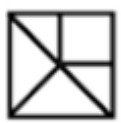
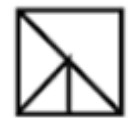
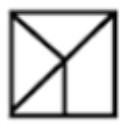
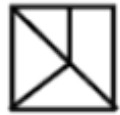
Choose from the alternatives the figure that best completes the pattern given below.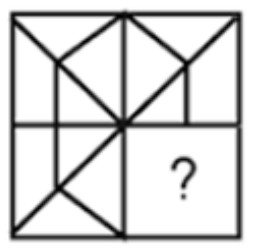
To solve this pattern completion problem, we need to identify the logical sequence or pattern in the given diagram and select the option that best continues this pattern.
Correct Option: D) The option with intersecting lines forming a similar pattern of triangles and quadrilaterals, consistent with the other squares.
The question asks for the full form or expansion of the acronym NASA. This is a factual recall question commonly found in general knowledge sections of competitive exams.
NASA stands for the National Aeronautics and Space Administration. It is an independent agency of the U.S. federal government responsible for the civilian space program, as well as aeronautics and aerospace research.
Correct Option: C) National Aeronautics and Space Administration
The question asks about the primary function of insulin. To answer this, recall the role of insulin in the human body's metabolic processes.
C) Blood glucose level — Insulin is a key hormone in maintaining glucose homeostasis. It lowers high blood glucose levels by promoting the uptake of glucose into cells and its conversion into glycogen or fat for storage.
The question asks us to identify the missing number in the series 8888, 666, 44, (...). To solve this, we need to observe the relationship between consecutive terms. The pattern involves decreasing repeated digits and reducing the number of digits by one at each step.
Observe the given series:
\[ 8888,\ 666,\ 44,\ ? \]Each term consists of a single digit repeated a certain number of times.
Identify the pattern in the digits:
The repeated digits decrease by 2 in each successive term.
Therefore, the digit pattern is:
\[ 8,\ 6,\ 4,\ 2 \]Identify the pattern in the number of repetitions:
The number of repetitions decreases by 1 at each step.
\[ 4,\ 3,\ 2,\ 1 \]Combining both patterns:
\[ \underbrace{8888}_{4\text{ times}},\ \underbrace{666}_{3\text{ times}},\ \underbrace{44}_{2\text{ times}},\ \underbrace{2}_{1\text{ time}} \]Determine the missing term:
The next digit is 2, and it must appear only once.
\[ \boxed{2} \]Therefore, the completed series is:
\[ 8888,\ 666,\ 44,\ 2 \]Correct Option: B) 2 — The repeated digits decrease by 2 (8, 6, 4, 2), while the number of repetitions decreases by 1 (4, 3, 2, 1). Therefore, the missing term is 2. Hence, Option B is the correct answer.
A) 20: This is incorrect because the next term must contain the digit 2 repeated once. The number 20 does not follow the repeated-digit pattern.
C) 0: This is incorrect because the repeated digits decrease by 2, making 2 the next digit after 4. Zero would come after 2 if the pattern continued further.
D) 22: This is incorrect because the next term should contain only one digit. Although 22 uses the expected digit 2, repeating it twice does not follow the decreasing repetition pattern of 4, 3, 2, 1.
The problem presents a number series, and we need to find the missing term. We will analyze the pattern of operations (addition, subtraction, multiplication, division) between consecutive terms to identify the rule governing the series.
D) 228 — The series follows an alternating pattern of dividing by 2 and adding 8. Starting with 864, the operations are: \(864 \div 2 = 432\), \(432 + 8 = 440\), \(440 \div 2 = 220\). The next operation is \(+ 8\), so \(220 + 8 = 228\). This is confirmed by the subsequent operation: \(228 \div 2 = 114\).
The question asks about the process by which the smell of perfume quickly reaches our nose. This phenomenon is related to the movement of particles from a region of higher concentration to a region of lower concentration. We need to identify the physical process that describes this movement.
A) Diffusion — Diffusion is the process by which particles spread out from an area of higher concentration to an area of lower concentration. The smell of perfume spreading through the air is a classic example of diffusion, as the volatile perfume molecules mix with air molecules and travel to our nose.