SSC CHSL 2024-10.07.2024-3 SSC Question Paper

SSC CHSL 2024-10.07.2024-3 SSC Questions

31.
15 is related to 195 following a certain logic. Following the same logic, 19 is related to 247. To which of the following is 24 related following the same logic?
(NOTE : Operations should be performed on the whole numbers, without breaking down the numbers into its constituent digits. E.g. 13 – Operations on 13 such as adding /deleting /multiplying etc., to 13 can be performed. Breaking down 13 into 1 and 3 and then performing mathematical operations on 1 and 3 is not allowed.)
A.
322
B.
332
C.
300
D.
312
ANSWER :
D. 312
32.
What will come in the place of '?' in the following equation, if '' and '÷' are interchanged?
160,187,216,247,?
A.
290
B.
280
C.
209
D.
208
ANSWER :
B. 280
33.
In a certain code language,
‘A+ B’ means ‘A is the son of B’,
‘A – B’ means ‘A is the brother of B’,
‘A × B’ means ‘A is the wife of B’,
‘A ÷ B’ means ‘A is the daughter of B’.
Based on the above, how is L related to M if ‘L – N ÷ O × M +P’?
A.
Father’s father
B.
Brother
C.
Son
D.
Father
ANSWER :
C. Son
34.
In a certain code language, ‘my best friend’ is written as ‘ck rl mk’ and ‘friend is life’ is written as ‘rt mp ck’. How is ‘friend’ written in the given language?
A.
rt
B.
ck
C.
rl
D.
mk
ANSWER :
B. ck
35.
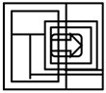
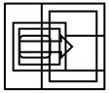
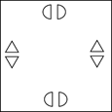
Select the option figure in which the given figure (X) is embedded as its part (rotation is NOT allowed).
ANSWER :
A. undefined
36.
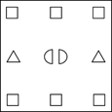
A paper is folded and cut as shown below. How will it appear when unfolded?
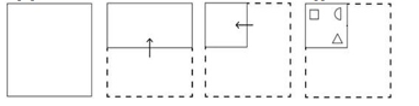
ANSWER :
C. undefined
37.
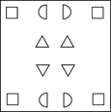
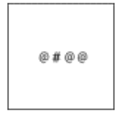
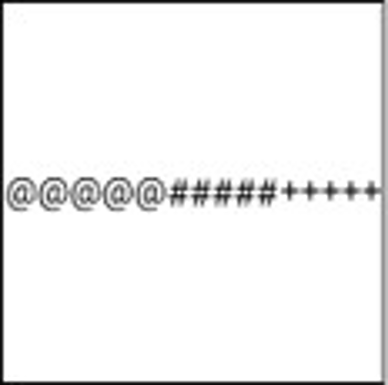
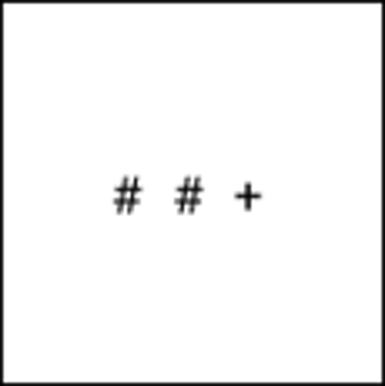
Identify the figure in the options that when put in place of the question mark (?) will logically complete the series?

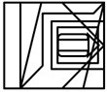
ANSWER :
B. undefined
38.
What should come in place of the question mark (?) in the given series?
23, 44, 65, 86, ?, 128
A.
103
B.
109
C.
107
D.
105
ANSWER :
C. 107
39.
The position of how many letters will remain unchanged if each of the letters in the word COMPLEXITY is arranged from left to right in alphabetical order?
A.
One
B.
Two
C.
None
D.
Three
ANSWER :
B. Two
40.
Read the given statements and conclusions carefully. Assuming that the information given in the statements is true, even if it appears to be at variance with commonly known facts, decide which of the given conclusions logically follow(s) from the statements.
Statements:
Some laptops are computers.
No computer is a robot.
Some robots are humans.
Conclusions:
(I) All humans can never be computers.
(II) Some robots are laptops
A.
Only conclusion II follows
B.
Only conclusion I follows
C.
Both conclusions I and II follow
D.
None of the conclusions follow
ANSWER :
B. Only conclusion I follows