Home
MCQ
TNPSC
TNPSC Group 1
TNPSC Group 2 2A
TNPSC Group 4 VAO
UPSC
TNTET
TNTET Paper 1
TNTET Paper 2
TNUSRB
TNUSRB PC
TNUSRB SI
Defence (NDA,CDS,AFCAT)
NDA
CDS
AFCAT
NEET
SSC
SSC CGL
SSC CHSL
SSC MTS
SSC GD
RRB
RRB NTPC
RRB Group D
RRB ALP
RRB JE
Blog
Reach Us
Login
Kepler’s Law of Planetary Motion NEET Questions
NEET SYLLABUS
Physics - Gravitation
Universal Law of Gravitation
Acceleration Due to Gravity and its Variation With Altitude and Depth
Kepler’s Law of Planetary Motion
Motion of a Satellite ( Orbital Velocity, Time Period and Energy of Satellite )
Gravitational Potential Energy and Gravitational Potential
Escape Velocity
Topics
Kepler’s Law of Planetary Motion
Page 3/10
Kepler’s Law of Planetary Motion MCQ Questions
Prev
1
2
3
4
5
6
7
8
9
10
Next
1-10
13.
The area swept by the Earth-Sun radius vector in one month (January) is _____ the area swept in one month (July).
A.
Less than
B.
Greater than
C.
Equal to
D.
Cannot be determined
😑
View Answer
Error
ANSWER
:
C. Equal to
14.
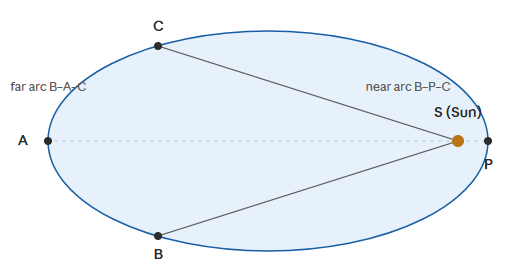
The area SBAC bounded by the ellipse and radius vectors SB and SC is compared to area SBPC. Which is larger and what does it imply?
A.
SBPC > SBAC; planet takes longer to traverse CPB
B.
SBAC > SBPC; planet takes longer to traverse BAC than CPB
C.
SBAC = SBPC; equal time for both arcs
D.
Cannot be determined from the figure
😑
View Answer
Error
ANSWER
:
B. SBAC > SBPC; planet takes longer to traverse BAC than CPB
15.
Kepler's Third Law (Law of Periods) states that:
A.
T² ∝ a (time period is proportional to semi-major axis)
B.
T ∝ a³ (time period is proportional to cube of semi-major axis)
C.
T² ∝ a³ (square of time period is proportional to cube of semi-major axis)
D.
T³ ∝ a² (cube of time period is proportional to square of semi-major axis)
😑
View Answer
Error
ANSWER
:
C. T² ∝ a³ (square of time period is proportional to cube of semi-major axis)
16.
For circular orbits, the mathematical expression for Kepler's Third Law derived from Newton's gravitation is:
A.
T² = (4π²/GM_s)·R³
B.
T² = (2π/GM_s)·R²
C.
T = (4π²/GM_s)·R³
D.
T² = (GM_s/4π²)·R³
😑
View Answer
Error
ANSWER
:
A. T² = (4π²/GM_s)·R³
17.
According to Kepler's third law, the value of T²/a³ for all planets around the Sun is approximately:
A.
Different for each planet (confirms orbits are different)
B.
Same for all planets ≈ 2.97×10⁻³⁴ y²·m⁻³ (confirms Kepler's Third Law)
C.
Increases with distance from Sun
D.
Equal to G times the mass of the planet
😑
View Answer
Error
ANSWER
:
B. Same for all planets ≈ 2.97×10⁻³⁴ y²·m⁻³ (confirms Kepler's Third Law)
18.
If the time period of Earth around the Sun is T_E and that of Mars is T_M, and their orbital radii are R_E and R_M respectively, then T_M/T_E equals:
A.
(R_M/R_E)²
B.
(R_M/R_E)^(3/2)
C.
(R_M/R_E)^(2/3)
D.
(R_M/R_E)³
😑
View Answer
Error
ANSWER
:
B. (R_M/R_E)^(3/2)
Prev
Next page
Prev
1
2
3
4
5
6
7
8
9
10
Next
1-10
Your Name
*
Your Email
*
Justify your answer :
*
Send Message