
The problem involves arranging seven boxes (A, B, C, D, E, F, G) one over the other based on given conditions. We need to deduce the final arrangement and then find the number of boxes between E and C.
There are 7 boxes. Let's denote the positions from bottom to top as 1 to 7.
"D is kept third from the bottom."
This means D is at position 3.
Position 7:
Position 6:
Position 5:
Position 4:
Position 3: D
Position 2:
Position 1:
"E is kept on one of the positions above D."
So, E can be at position 4, 5, 6, or 7.
"Only three boxes are kept between G and E."
This is a crucial condition. If E is above D, and there are three boxes between G and E, then G must be below E. Let's consider possible cases for E and G:
So, E can be at 6 or 5.
Let's combine with the condition that D is at position 3.
Position 7:
Position 6: E
Position 5:
Position 4:
Position 3: D
Position 2: G
Position 1:
Position 7:
Position 6:
Position 5: E
Position 4:
Position 3: D
Position 2:
Position 1: G
"B is kept immediately above F."
This means B and F are consecutive, with B on top of F (B/F).
"Only one box is kept between F and A."
This means F _ A or A _ F.
Let's try to fit B and F in Case 1:
Position 7:
Position 6: E
Position 5:
Position 4:
Position 3: D
Position 2: G
Position 1:
The only consecutive empty spots for B/F are positions 4 and 5 (B at 5, F at 4).
Position 7:
Position 6: E
Position 5: B
Position 4: F
Position 3: D
Position 2: G
Position 1:
Now, place A. "Only one box is kept between F and A." F is at 4. One box between F and A means A can be at position 2 (F _ A) or position 6 (A _ F). But position 2 is G and position 6 is E. So, Case 1 is not possible.
Let's try to fit B and F in Case 2:
Position 7:
Position 6:
Position 5: E
Position 4:
Position 3: D
Position 2:
Position 1: G
The consecutive empty spots for B/F are positions 6 and 7 (B at 7, F at 6) or positions 2 and 4 (B at 4, F at 2).
Position 7: B
Position 6: F
Position 5: E
Position 4:
Position 3: D
Position 2:
Position 1: G
Now, place A. "Only one box is kept between F and A." F is at 6. One box between F and A means A can be at position 4 (F _ A) or position 8 (not possible). So A is at position 4.
Position 7: B
Position 6: F
Position 5: E
Position 4: A
Position 3: D
Position 2:
Position 1: G
The only remaining box is C, and the only remaining position is 2. So C is at position 2.
Position 7: B
Position 6: F
Position 5: E
Position 4: A
Position 3: D
Position 2: C
Position 1: G
This arrangement satisfies all conditions.
Position 7:
Position 6:
Position 5: E
Position 4: B
Position 3: D
Position 2: F
Position 1: G
Now, place A. "Only one box is kept between F and A." F is at 2. One box between F and A means A can be at position 4 (F _ A) or position 0 (not possible). But position 4 is B. So, Subcase 2b is not possible.
Thus, the final arrangement is:
Position 7: B
Position 6: F
Position 5: E
Position 4: A
Position 3: D
Position 2: C
Position 1: G
The question asks: "How many boxes are kept between E and C?"
E is at position 5. C is at position 2. The boxes between E and C are A and D (at positions 4 and 3 respectively). There are 2 boxes between E and C.
The problem asks us to identify symbols in a given series that are immediately preceded by an even number and immediately followed by an even number. We need to scan the series from left to right and check each symbol against this condition.
B) One is the correct answer because only the symbol '£' in the series is immediately preceded by an even number (8) and immediately followed by an even number (6).
This problem can be solved using the concept of similar triangles. At any given time, the angle of elevation of the sun is constant for objects in the same vicinity. This means that an object and its shadow form a right-angled triangle, and all such triangles formed by different objects and their shadows at the same time will be similar. Therefore, the ratio of the height of an object to the length of its shadow will be constant.
The ratio of the man's height to his shadow length is:
\[ \frac{H_m}{S_m} = \frac{6 \text{ feet}}{4 \text{ feet}} \]The ratio of the pole's height to its shadow length is:
\[ \frac{H_p}{S_p} = \frac{H_p}{36 \text{ feet}} \]Since the angle of elevation of the sun is the same for both, the ratios of height to shadow length must be equal:
\[ \frac{H_m}{S_m} = \frac{H_p}{S_p} \]\[ \frac{6}{4} = \frac{H_p}{36} \]To find \(H_p\), multiply both sides by 36:
\[ H_p = \frac{6}{4} \times 36 \]\[ H_p = \frac{3}{2} \times 36 \]\[ H_p = 3 \times 18 \]\[ H_p = 54 \text{ feet} \]B) 54 feet is the correct height of the pole.
The reactivity of metals with water depends on their position in the reactivity series. Highly reactive metals react vigorously with cold water, moderately reactive metals react with steam or hot water, and less reactive metals do not react with water at all.
Correct Option: D) Aluminium, iron and zinc. These three metals are less reactive and do not react with cold water. They typically react with steam (hot water vapor) at high temperatures.
This is a coding-decoding problem where letters are assigned specific numerical codes. We need to identify the common letters and their corresponding codes from the given coded words to deduce the code for the letter 'E'.
Let's list the letters and their potential codes:
FROM: F, R, O, M \(\rightarrow\) 4, 9, 3, 5
MORE: M, O, R, E \(\rightarrow\) 3, 1, 5, 4
Common letters are M, O, R.
Let's try to match them:
From 'FROM' (4935) and 'MORE' (3154):
Let's find the unique letters and their codes first:
Let's verify this with the common letters:
Now, let's look at the remaining letters and digits:
For 'FROM' (4935): F=9. Remaining: R, O, M and 4, 3, 5.
For 'MORE' (3154): E=1. Remaining: M, O, R and 3, 5, 4.
Comparing the remaining:
Let's list the letters and their possible codes from each word:
FROM: F, R, O, M
Codes: 4, 9, 3, 5
MORE: M, O, R, E
Codes: 3, 1, 5, 4
The letters common to both words are M, O, R.
The digits common to both codes are 3, 4, 5.
The letter 'F' is only in 'FROM'. Its code must be the digit only in '4935' but not in '3154'. That digit is 9. So, F = 9.
The letter 'E' is only in 'MORE'. Its code must be the digit only in '3154' but not in '4935'. That digit is 1. So, E = 1.
We can also deduce the others:
By comparing the remaining sets {R, O, M} and {4, 3, 5} from FROM, and {M, O, R} and {3, 5, 4} from MORE, we can see that the mapping is consistent. For example:
Let's re-evaluate the common elements more carefully:
Given:
FROM \(\rightarrow\) 4935
MORE \(\rightarrow\) 3154
Letters in FROM: F, R, O, M
Letters in MORE: M, O, R, E
Common letters: M, O, R
Common digits in codes: 3, 4, 5
Unique letter in FROM: F. Its code must be the unique digit in 4935. Unique digit is 9. So, F = 9.
Unique letter in MORE: E. Its code must be the unique digit in 3154. Unique digit is 1. So, E = 1.
This method directly gives the code for 'E'.
Correct Option: B) 1
The question asks to identify the Indian actress who played the female protagonist in the movie "Sister Midnight," which was featured at the Cannes Film Festival in 2024. This requires knowledge of recent film news and specific movie castings.
A) Radhika Apte played the female protagonist in the movie "Sister Midnight," which was showcased at the Cannes Film Festival in 2024. The film, directed by Karan Kandhari, premiered in the ACID section of the festival.
This is a letter-coding problem where we need to find the pattern or relationship between the given pairs of letters. We will assign numerical positions to each letter of the alphabet (A=1, B=2, ..., Z=26) and then identify the mathematical operation or sequence that transforms the first pair into the second. Once the rule is established, we apply it to the third given letter pair to find the missing related pair.
Study the given graph and answer the question that follows.
The graph shows the number of employees who used different modes of transport in the year 2010.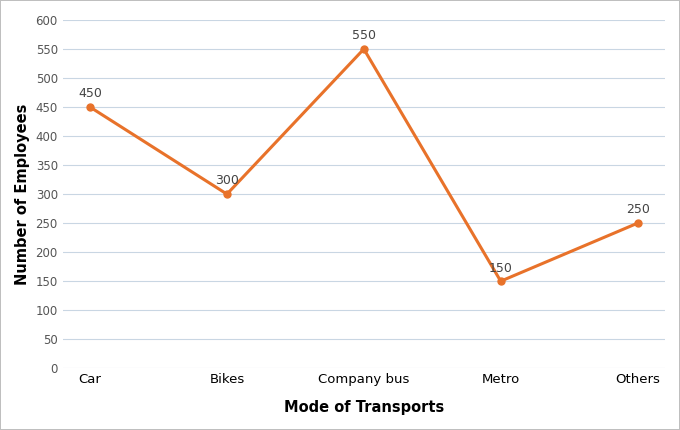
What is the respective ratio between the number of employees who used Bike to the number of employees who used Metro?
To find the ratio between the number of employees using Bikes and Metro, we need to extract the relevant data from the graph and compute the ratio.
Correct Option: B) 2 : 1
To solve this problem, we need to apply the given rules to each letter in the word "CONSTRUCTION". Vowels are changed to the next letter, and consonants are changed to the previous letter in alphabetical order. After forming the new word, we will identify the sixth letter from the right.
D) The sixth letter from the right in the transformed group of letters is V.
The given series consists of pairs of numbers. We need to identify the pattern or relationship between the numbers within each pair and between consecutive pairs to find the missing number.
D) 156 — The series consists of pairs where the second number is three times the first number. The first numbers of the pairs (26, 36, 66, ?) follow a pattern where the differences between consecutive terms are 10, 30, and then \(30 \times 3 = 90\). So, the next first number is \(66 + 90 = 156\).