
The question asks to identify the type of turbine suitable for low head applications. Turbines are classified based on the head (height of water) and flow rate they operate under. Understanding the characteristics of different turbine types is crucial for selecting the correct one.
Correct Option: A) Kaplan turbine is an axial-flow reaction turbine with adjustable blades, making it highly efficient for very low heads (typically less than 30 meters) and large flow rates.
The question asks for the standard unit in which transformer ratings are expressed. This relates to the fundamental principles of electrical engineering and how power is characterized in AC circuits, especially for devices like transformers.
Correct Option: A) kVA
Transformers are rated in kVA (kiloVolt-Ampere) because their internal losses (copper losses and iron losses) depend on the voltage and current, not on the power factor of the load. The manufacturer designs the transformer to handle a certain maximum voltage and current, which corresponds to an apparent power rating.
The question asks what a step-up transformer increases. To answer this, we need to understand the fundamental principle of a transformer and the relationship between voltage, current, and the number of turns in its primary and secondary coils.
A transformer is an electrical device that transfers electrical energy between two or more circuits through electromagnetic induction. It is primarily used to change voltage levels in an AC circuit.
A step-up transformer is designed to increase the voltage from the primary coil to the secondary coil. This is achieved by having more turns in the secondary coil than in the primary coil.
The relationship between the primary voltage (\(V_p\)), secondary voltage (\(V_s\)), primary turns (\(N_p\)), and secondary turns (\(N_s\)) is given by the transformer equation:
\[ \frac{V_s}{V_p} = \frac{N_s}{N_p} \]For a step-up transformer, \(N_s > N_p\), which implies \(V_s > V_p\). Therefore, a step-up transformer increases voltage.
According to the principle of conservation of energy, an ideal transformer does not change the power. If voltage increases, the current must decrease proportionally to keep the power constant (since Power \(P = V \times I\)).
C) voltage. A step-up transformer is specifically designed to increase the output voltage compared to the input voltage.
A) power: An ideal transformer conserves power. In a real transformer, there are losses (e.g., copper losses, iron losses), so the output power is slightly less than the input power. A transformer does not increase power; it merely transforms voltage and current levels.
B) resistance: A transformer does not directly increase the resistance of the circuit. While the effective impedance seen by the source can change, the transformer itself is not primarily designed to increase resistance.
D) frequency: A transformer operates on alternating current (AC) and transfers energy at the same frequency. It does not change the frequency of the AC supply.
The question asks to identify the electrical quantity represented by the ratio of kW to kVA in an AC circuit. This involves understanding the different types of power in AC circuits and their relationships.
Correct Option: A) Power factor
The question asks where a depletion layer is found. We need to understand what a depletion layer is and in which semiconductor devices or materials it forms.
C) diodes. Diodes are semiconductor devices formed by a p-n junction, and the depletion layer is a fundamental characteristic of this junction.
The question asks about the typical energy gap in a semiconductor. The energy gap, also known as the band gap, is a fundamental property that distinguishes conductors, semiconductors, and insulators. It represents the energy required for an electron to move from the valence band to the conduction band.
D) of the order of 1 eV. This range (typically from about 0.5 eV to 3 eV) is characteristic of semiconductors, allowing them to exhibit conductivity under certain conditions (e.g., heating, doping, illumination) but act as insulators at very low temperatures.
The question asks for the full form of the acronym BJT. This is a fundamental concept in electronics engineering, often tested in competitive exams to check basic knowledge of semiconductor devices.
B) Bipolar Junction Transistor — This is the correct and universally accepted full form for BJT. A Bipolar Junction Transistor is a three-terminal semiconductor device used for amplification or switching electronic signals and electrical power. It is called "bipolar" because its operation involves both electrons and holes as charge carriers.
The following figure is an electrical equivalent of 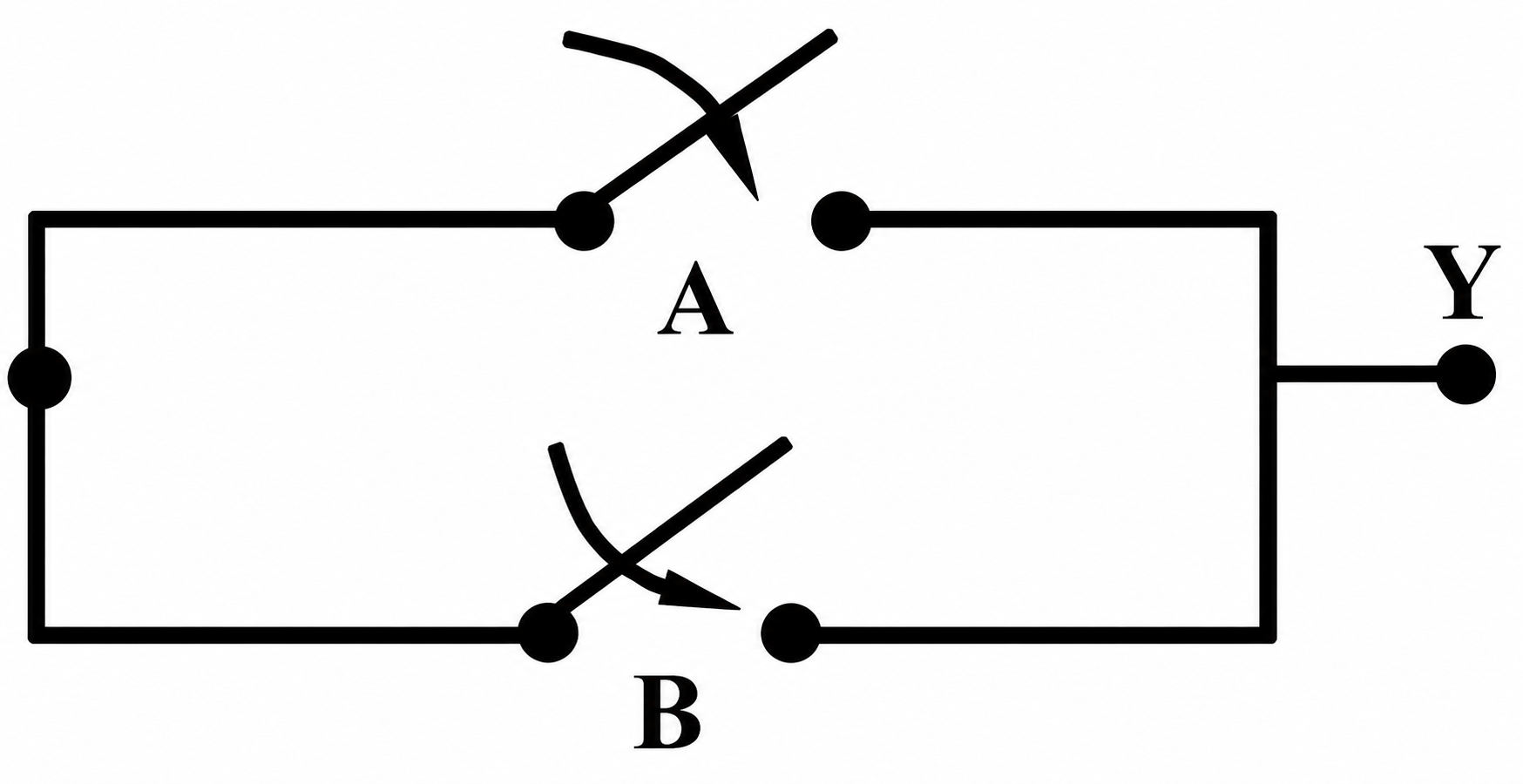
The diagram represents a basic electrical circuit with two switches labeled A and B. This setup is used to determine the logic gate equivalent by analyzing the behavior of the circuit based on the positions of the switches.
Correct Option: B) OR gate
To convert a decimal number to its hexadecimal equivalent, we use the method of successive division by the base of the target number system, which is 16 for hexadecimal. We record the remainders at each step, and the hexadecimal equivalent is formed by reading these remainders from bottom to top. For remainders 10 through 15, we use the hexadecimal digits A through F.
Let's apply this to the decimal number 210:
The final quotient is D, and the remainder is 2. So, reading from bottom to top, we get D2.
Therefore, the hexadecimal equivalent of the decimal number 210 is D2.
C) D2 — As calculated, the successive division of 210 by 16 yields a quotient of 13 (D in hexadecimal) and a remainder of 2. Reading these from bottom to top gives D2.
To determine the number of atoms in a body-centred unit cell, we need to consider the contribution of atoms located at different positions within the unit cell. In a body-centred cubic (BCC) unit cell, atoms are present at all eight corners and one atom is located exactly at the centre of the body.
Thus, a body-centred unit cell contains 2 atoms.
Correct Option: B) The calculation shows that a body-centred unit cell has 1 atom from the corners and 1 atom from the body centre, summing up to a total of 2 atoms.