
The question asks about the magnitude of current in a P-N junction diode when it is reverse-biased. Understanding the behavior of a P-N junction under reverse bias is crucial to determine the current level.
D) few microamperes to nanoamperes. This range accurately reflects the magnitude of the reverse saturation current in typical P-N junction diodes (silicon and germanium).
The ripple frequency of a rectifier circuit depends on the type of rectifier (half-wave or full-wave) and the input supply frequency. For a full-wave bridge rectifier, both positive and negative half-cycles of the input AC signal are rectified, resulting in a pulsating DC output. We need to determine how this rectification affects the frequency of the ripple component.
Correct Option: C) 100 Hz is the lowest ripple frequency for a full-wave bridge rectifier supplied with 50 Hz AC, as it is twice the input frequency.
Identify the following logic gate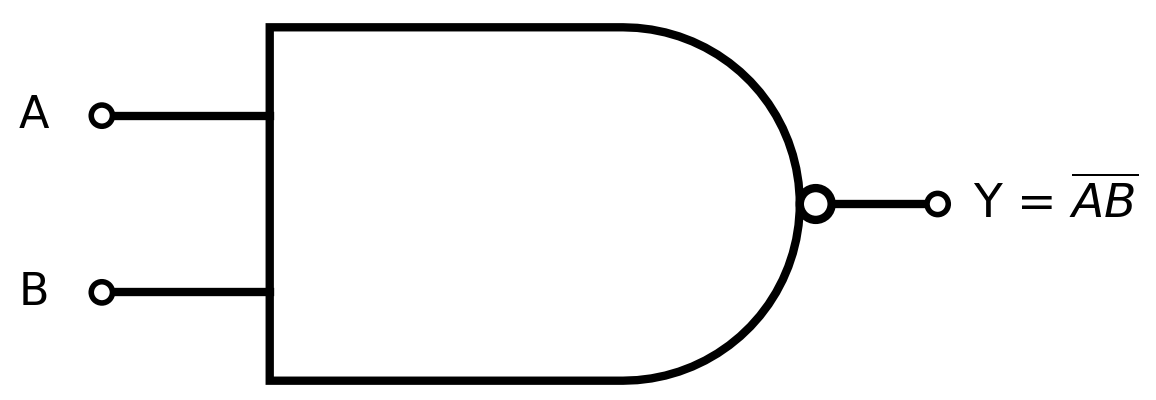
To identify the logic gate, examine the diagram and the expression associated with it. The gate's shape and the expression will help determine its type.
Correct Option: C) NAND gate
The question asks for the forbidden energy gap (band gap) of germanium. This is a fundamental property of semiconductor materials, and its value is typically memorized or looked up from standard material properties tables. The energy gap determines the electrical conductivity of the material and its applications in electronic devices.
Correct Option: B) 0.72 eV — This is the widely accepted value for the forbidden energy gap of germanium at room temperature.
The question asks about the meaning of "nominal stress" in the context of a stress-strain curve for mild steel. Understanding how stress is calculated in engineering applications, especially when dealing with material deformation, is key.
A) Average stress. Nominal stress is calculated by dividing the applied load by the original cross-sectional area of the specimen. Since this area remains constant in the calculation, the stress value represents an average across the original cross-section, rather than the instantaneous stress at a reduced area. Therefore, nominal stress is synonymous with average stress (calculated over the original area).
The question asks to identify the soil classification symbol for an inorganic soil with low compressibility. This requires knowledge of the Unified Soil Classification System (USCS) symbols and their corresponding soil properties.
C) ML represents inorganic silt of low plasticity or low compressibility. Silt is an inorganic fine-grained soil, and the 'L' suffix indicates low compressibility, which perfectly matches the given description.
The question asks for the minimum grade of concrete to be used in reinforced concrete (RC) as per Indian Standards. This is a direct factual question based on the IS 456:2000 code for plain and reinforced concrete.
Correct Option: C) M 20 is the minimum grade of concrete specified by IS 456:2000 for reinforced concrete work under normal exposure conditions.
The question asks to identify a compression member from the given options. A compression member is a structural element designed primarily to resist forces that push on its ends, causing it to shorten or compress. We need to analyze the primary function of each option.
B) Boom — A boom, especially in a crane, is a structural member that is primarily subjected to compressive forces as it supports and lifts heavy loads. It functions as a compression member.
This question asks about the nature of absolute pressure in a flow system. To answer this, we need to understand the definition of absolute pressure and its relation to atmospheric pressure and gauge pressure.
Correct Option: C) May be above, below or equal to the local atmospheric pressure
The question asks about the primary function of Gantt charts. To answer this, we need to understand what a Gantt chart is and what information it typically conveys in project management.
A) Comparison of actual progress with the scheduled progress. Gantt charts are fundamental tools for project scheduling and progress tracking, allowing for a clear visual comparison between what was planned and what has actually been achieved.