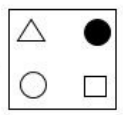
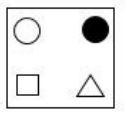
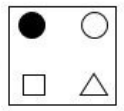
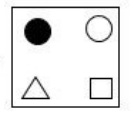
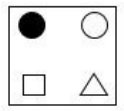
Look carefully at the sequence of symbols to find the pattern.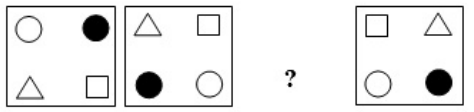
Which of the following will replace the (?) in the sequence?
To solve this problem, we need to identify the pattern in the sequence of symbols and predict which option completes the sequence correctly.
Correct Option: C) The symbols are rotated clockwise, matching the pattern.
This is a coding-decoding problem where digits represent words. We need to find the digit that represents the word 'sour' by comparing the given coded statements.
C) 6 is the correct answer because, through a process of elimination and comparison of the given coded statements, the digit '6' is uniquely identified as representing the word 'sour'.
The question asks to identify the correct statement regarding a Glucometer. We need to understand what a glucometer is and its primary function to evaluate the given options.
Correct Option: A) It is a medical device.
A glucometer is specifically designed and used for medical purposes, primarily for monitoring blood glucose levels in patients, especially those with diabetes. Therefore, it is classified as a medical device.
To find the speed of car B, we first need to determine the speed of car A using the given distance and time. Once we have the speed of car A, we can use the information that car B is twice as fast as car A to calculate car B's speed.
The formula for speed is:
\[ \text{Speed} = \frac{\text{Distance}}{\text{Time}} \]Given for car A:
So, the speed of car A is:
\[ \text{Speed of A} = \frac{90 \text{ km}}{2 \text{ hours}} = 45 \text{ kmph} \]The problem states that car B is twice as fast as car A.
Speed of B = 2 \times \text{Speed of A}
Substitute the speed of car A:
\[ \text{Speed of B} = 2 \times 45 \text{ kmph} = 90 \text{ kmph} \]Thus, the speed of car B is 90 kmph.
Correct Option: A) 90 kmph
The question asks to identify which of the given gases is NOT colorless and odorless. This requires knowledge of the physical properties (color and odor) of common gases.
B) Chlorine is a yellowish-green gas with a pungent, irritating odor. Therefore, it is not colorless and odorless.
To find the speed of X, we first need to determine the speed of Y using the given distance and time. Once Y's speed is known, we can use the given ratio of speeds of X and Y to calculate the speed of X.
The formula for speed is:
\[ \text{Speed} = \frac{\text{Distance}}{\text{Time}} \]Given that Y covers a distance of 420 km in 3 hours.
\[ \text{Speed of Y} = \frac{420\ \text{km}}{3\ \text{hours}} = 140\ \text{kmph} \]The ratio of speeds of X and Y is given as 5:7.
\[ \frac{\text{Speed of X}}{\text{Speed of Y}} = \frac{5}{7} \]We know the speed of Y is 140 kmph. Let the speed of X be \(S_X\).
\[ \frac{S_X}{140\ \text{kmph}} = \frac{5}{7} \]Now, solve for \(S_X\):
\[ S_X = \frac{5}{7} \times 140\ \text{kmph} \]\[ S_X = 5 \times 20\ \text{kmph} \]
\[ S_X = 100\ \text{kmph} \]
C) 100 kmph is the calculated speed of X.
The question asks about the host countries for the Cricket World Cup 2015. This is a factual question related to major international sporting events, which are often covered in general knowledge sections of competitive exams.
The 2015 ICC Cricket World Cup was jointly hosted by Australia and New Zealand. This was the second time the tournament was held in these two countries, the first being in 1992.
D) New Zealand & Australia — The 2015 Cricket World Cup was indeed co-hosted by New Zealand and Australia. The final match was played at the Melbourne Cricket Ground in Australia, where Australia defeated New Zealand to win the trophy.
The question asks about the famous feature of the World Heritage Site Bhimbetka in Madhya Pradesh. This requires knowledge of prominent geographical and historical characteristics of well-known Indian heritage sites.
Correct Option: C) Rock shelters
The standard deviation of the set {10, 11, 9, 11, 9} is
\(\frac{1}{\sqrt{5}}\)
\(\frac{2}{\sqrt{5}}\)
\(\frac{3}{\sqrt{5}}\)
0
To find the standard deviation of a set of numbers, we first need to calculate the mean of the set. Then, we find the variance by calculating the average of the squared differences from the mean. Finally, the standard deviation is the square root of the variance.
The given set of numbers is \(\{10, 11, 9, 11, 9\}\).
The mean is the sum of all values divided by the number of values.
\[ \bar{x} = \frac{10 + 11 + 9 + 11 + 9}{5} \]\[ \bar{x} = \frac{50}{5} \]\[ \bar{x} = 10 \]The variance is the sum of the squared deviations divided by the number of values (\(N\)).
\[ \sigma^2 = \frac{\sum (x_i - \bar{x})^2}{N} \]\[ \sigma^2 = \frac{0 + 1 + 1 + 1 + 1}{5} \]\[ \sigma^2 = \frac{4}{5} \]The standard deviation is the square root of the variance.
\[ \sigma = \sqrt{\sigma^2} \]\[ \sigma = \sqrt{\frac{4}{5}} \]\[ \sigma = \frac{\sqrt{4}}{\sqrt{5}} \]\[ \sigma = \frac{2}{\sqrt{5}} \]B) The standard deviation is \(\frac{2}{\sqrt{5}}\).
The question asks us to evaluate an assertion (A) and a reason (R) related to photosynthesis and energy use. We need to determine if each statement is true and if the reason correctly explains the assertion.
Correct Option: B) Both A and R are true, but R is not the correct explanation of A