
The question asks to identify the FALSE statement about the Richter scale. We need to evaluate each option based on our knowledge of the Richter scale and earthquake measurement.
Correct Option: D) Magnitude of 8-9 on a Richter scale means it is a micro earthquake.
This statement is false because earthquakes with magnitudes of 8-9 are classified as 'great' earthquakes, which are extremely powerful and destructive, not micro earthquakes. Micro earthquakes have magnitudes typically less than 2.0.
The following bar graph shows the marks obtained by 5 students. Their marks are given out of 10.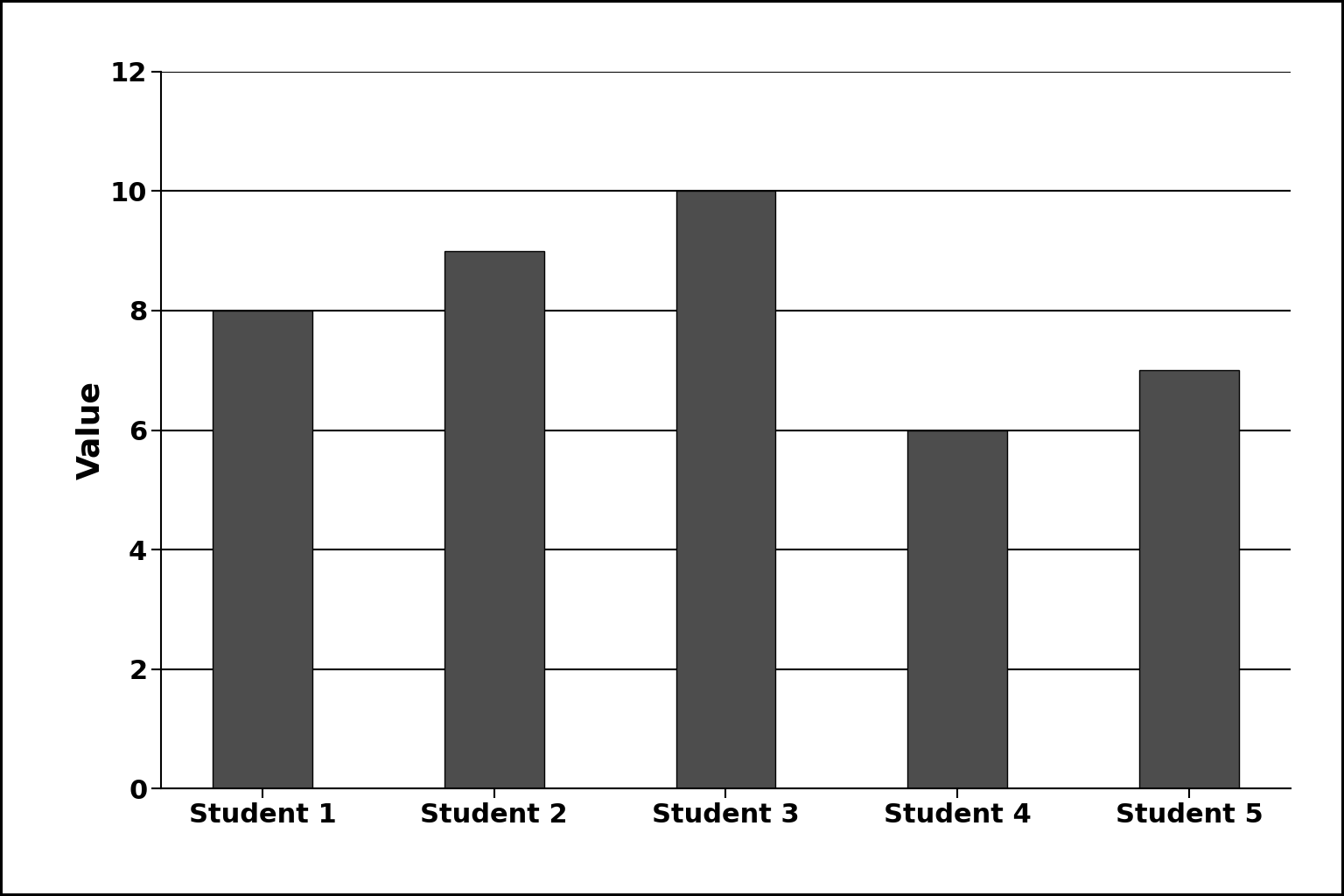
How many more marks did Student 3 and Student 5 get than Student 4 and Student 1?
To solve this problem, we need to compare the marks obtained by Student 3 and Student 5 with those obtained by Student 4 and Student 1, using the bar graph provided.
The correct answer is that Student 3 and Student 5 obtained 4 more marks than Student 4 and Student 1.
Correct Option: C) 3
The question asks to identify the device that converts digital signals to analog signals. This is a fundamental concept in networking and telecommunications. We need to understand the function of each given option.
Correct Option: B) Modem
If N:38::3:57, Find N.
The problem presents a proportion in the format A:B::C:D, which means that the ratio A to B is equal to the ratio C to D. This can be written as a fraction equation: \[\frac{A}{B} = \frac{C}{D}\]. We will use this property to solve for N.
Correct Option: D) 2
The distance between two points A and B is covered in 5\( \frac{1}{2} \) hours at a speed of 50 km/hr. If the speed is increased by 5 km/hr, how much time would be saved?
The problem requires calculating the time saved when the speed of travel between two points is increased. First, we need to calculate the total distance using the initial speed and time. Then, we calculate the new time taken to cover the same distance with the increased speed. Finally, the difference between the initial time and the new time will give us the time saved.
Calculate the initial time in hours:
The given initial time is \(5 \frac{1}{2}\) hours.
\[ \text{Initial Time } (T_1) = 5 \frac{1}{2} \text{ hours} = 5.5 \text{ hours} \]Identify the initial speed:
The initial speed is given as 50 km/hr.
\[ \text{Initial Speed } (S_1) = 50 \text{ km/hr} \]Calculate the distance between points A and B:
The formula for distance is \(\text{Distance} = \text{Speed} \times \text{Time}\).
\[ \text{Distance } (D) = S_1 \times T_1 = 50 \text{ km/hr} \times 5.5 \text{ hours} = 275 \text{ km} \]Calculate the new speed:
The speed is increased by 5 km/hr.
\[ \text{New Speed } (S_2) = \text{Initial Speed} + 5 \text{ km/hr} = 50 \text{ km/hr} + 5 \text{ km/hr} = 55 \text{ km/hr} \]Calculate the new time taken to cover the same distance:
Using the formula \(\text{Time} = \frac{\text{Distance}}{\text{Speed}}\).
\[ \text{New Time } (T_2) = \frac{D}{S_2} = \frac{275 \text{ km}}{55 \text{ km/hr}} = 5 \text{ hours} \]Calculate the time saved:
Time saved is the difference between the initial time and the new time.
\[ \text{Time Saved} = T_1 - T_2 = 5.5 \text{ hours} - 5 \text{ hours} = 0.5 \text{ hours} \]Convert the time saved to minutes:
Since 1 hour = 60 minutes.
\[ \text{Time Saved in Minutes} = 0.5 \text{ hours} \times 60 \text{ minutes/hour} = 30 \text{ minutes} \]Correct Option: D) 30 minutes
If x = 7 - 4\(\sqrt{3}\), find the value of \(\sqrt{x}\) + \(\frac{1}{\sqrt{x}}\)
The problem asks us to find the value of \(\sqrt{x} + \frac{1}{\sqrt{x}}\) given \(x = 7 - 4\sqrt{3}\). The key to solving this is to simplify \(\sqrt{x}\) first by recognizing \(x\) as a perfect square of the form \((a-b)^2\).
Simplify \(x\):
We are given \(x = 7 - 4\sqrt{3}\). We want to express this in the form \((a-b)^2 = a^2 - 2ab + b^2\).
Compare \(7 - 4\sqrt{3}\) with \(a^2 - 2ab + b^2\).
We can write \(4\sqrt{3}\) as \(2 \times 2 \times \sqrt{3}\). So, we can set \(2ab = 2 \times 2 \times \sqrt{3}\). This suggests \(a=2\) and \(b=\sqrt{3}\) (or vice-versa).
Let's check if \(a^2 + b^2 = 7\) with these values:
\[ a^2 + b^2 = (2)^2 + (\sqrt{3})^2 = 4 + 3 = 7 \]This matches the constant term. Therefore, we can write \(x\) as:
\[ x = 2^2 - 2(2)(\sqrt{3}) + (\sqrt{3})^2 = (2 - \sqrt{3})^2 \]Find \(\sqrt{x}\):
Now, we can find \(\sqrt{x}\):
Since \(2 = \sqrt{4}\) and \(\sqrt{4} > \sqrt{3}\), \(2 - \sqrt{3}\) is positive. So, \(|2 - \sqrt{3}| = 2 - \sqrt{3}\).
\[ \sqrt{x} = 2 - \sqrt{3} \]Find \(\frac{1}{\sqrt{x}}\):
Next, we find the reciprocal of \(\sqrt{x}\):
To rationalize the denominator, multiply the numerator and denominator by the conjugate of the denominator, which is \(2 + \sqrt{3}\):
\[ \frac{1}{2 - \sqrt{3}} \times \frac{2 + \sqrt{3}}{2 + \sqrt{3}} = \frac{2 + \sqrt{3}}{(2)^2 - (\sqrt{3})^2} = \frac{2 + \sqrt{3}}{4 - 3} = \frac{2 + \sqrt{3}}{1} = 2 + \sqrt{3} \]So, \(\frac{1}{\sqrt{x}} = 2 + \sqrt{3}\).
Calculate \(\sqrt{x} + \frac{1}{\sqrt{x}}\):
Finally, add the values of \(\sqrt{x}\) and \(\frac{1}{\sqrt{x}}\):
The \(\sqrt{3}\) terms cancel out:
\[ \sqrt{x} + \frac{1}{\sqrt{x}} = 2 + 2 = 4 \]C) The value of \(\sqrt{x} + \frac{1}{\sqrt{x}}\) is 4.
Which is India's longest river that does not flow into the sea?
The question asks for India's longest river that does not flow into the sea. This requires knowledge of major Indian rivers and their drainage patterns. We need to identify which of the given options is an inland river or a tributary that eventually merges with another river before reaching the sea.
Correct Option: B) Yamuna is the longest tributary river in India. It originates from the Yamunotri Glacier in the Himalayas and flows through several states before merging with the Ganga River at Prayagraj. It does not have an independent outlet to the sea.
The question asks to identify the most cultivated crop in India. This requires knowledge of agricultural statistics and major food crops grown in the country.
Correct Option: D) Rice is the most cultivated crop in India. It is the staple food for a majority of the Indian population and accounts for the largest share of agricultural land and production among food grains.
The question asks about the city where the global value of gold is determined. This refers to the historical and current practice of gold price fixing, which is a key event in the global precious metals market.
Correct Option: D) London
The question asks to find a common similarity among Elephant, Camel, Buffalo, and Giraffe. We need to evaluate each option based on biological facts about these animals.
D) The young ones of all of them are called calf. This is a correct biological term for the young of all the listed animals.