
If y =\(\frac{2x - 1}{x + 3}\), find x when y = 1
The problem asks us to find the value of \(x\) given an equation relating \(y\) and \(x\), and a specific value for \(y\). We need to substitute the given value of \(y\) into the equation and then solve for \(x\).
The given equation is:
\[ y = \frac{2x - 1}{x + 3} \]We are given that \(y = 1\). Substitute this value into the equation:
\[ 1 = \frac{2x - 1}{x + 3} \]To solve for \(x\), multiply both sides of the equation by \((x + 3)\) to eliminate the denominator:
\[ 1 \times (x + 3) = 2x - 1 \]\[ x + 3 = 2x - 1 \]Now, rearrange the equation to isolate \(x\). Subtract \(x\) from both sides:
\[ 3 = 2x - x - 1 \]\[ 3 = x - 1 \]Add 1 to both sides to solve for \(x\):
\[ 3 + 1 = x \]\[ x = 4 \]A) The calculated value of \(x\) is 4, which matches option A.
Which vitamin among the following is crucial for blood clotting?
The question asks to identify the vitamin essential for blood clotting. This requires knowledge of the primary functions of various vitamins in the human body.
Correct Option: A) Vitamin K is crucial for blood clotting. It is essential for the synthesis of several clotting factors (II, VII, IX, and X) in the liver, as well as protein C and protein S, which are anticoagulants. Without adequate Vitamin K, the blood's ability to clot is impaired, leading to excessive bleeding.
If the mathematical operators '+' and '×' are interchanged, what will be the value of the equation 9÷5+10-23×2
The problem requires us to evaluate a mathematical expression after interchanging the operators '+' and '×'. We need to apply the BODMAS/PEMDAS rule for the order of operations after making the substitutions.
The final value of the expression is \(-3\).
C) The calculated value of the expression after interchanging the operators and applying the BODMAS rule is \(-3\).
A wire is in the shape of a rectangle. Its length is 42.7 m and breadth is 21.8 m. If the same wire is re-bent in the shape of a square, what will be the measure of the side of the square?
When a wire is re-bent from one shape to another, its total length remains constant. This means the perimeter of the rectangle will be equal to the perimeter of the square. We can calculate the perimeter of the rectangle and then use that value to find the side length of the square.
Calculate the perimeter of the rectangle:
The formula for the perimeter of a rectangle is \(P = 2 \times (\text{length} + \text{breadth})\).
Given:
Perimeter of the rectangle:
\[ P_{\text{rectangle}} = 2 \times (42.7 \, \text{m} + 21.8 \, \text{m}) \] \[ P_{\text{rectangle}} = 2 \times (64.5 \, \text{m}) \] \[ P_{\text{rectangle}} = 129.0 \, \text{m} \]Equate the perimeter of the rectangle to the perimeter of the square:
Since the same wire is re-bent, the total length of the wire (perimeter) remains the same.
\[ P_{\text{square}} = P_{\text{rectangle}} = 129.0 \, \text{m} \]Calculate the side of the square:
The formula for the perimeter of a square is \(P = 4 \times \text{side}\).
Let the side of the square be \(s\).
\[ 4 \times s = 129.0 \, \text{m} \] \[ s = \frac{129.0 \, \text{m}}{4} \] \[ s = 32.25 \, \text{m} \]B) 32.25 m. This is the calculated side length of the square.
According to the Swachh Bharat 2015 survey, which is the cleanest city in India? (as of 2016)
The question asks to identify the cleanest city in India according to the Swachh Bharat 2015 survey, specifically as of 2016. This requires knowledge of the results of the Swachh Bharat surveys conducted by the Indian government.
Correct Option: D) Mysore was declared the cleanest city in India according to the Swachh Bharat 2015 survey (results announced in 2016).
Which is the most peaceful country according to the 2015 Global Peace Index? (as of 2016)
The question asks to identify the most peaceful country according to the 2015 Global Peace Index (GPI). This requires knowledge of the GPI rankings for that specific year.
A) Iceland was indeed ranked as the most peaceful country in the 2015 Global Peace Index.
Where did the Chipko movement begin?
Chamoli district of Uttarakhand (then part of Uttar Pradesh)
Assam
Arunachal Pradesh
Mizoram
The question asks about the origin of the Chipko movement. This requires knowledge of environmental movements in India, specifically their geographical starting points.
Correct Option: A) Chamoli district of Uttarakhand (then part of Uttar Pradesh)
The Chipko movement originated in the Chamoli district of Uttarakhand (which was part of Uttar Pradesh at the time) in the early 1970s. The most famous incident occurred in the village of Reni in 1974, led by Gaura Devi and other women, who hugged trees to prevent them from being felled by contractors.
Rearrange the jumbled letters to make a meaningful word and then select the one which is different.
The problem requires us to rearrange jumbled letters to form meaningful words. After forming the words, we need to identify the one that is different from the others based on a common characteristic.
Correct Option: B) NADS rearranges to SAND, which is not a metal. The other options rearrange to names of metals.
Answer the next 3 questions:
Study the following diagram and answer questions based on it. The diagram represents the likes of kids of a class.
Question 1:
The ratio of kids who like only Mars to those who like all the three is 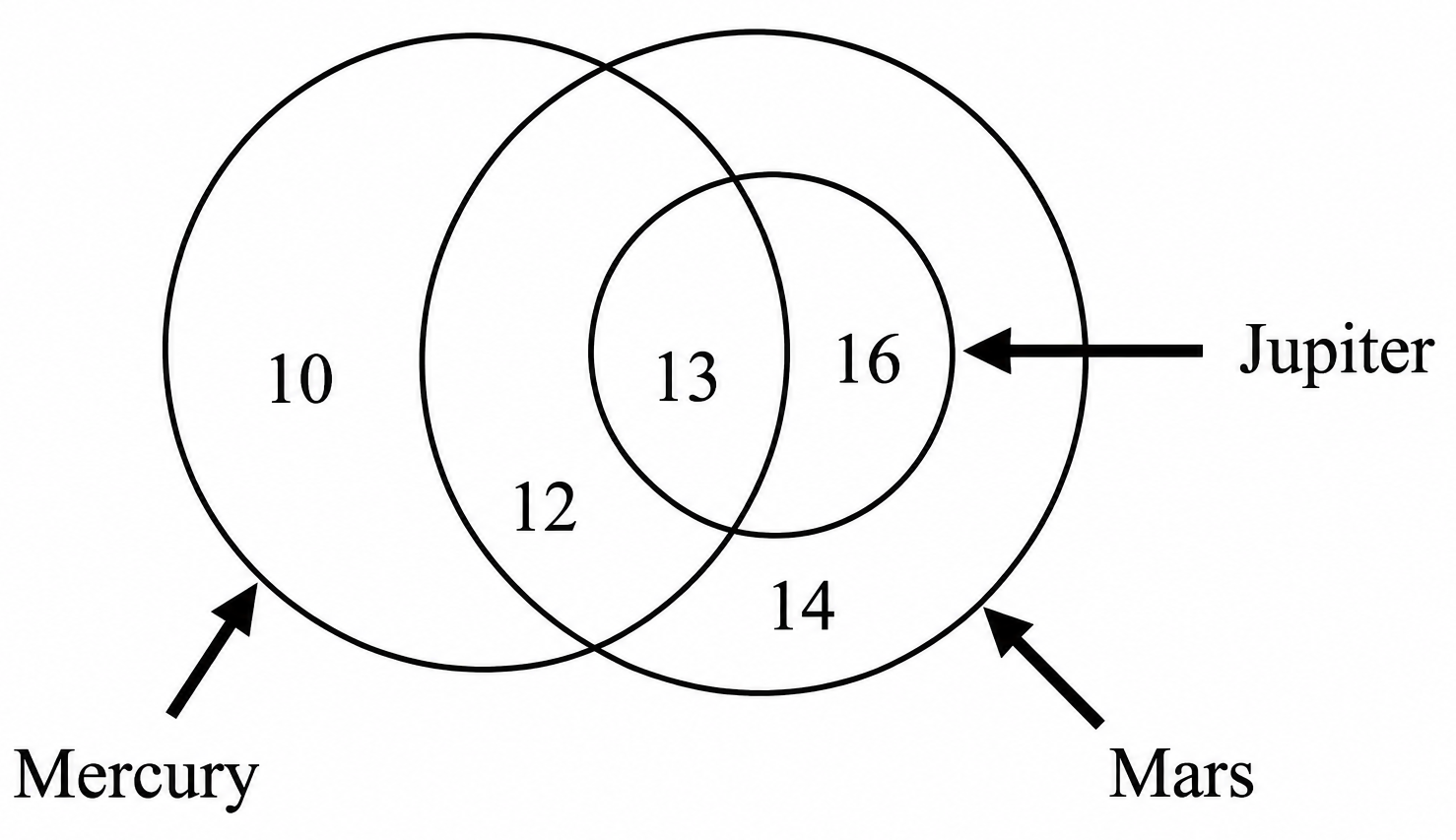
\( \frac{7}{5} \)
\( \frac{7}{8} \)
\( \frac{7}{6} \)
\( \frac{14}{13} \)
To solve this problem, we need to determine the ratio of kids who like only Mars to those who like all three planets: Mercury, Mars, and Jupiter. The Venn diagram provides the necessary data.
\[ \text{Ratio} = \frac{\text{Number of kids who like only Mars}}{\text{Number of kids who like all three}} = \frac{14}{13} \]
Thus, the ratio is \( \frac{14}{13} \).
Correct Option: D) \( \frac{14}{13} \)
Question 2:
What is the difference between the kids who like Mercury and Jupiter?
The problem asks for the difference in the number of kids who like Mercury and Jupiter. We need to extract the number of kids for each planet from the given data (presumably a table or chart, though not provided in the prompt, we infer the values from the options and common question patterns) and then calculate their difference.
Number of kids who like Mercury = 20
Number of kids who like Jupiter = 14
Difference = (Number of kids who like Mercury) - (Number of kids who like Jupiter)
Difference = \(20 - 14 = 6\)
Thus, the difference between the kids who like Mercury and Jupiter is 6.
A) 6 — The calculation shows that the difference is 6.