
Who along with Bhagat Singh, was the main accused in Assembly bomb Case?
Ram Prasad Bismil
Ashfaqulla
Surya Sen
Batukeshwar Dutta
The question asks to identify the person who, along with Bhagat Singh, was the main accused in the Assembly Bomb Case. This requires knowledge of key events and figures in the Indian independence movement, specifically the revolutionary activities of the late 1920s.
Correct Option: D) Batukeshwar Dutta
The question asks about the locations of two new Indian Institutes of Management (IIMs) announced in the Union Budget 2015-16. To answer this, one needs to recall the key announcements made in that specific budget regarding higher education institutions.
Correct Option: C) Andhra Pradesh, Jammu & Kashmir
In the Union Budget 2015-16, it was announced that two new Indian Institutes of Management (IIMs) would be opened in Andhra Pradesh and Jammu & Kashmir. These were part of the government's initiative to expand access to quality management education across the country.
The question asks for the full form of the acronym CDM. This is a direct knowledge-based question related to environmental agreements and mechanisms, which are common topics in competitive exams.
Correct Option: A) Clean Development Mechanism
The Clean Development Mechanism (CDM) is an international carbon offset scheme that allows developed countries to finance greenhouse gas emission reduction projects in developing countries and receive credits for doing so. These credits can then be used to meet their own emission reduction targets under the Kyoto Protocol. It was one of the three market-based mechanisms established under the Kyoto Protocol to help countries achieve their emission reduction commitments.
This is a blood relations problem. We need to deduce the relationship between S and R based on the given statements. We can use a family tree or logical deductions to solve this.
Correct Option: B) Sister
The question asks to identify the Indian city known as 'The City Of Pearls' due to its historical significance as a global center for large diamonds and natural pearls. This requires knowledge of Indian geography and history, specifically the historical trade and economic prominence of various cities.
A) Hyderabad is famously known as 'The City Of Pearls'. This is because, during the rule of the Nizams, Hyderabad became a global center for the trade of natural pearls and diamonds. The Golconda mines near Hyderabad were the source of some of the world's most famous diamonds, and the city's skilled artisans processed and traded pearls extensively, attracting merchants from across the globe.
To solve this problem, we need to first determine the cost price (CP) of the rice. We are given the selling price (SP) and the percentage loss. Once the cost price is known, we can calculate the new selling price required to achieve a 20% profit.
Calculate the Cost Price (CP):
Given:
The formula for selling price with a loss is:
\[ \text{SP} = \text{CP} \times \left(1 - \frac{\text{Loss \%}}{100}\right) \]Substitute the given values:
\[ 45 = \text{CP} \times \left(1 - \frac{20}{100}\right) \] \[ 45 = \text{CP} \times \left(1 - 0.20\right) \] \[ 45 = \text{CP} \times 0.80 \]Now, solve for CP:
\[ \text{CP} = \frac{45}{0.80} \] \[ \text{CP} = \frac{45}{\frac{80}{100}} \] \[ \text{CP} = \frac{45 \times 100}{80} \] \[ \text{CP} = \frac{45 \times 10}{8} \] \[ \text{CP} = \frac{45 \times 5}{4} \] \[ \text{CP} = \frac{225}{4} \] \[ \text{CP} = 56.25 \]So, the Cost Price of the rice is Rs. 56.25 per kg.
Calculate the New Selling Price (\(\text{SP}_2\)) for 20% Profit:
We want to earn a profit of 20% on the Cost Price (CP = Rs. 56.25).
The formula for selling price with a profit is:
\[ \text{SP} = \text{CP} \times \left(1 + \frac{\text{Profit \%}}{100}\right) \]Substitute the values:
\[ \text{SP}_2 = 56.25 \times \left(1 + \frac{20}{100}\right) \] \[ \text{SP}_2 = 56.25 \times \left(1 + 0.20\right) \] \[ \text{SP}_2 = 56.25 \times 1.20 \]To calculate \(56.25 \times 1.20\):
\[ 56.25 \times 1.20 = 56.25 \times \frac{120}{100} \] \[ 56.25 \times \frac{6}{5} \] \[ \frac{225}{4} \times \frac{6}{5} \] \[ \frac{45}{4} \times 6 \] \[ \frac{45}{2} \times 3 \] \[ \frac{135}{2} \] \[ \text{SP}_2 = 67.50 \]So, the selling price should be Rs. 67.50 per kg to earn a profit of 20%.
A) Rs. 67.50 is the correct selling price to achieve a 20% profit after incurring a 20% loss at Rs. 45.
This question tests logical deduction based on a given statement. We need to analyze the statement "Most garments in that shop are expensive" and determine which conclusion logically follows from it. The key word here is "Most", which implies a majority but not necessarily all.
C) There are cheap garments also in that shop. This is the most logical conclusion. If 'most' garments are expensive, it implies that there is a remaining portion of garments that are not expensive. These non-expensive garments could be categorized as cheap.
Choose the figure which is different from the rest three.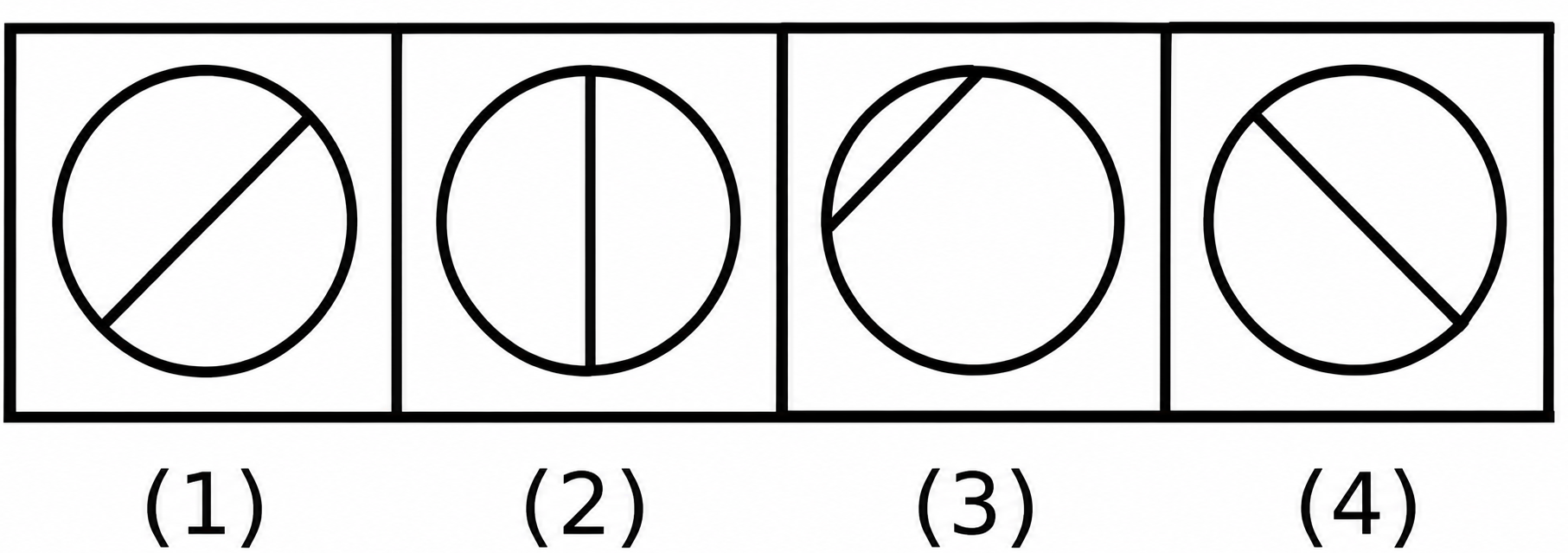
To solve this problem, we need to identify the figure that is different from the others based on a consistent pattern or characteristic. Each figure consists of a circle with a line inside a square boundary. The task is to determine which figure does not share the same characteristic as the others.
Correct Option: C) Figure 3 is different because its line does not symmetrically bisect the circle like the others.
Shivam Industries installed a flour mill for Rs. 300,000 five years ago. If the fixed annual rate of depreciation is 5% and they sold the mill for Rs. 247,500, their gain/loss % is?
No Gain - No loss
Loss, 10%
Gain, 12.5%
Gain, 10.0%
To determine the gain or loss percentage, we first need to calculate the book value of the flour mill after 5 years of depreciation. Then, we compare this book value with the selling price to find the gain or loss, and finally express it as a percentage of the book value.
The initial cost of the mill is Rs. 300,000 and the annual depreciation rate is 5%.
\[ \text{Annual Depreciation} = \text{Initial Cost} \times \text{Depreciation Rate} \]\[ \text{Annual Depreciation} = 300,000 \times 0.05 = \text{Rs. } 15,000 \]Since the depreciation is a fixed annual rate (straight-line method implied), we multiply the annual depreciation by the number of years.
\[ \text{Total Depreciation} = \text{Annual Depreciation} \times \text{Number of Years} \]\[ \text{Total Depreciation} = 15,000 \times 5 = \text{Rs. } 75,000 \]The book value is the initial cost minus the total depreciation.
\[ \text{Book Value} = \text{Initial Cost} - \text{Total Depreciation} \]\[ \text{Book Value} = 300,000 - 75,000 = \text{Rs. } 225,000 \]The mill was sold for Rs. 247,500, and its book value was Rs. 225,000.
\[ \text{Gain/Loss} = \text{Selling Price} - \text{Book Value} \]\[ \text{Gain/Loss} = 247,500 - 225,000 = \text{Rs. } 22,500 \]Since the selling price is greater than the book value, there is a gain.The gain percentage is calculated based on the book value.
\[ \text{Gain Percentage} = \frac{\text{Gain}}{\text{Book Value}} \times 100 \% \]\[ \text{Gain Percentage} = \frac{22,500}{225,000} \times 100 \% \]\[ \text{Gain Percentage} = 0.1 \times 100 \% = 10 \% \]D) Gain, 10.0%
This question tests knowledge about plant hormones, specifically cytokinins like zeatin, their site of synthesis, and their transport within the plant body. Understanding the primary roles of different plant organs in hormone production is key.
Correct Option: B) Zeatin is produced in Roots and transported to Shoots in the xylem where it promotes cell division.