
Read the statements and select a conclusion from the given alternatives.
Statement:
All the tablas are instruments.
All instruments are pianos.
Conclusion:
I. All the pianos are instruments.
II. All the tablas are pianos.
Only I conclusion follows
Only II conclusion follows
Either I or II follows
Neither I nor II follows
This is a syllogism problem. We need to evaluate the given statements and determine which of the conclusions logically follow. We can use Venn diagrams to visualize the relationships between the categories mentioned in the statements.
B) Only II conclusion follows. As explained above, Conclusion II is a direct logical consequence of the two given statements.
The question asks to identify the first human who got married in space. This is a factual question related to space history. We need to recall the specific event and the individual involved.
Correct Option: C) Yuri Malenchenko
Yuri Malenchenko was the first person to get married while in space. He was on the International Space Station (ISS) when he married Ekaterina Dmitriev, who was on Earth, via a video link on August 10, 2003.
The question asks to identify the name of an ecologically clean rocket developed by a Russian space research center. This requires knowledge of specific rocket programs and their environmental characteristics.
A) Angara — The Angara rocket family is a new generation of Russian launch vehicles that uses environmentally friendlier propellants (kerosene and liquid oxygen) compared to its predecessors, making it an "ecologically clean" rocket.
To find the factors of a quadratic expression of the form \( ax^2 + bx + c \), we look for two numbers that multiply to \( ac \) and add up to \( b \). In this case, the expression is \( x^2 + 8x + 12 \), which is a quadratic trinomial where \( a=1 \), \( b=8 \), and \( c=12 \).
Identify the coefficients of the quadratic expression \( x^2 + 8x + 12 \).
We need to find two numbers, let's call them \( p \) and \( q \), such that their product \( p \times q \) is equal to \( ac \) and their sum \( p + q \) is equal to \( b \).
List pairs of integers whose product is 12:
From these pairs, find the one whose sum is 8:
So, the two numbers are 2 and 6.
Rewrite the middle term \( 8x \) using these two numbers:
\[ x^2 + 8x + 12 = x^2 + 2x + 6x + 12 \]Factor by grouping:
\[ (x^2 + 2x) + (6x + 12) \]\[ x(x + 2) + 6(x + 2) \]Factor out the common binomial factor \( (x + 2) \):
\[ (x + 2)(x + 6) \]Therefore, the factors of \( x^2 + 8x + 12 \) are \( (x+6)(x+2) \).
A) \( (x+6)(x+2) \) is the correct factorization, as derived in the step-by-step explanation.
Insert the missing character marked as '?'.
| 18 | 24 | 32 |
| 12 | 14 | 16 |
| 3 | ? | 4 |
| 72 | 112 | 128 |
The problem presents a set of numbers arranged in a grid-like format. We need to identify the pattern or relationship between the numbers in each column or row to find the missing character. Let's analyze the given numbers column by column.
B) 3 is the correct answer because it fits the established pattern where the product of the first two numbers in a column, divided by the third number, yields the fourth number.
The question asks for the initial name of the International Cricket Council (ICC) when it was founded in 1909. This requires knowledge of the historical evolution of the organization's name.
Therefore, the initial name was Imperial Cricket Conference.
Correct Option: D) Imperial Cricket Conference
Read the information and answer the question based on it.
In an examination, a student gets an average of 76.2 marks. The total marks for the five subjects are 500. His marks in 4 subjects are mentioned; calculate the marks obtained by the students in Social science marked as 'x' in the table below.
| Subject | Maths | English | Sanskrit | Science | Social Science |
| Marks Obtained | 76 | 87 | 83 | 78 | x |
To find the marks obtained in Social Science, we first need to calculate the total marks obtained by the student based on the given average. Then, we sum the marks obtained in the four known subjects. Finally, we subtract the sum of known marks from the total marks to find the marks in Social Science.
Calculate the total marks obtained by the student:
The student has an average of 76.2 marks across 5 subjects. The total marks for the five subjects are 500, implying each subject is out of 100 marks. The average is calculated as:
Given the average marks are 76.2 and the number of subjects is 5, we can find the total marks obtained:
\[ \text{Total Marks Obtained} = \text{Average Marks} \times \text{Number of Subjects} \]\[ \text{Total Marks Obtained} = 76.2 \times 5 = 381 \]Sum the marks obtained in the four known subjects:
The marks in Maths, English, Sanskrit, and Science are 76, 87, 83, and 78 respectively.
Calculate the marks obtained in Social Science (x):
The total marks obtained is the sum of marks in all five subjects. So,
Rearranging the formula to find x:
\[ x = \text{Total Marks Obtained} - \text{Sum of known marks} \]\[ x = 381 - 324 = 57 \]C) 57 — The marks obtained in Social Science are 57, which is calculated by subtracting the sum of marks in the other four subjects from the total marks obtained based on the average.
In a right angled triangle, the hypotenuse is 4 cm longer than the perpendicular which is 4 cm longer than the base. Calculate the length of the hypotenuse.
This problem involves a right-angled triangle and its properties, specifically the Pythagorean theorem. We are given relationships between the lengths of the hypotenuse, perpendicular (height), and base. We will set up equations based on these relationships and then use the Pythagorean theorem to solve for the unknown lengths.
Define variables:
Let the length of the base be \(b\) cm.
Let the length of the perpendicular be \(p\) cm.
Let the length of the hypotenuse be \(h\) cm.
Formulate equations from the given information:
"the perpendicular which is 4 cm longer than the base":
\[ p = b + 4 \quad (1) \]
"the hypotenuse is 4 cm longer than the perpendicular":
\[ h = p + 4 \quad (2) \]
Substitute equation (1) into equation (2) to express \(h\) in terms of \(b\):
\[ h = (b + 4) + 4 \]\[ h = b + 8 \quad (3) \]
Apply the Pythagorean theorem:
In a right-angled triangle, the square of the hypotenuse is equal to the sum of the squares of the other two sides:
\[ h^2 = p^2 + b^2 \quad (4) \]
Substitute the expressions for \(p\) and \(h\) in terms of \(b\) into the Pythagorean theorem:
Substitute equations (1) and (3) into equation (4):
\[ (b + 8)^2 = (b + 4)^2 + b^2 \]
Expand and solve the equation for \(b\):
\[ b^2 + 16b + 64 = (b^2 + 8b + 16) + b^2 \]
\[ b^2 + 16b + 64 = 2b^2 + 8b + 16 \]
Rearrange the terms to form a quadratic equation:
\[ 0 = 2b^2 - b^2 + 8b - 16b + 16 - 64 \]
\[ 0 = b^2 - 8b - 48 \]
Solve the quadratic equation:
We can factor the quadratic equation \(b^2 - 8b - 48 = 0\). We need two numbers that multiply to -48 and add to -8. These numbers are -12 and 4.
\[ (b - 12)(b + 4) = 0 \]
This gives two possible values for \(b\):
\[ b - 12 = 0 \implies b = 12 \]\[ b + 4 = 0 \implies b = -4 \]
Since length cannot be negative, we take \(b = 12\) cm.
Calculate the length of the hypotenuse:
Using equation (3):
\[ h = b + 8 \]
\[ h = 12 + 8 \]
\[ h = 20 \text{ cm} \]
Correct Option: C) 20 cm
To find the gain percentage, we need to determine the total cost price and the total gain. The problem states that the gain is equal to the cost price of a certain quantity of cloth. We can set up equations based on the cost price (CP) and selling price (SP) of 1 meter of cloth.
Let the cost price of 1 meter of cloth be \(C\).
The cost price of 33 meters of cloth will be:
\[ \text{CP of 33 m} = 33 \times C = 33C \]The problem states that the person sells 33 meters of cloth. Let the selling price of 1 meter of cloth be \(S\).
The selling price of 33 meters of cloth will be:
\[ \text{SP of 33 m} = 33 \times S = 33S \]The gain is equal to the cost price of 11 meters of cloth. So, the gain is:
\[ \text{Gain} = \text{CP of 11 m} = 11 \times C = 11C \]We know that Gain = Selling Price - Cost Price. For 33 meters of cloth:
\[ \text{Gain} = \text{SP of 33 m} - \text{CP of 33 m} \]Substitute the values we found:
\[ 11C = 33S - 33C \]Rearrange the equation to find the relationship between \(S\) and \(C\):
\[ 11C + 33C = 33S \] \[ 44C = 33S \] \[ S = \frac{44C}{33} = \frac{4}{3}C \]Now, calculate the gain percentage. The gain percentage is given by:
\[ \text{Gain percent} = \left( \frac{\text{Gain}}{\text{CP}} \right) \times 100\% \]In this case, the gain is \(11C\) and the cost price for which this gain was made is \(33C\).
\[ \text{Gain percent} = \left( \frac{11C}{33C} \right) \times 100\% \]Simplify the expression:
\[ \text{Gain percent} = \left( \frac{11}{33} \right) \times 100\% \] \[ \text{Gain percent} = \left( \frac{1}{3} \right) \times 100\% \] \[ \text{Gain percent} = 33.33\% \text{ (approximately)} \]B) 33.33% is the calculated gain percentage.
Answer the next 3 Questions.
Comprehension:
The following bar chart shows the trends of mutual funds investments into India from all over the world.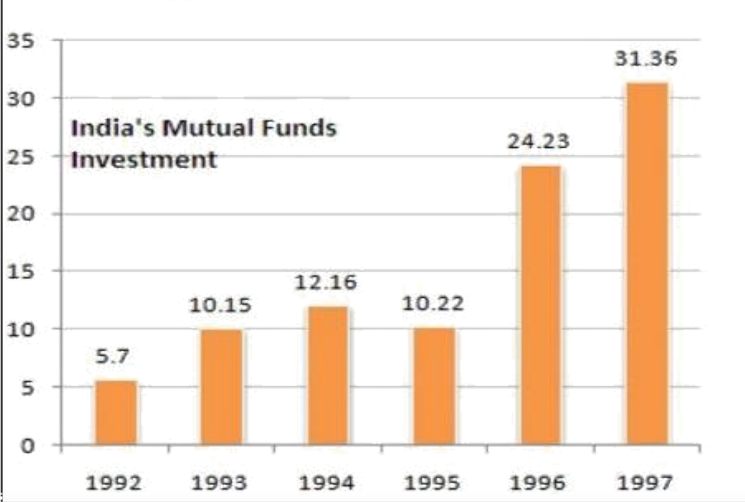
SubQuestion No: 1
What was absolute difference in the mutual funds investments to India in between 1996 and 1997?
To find the absolute difference in mutual funds investments between 1996 and 1997, we need to subtract the investment value of 1996 from that of 1997 as shown in the bar chart.
Correct Option: B) 7.13