
Study the given Venn diagram carefully and answer the question that follows.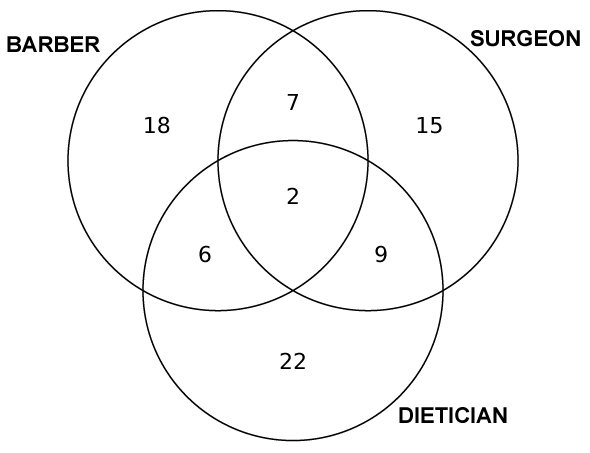
The numbers in different sections indicate the number of persons. How many surgeons are there who are also dieticians but not barbers?
To solve this problem, we need to identify the number of people who are both surgeons and dieticians but not barbers, using the provided Venn diagram.
Correct Option: C) 9
The question asks for the specific feature in MS Word 365 that allows users to customize the appearance of bulleted lists, including selecting different bullet styles, symbols, size, and color. We need to identify the option that directly relates to managing and applying bullet customizations.
Correct Option: C) Bullet Library
The Bullet Library in MS Word provides a gallery of standard bullet styles and also includes the "Define New Bullet" option, which allows users to choose symbols, pictures, or fonts for bullets, and then further customize their size and color. This feature directly addresses all aspects mentioned in the question.
The question asks to identify the correct statements regarding the World Trade Organization (WTO). We need to evaluate each statement based on the objectives, functions, and impact of the WTO, particularly concerning India's role.
D) 1, 2 and 3 — All three statements are accurate descriptions of the WTO's functions, objectives, and India's compliance with its commitments.
This problem involves calculating the percentage increase required to restore an original value after a percentage decrease. We can assume an initial production value and then calculate the decreased production. Finally, we determine the percentage increase needed from the decreased value to reach the original value.
Therefore, the working hours should be increased by approximately 13.64% to restore the original production.
Correct Option: C) 13.64%
To solve this problem, we need to track Mr. U's movements step-by-step on a coordinate plane or by visualizing the directions. We will determine his final position relative to his starting point F and then calculate the shortest distance and direction required to return to F.
Therefore, he should drive 6 km towards the north to reach Point F again.
C) 6 km towards the north
The problem requires us to evaluate a given mathematical expression after interchanging specific operators. We need to replace '+' with '−', '−' with '+', '×' with '÷', and '÷' with '×'. After performing these substitutions, we will solve the new expression following the order of operations (BODMAS/PEMDAS).
A) The final calculated value is \(681\).
The volume (in m3) of a cube, each of whose edges is 25 m, is:
To find the volume of a cube, we need to know the length of one of its edges. The volume of a cube is calculated by cubing the length of its edge.
Correct Option: B) 15,625
To find a number divisible by both 43 and 32, we need to find a number that is a multiple of their product, since 43 and 32 are coprime (their greatest common divisor is 1). Alternatively, we can test each option by dividing it by both 43 and 32.
Correct Option: B) 136224
Which of the options below is equivalent to 216x3 + 343y3 + 756x2y + 882xy2?
The given expression is a polynomial with four terms. We need to identify which of the given options, which are in the form of a cube of a binomial \((a+b)^3\), is equivalent to the given expression. We will use the algebraic identity for \((a+b)^3\).
The identity for the cube of a binomial is:
\[ (a+b)^3 = a^3 + b^3 + 3a^2b + 3ab^2 \]The given expression is \(216x^3 + 343y^3 + 756x^2y + 882xy^2\).
The first two terms are perfect cubes:
This suggests that if the expression is of the form \((a+b)^3\), then \(a\) might be \(6x\) and \(b\) might be \(7y\).
Let's assume \(a = 6x\) and \(b = 7y\). Substitute these into the identity \((a+b)^3 = a^3 + b^3 + 3a^2b + 3ab^2\):
\[ (6x + 7y)^3 = (6x)^3 + (7y)^3 + 3(6x)^2(7y) + 3(6x)(7y)^2 \]So, \((6x + 7y)^3 = 216x^3 + 343y^3 + 756x^2y + 882xy^2\).
This matches the given expression exactly.
Correct Option: C) \((6x + 7y)^3\) — As shown in the step-by-step derivation, expanding \((6x + 7y)^3\) yields the given expression \(216x^3 + 343y^3 + 756x^2y + 882xy^2\).
The problem asks us to identify numbers in a given series that are immediately preceded by a symbol and immediately followed by a symbol. We need to scan the series from left to right and apply this condition to each number.
6 £ & 8 4 * % 7 2 & 2 2 9 £ 1 & € 1 2 6 6 26 £ &: '6' is a number, but it's not preceded by a symbol.£ & 8: '8' is a number, preceded by '&', but followed by '4' (a number). Not a match.& 8 4: '8' is a number, preceded by '&', but followed by '4' (a number). Not a match.8 4 *: '4' is a number, preceded by '8' (a number). Not a match.4 * %: '*' is a symbol, '%' is a symbol. '4' is a number, preceded by '8' (a number). Not a match.* % 7: '%' is a symbol, '7' is a number. '7' is preceded by '%' but followed by '2' (a number). Not a match.% 7 2: '7' is a number, preceded by '%' but followed by '2' (a number). Not a match.7 2 &: '2' is a number, preceded by '7' (a number). Not a match.2 & 2: '2' is a number, immediately preceded by '&' (symbol) and immediately followed by '2' (number). Not a match. (Wait, the second '2' is a number, not a symbol. Let's re-evaluate carefully.)6 £ &: No number in the middle.£ & 8: '8' is preceded by '&' (symbol) but followed by '4' (number). No.& 8 4: '8' is preceded by '&' (symbol) but followed by '4' (number). No.8 4 *: '4' is preceded by '8' (number). No.4 * %: '*' and '%' are symbols. No number in the middle.* % 7: '7' is preceded by '%' (symbol) but followed by '2' (number). No.% 7 2: '7' is preceded by '%' (symbol) but followed by '2' (number). No.7 2 &: '2' is preceded by '7' (number). No.2 & 2: The first '2' is preceded by '7' (number). The second '2' is preceded by '&' (symbol) but followed by '2' (number). No.& 2 2: The first '2' is preceded by '&' (symbol) but followed by '2' (number). No.2 2 9: The first '2' is preceded by '2' (number). The second '2' is preceded by '2' (number). No.2 9 £: '9' is preceded by '2' (number). No.9 £ 1: '1' is preceded by '£' (symbol) and followed by '&' (symbol). This is a match! (1st instance)£ 1 &: '1' is preceded by '£' (symbol) and followed by '&' (symbol). This is the same instance as above.1 & €: '&' and '€' are symbols. No number in the middle.& € 1: '1' is preceded by '€' (symbol) but followed by '2' (number). No.€ 1 2: '1' is preceded by '€' (symbol) but followed by '2' (number). No.1 2 6: '2' is preceded by '1' (number). No.2 6 6: '6' is preceded by '2' (number). No.6 6 2: '6' is preceded by '6' (number). No.£ 1 &).B) 1 — There is only one number (1) that fits the criteria of being immediately preceded by a symbol (£) and immediately followed by a symbol (&).