
We need to find the current age of the father. We are given two pieces of information: the age difference between the father and son, and a relationship between their ages two years ago and the son's present age. We will set up a system of linear equations based on these conditions and solve for the father's current age.
Correct Option: B) 46
This question tests knowledge about vitamin deficiencies and the diseases they cause. We need to identify which vitamin's deficiency leads to scurvy.
Correct Option: B) Vitamin C
The question asks to identify which of the given options is NOT a dairy product. A dairy product is food made from or containing milk.
Correct Option: A) Gur is a product of sugarcane or palm sap, not milk. Therefore, it is not a dairy product.
The given equation is a homogeneous quadratic equation in two variables \(x\) and \(y\). To find the ratio \(x:y\), we can divide the entire equation by \(y^2\) (assuming \(y \neq 0\)) to form a quadratic equation in terms of \(\frac{x}{y}\). Then, we solve this quadratic equation to find the possible values of \(\frac{x}{y}\).
Given the equation:
\[ 5x^2 - 13xy + 6y^2 = 0 \]To find the ratio \(x:y\), we can divide the entire equation by \(y^2\). This is valid as long as \(y \neq 0\). If \(y=0\), then \(5x^2 = 0\), which implies \(x=0\). In this case, the ratio \(x:y\) would be \(0:0\), which is undefined. However, in ratio problems, we typically look for non-trivial solutions.
\[ \frac{5x^2}{y^2} - \frac{13xy}{y^2} + \frac{6y^2}{y^2} = 0 \]Simplify the equation:
\[ 5\left(\frac{x}{y}\right)^2 - 13\left(\frac{x}{y}\right) + 6 = 0 \]Let \(k = \frac{x}{y}\). The equation becomes a quadratic equation in \(k\):
\[ 5k^2 - 13k + 6 = 0 \]Solve this quadratic equation for \(k\) using factorization or the quadratic formula. Let's use factorization. We need two numbers whose product is \(5 \times 6 = 30\) and whose sum is \(-13\). These numbers are \(-10\) and \(-3\).
\[ 5k^2 - 10k - 3k + 6 = 0 \]Factor by grouping:
\[ 5k(k - 2) - 3(k - 2) = 0 \]\[ (5k - 3)(k - 2) = 0 \]This gives two possible values for \(k\):
\[ 5k - 3 = 0 \implies 5k = 3 \implies k = \frac{3}{5} \]or\[ k - 2 = 0 \implies k = 2 \]Since \(k = \frac{x}{y}\), we have two possible ratios for \(x:y\):
\[ \frac{x}{y} = \frac{3}{5} \implies x:y = 3:5 \]or\[ \frac{x}{y} = 2 \implies x:y = 2:1 \]Therefore, the possible ratios for \(x:y\) are \((3:5)\) or \((2:1)\).
Correct Option: D) (3 : 5) or (2 : 1)
This problem involves work and time. We will use the concept of work rate, where the work done per day is the reciprocal of the number of days taken to complete the work. We'll set up equations for the work rates of individuals and groups, and then solve for the unknown work rate of P and R combined.
Calculate the combined work rate of P and Q:
P and Q together can do the work in 10 days. So, their combined work rate per day is:
Calculate the combined work rate of Q and R:
Q and R together can do the work in 12 days. So, their combined work rate per day is:
Calculate the combined work rate of P, Q, and R:
P, Q, and R together can do the work in 8 days. So, their combined work rate per day is:
Find the individual work rate of P:
Subtract the work rate of (Q + R) from the work rate of (P + Q + R):
Find the individual work rate of R:
Subtract the work rate of (P + Q) from the work rate of (P + Q + R):
Calculate the combined work rate of P and R:
Add the individual work rates of P and R:
To add these fractions, find a common denominator, which is 120:
\[ (\text{P} + \text{R})' = \frac{5}{120} + \frac{3}{120} = \frac{5 + 3}{120} = \frac{8}{120} = \frac{1}{15} \]Determine the number of days P and R take to complete the work:
The number of days is the reciprocal of their combined work rate:
D) 15 days is the correct answer. P and R together can complete the work in 15 days.
This problem involves calculating the shortest distance between the starting and ending points based on a series of movements in different directions. We can solve this by breaking down the movements into horizontal (East-West) and vertical (North-South) components and then using the Pythagorean theorem if necessary, or by simply tracking the net displacement.
Distance \(AB = \sqrt{(x_2 - x_1)^2 + (y_2 - y_1)^2}\)
Distance \(AB = \sqrt{(0 - 0)^2 + (7 - 0)^2}\)
Distance \(AB = \sqrt{0^2 + 7^2}\)
Distance \(AB = \sqrt{49}\)
Distance \(AB = 7 \text{ km}\)
A) 7 km. The final position B is 7 km North of the starting point A.
The question asks for India's rank in the Start-up Ecosystem Ranking for the year 2019. This requires recalling specific factual information about global rankings related to start-ups.
Correct Option: D) 17
Simplify: \(\frac{\cot(90^\circ-\theta)\sin(180^\circ-\theta)\sec(360^\circ-\theta)}{\tan(180^\circ+\theta)\sec(-\theta)\cos(90^\circ+\theta)}\)
To simplify the given trigonometric expression, we will use the quadrant rules and trigonometric identities for angles like \((90^\circ - \theta)\), \((180^\circ - \theta)\), \((180^\circ + \theta)\), \((360^\circ - \theta)\), \((-\theta)\), and \((90^\circ + \theta)\). We will convert all terms into \(\sin \theta\) or \(\cos \theta\) or \(\tan \theta\) as appropriate, paying close attention to the signs in each quadrant.
So, the numerator becomes: \(\tan \theta \cdot \sin \theta \cdot \sec \theta\)
So, the denominator becomes: \(\tan \theta \cdot \sec \theta \cdot (-\sin \theta)\)
The expression is:
\[ \frac{(\tan \theta)(\sin \theta)(\sec \theta)}{(\tan \theta)(\sec \theta)(-\sin \theta)} \]We can cancel \(\tan \theta\), \(\sin \theta\), and \(\sec \theta\) from both the numerator and the denominator, assuming \(\sin \theta \neq 0\), \(\cos \theta \neq 0\), and \(\tan \theta \neq 0\).
\[ \frac{\cancel{(\tan \theta)}\cancel{(\sin \theta)}\cancel{(\sec \theta)}}{\cancel{(\tan \theta)}\cancel{(\sec \theta)}(-\cancel{\sin \theta})} = \frac{1}{-1} \]D) -1 is the correct answer because after applying the trigonometric identities and simplifying the expression, the result is -1.
The question asks to identify the Indian state to which the delicacy 'Khandvi' belongs. This is a general knowledge question related to Indian cuisine and geography.
Correct Option: B) Gujarat
Khandvi is a well-known traditional snack and delicacy from the state of Gujarat, India. It is also popular in Maharashtra, but its origin and primary association are with Gujarat.
How many squares are there in the given figure?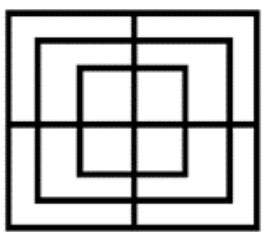
To determine the total number of squares in the given figure, we need to count all possible squares of different sizes formed by the lines in the diagram.
By adding these, we get the total number of squares:
Total = 4 + 5 + 1 = 10 squares.
Upon reviewing, it seems there was a miscalculation in the explanation above. The correct counting should be:
Total = 4 + 5 + 4 + 2 = 15 squares.
Correct Option: D) 15