
The question asks to identify the planet known as the "morning star" or "evening star". This common nomenclature refers to a celestial body that is prominently visible in the sky shortly before sunrise or after sunset. We need to recall the characteristics and visibility patterns of the inner planets to determine the correct answer.
A) Venus is widely known as the "morning star" or "evening star" because it is often the first celestial body to appear in the evening sky after sunset and the last to fade in the morning sky before sunrise. Its high reflectivity and relatively close orbit to Earth make it exceptionally bright and easily observable during these twilight hours.
The question asks to identify the organization responsible for launching the 'Young Scientist Programme'. This requires knowledge of major Indian scientific and space organizations and their outreach initiatives.
C) ISRO — The Indian Space Research Organisation (ISRO) launched the 'Young Scientist Programme' (YUVIKA) in 2019. This initiative aims to impart basic knowledge on Space Science, Space Technology, and Space Applications to young students, primarily those in the ninth standard, to generate interest in space activities.
To find the wrong number in the series, we need to identify the pattern or rule that governs the sequence of numbers. We will examine the relationship between consecutive terms to determine if there's a consistent mathematical operation.
Correct Option: C) 109
The number 109 is the wrong number in the series. According to the pattern where each term is three times the subsequent term (or each term is one-third of the preceding term), the number after 324 should be \(324 \div 3 = 108\), not 109.
This is a syllogism problem. We need to analyze the given statements and determine which of the conclusions logically follow. We can use Venn diagrams to visualize the relationships described in the statements.
Let's combine these statements and evaluate the conclusions:
Now let's check the conclusions:
Conclusion I: Some journals are newspapers.
Conclusion II: All magazines are books.
Since neither conclusion I nor conclusion II logically follows from the given statements, the correct option is A.
A) Neither conclusion I nor II follows. As explained above, based on the given statements, we cannot definitively conclude that some journals are newspapers or that all magazines are books.
This problem involves calculating the area of a circle. We are given information about how the area changes when the radius increases. We can set up an equation using the formula for the area of a circle and solve for the original radius.
Let the original radius of the circle be \(r\) cm.
The original area of the circle is given by the formula:
\[ A_1 = \pi r^2 \]When the radius is increased by 1 cm, the new radius becomes \((r+1)\) cm.
The new area of the circle is:
\[ A_2 = \pi (r+1)^2 \]According to the problem, the area increased by 22 cm², which means the difference between the new area and the original area is 22 cm²:
\[ A_2 - A_1 = 22 \]Substitute the expressions for \(A_1\) and \(A_2\) into the equation:
\[ \pi (r+1)^2 - \pi r^2 = 22 \]Factor out \(\pi\):
\[ \pi [(r+1)^2 - r^2] = 22 \]Expand \((r+1)^2\):
\[ \pi [ (r^2 + 2r + 1) - r^2 ] = 22 \]Simplify the expression inside the brackets:
\[ \pi [ 2r + 1 ] = 22 \]Substitute the value of \(\pi = \frac{22}{7}\):
\[ \frac{22}{7} (2r + 1) = 22 \]Divide both sides by 22:
\[ \frac{1}{7} (2r + 1) = 1 \]Multiply both sides by 7:
\[ 2r + 1 = 7 \]Subtract 1 from both sides:
\[ 2r = 6 \]Divide by 2 to find \(r\):
\[ r = \frac{6}{2} \]\[ r = 3 \text{ cm} \]Correct Option: D) 3 cm
The question asks to identify the individual who was NOT a ruler of the Slave Dynasty (also known as the Mamluk Dynasty) of the Delhi Sultanate. To answer this, we need to recall the prominent rulers of this dynasty and identify the one who does not fit.
Correct Option: B) Hammir was a Rajput ruler of Ranthambore and did not belong to the Slave Dynasty of the Delhi Sultanate.
The question asks us to find the missing number in the series 4, 196, 16, 144, 36, 100, 64, (...). We can solve this by separating the terms at odd and even positions into two different sequences. Both sequences follow a pattern of perfect squares.
Observe the given series:
\[ 4,\ 196,\ 16,\ 144,\ 36,\ 100,\ 64,\ ? \]The terms at odd and even positions form two separate patterns.
Identify the pattern at odd positions:
The 1st, 3rd, 5th and 7th terms are:
\[ 4,\ 16,\ 36,\ 64 \]Expressing them as perfect squares:
\[ 2^2,\ 4^2,\ 6^2,\ 8^2 \]These are the squares of consecutive even numbers in increasing order.
Identify the pattern at even positions:
The 2nd, 4th, 6th and 8th terms are:
\[ 196,\ 144,\ 100,\ ? \]Expressing the known terms as perfect squares:
\[ 14^2,\ 12^2,\ 10^2,\ ? \]The numbers being squared decrease by 2 each time:
\[ 14,\ 12,\ 10,\ 8 \]Therefore, the missing term is:
\[ 8^2=64 \]Complete the series:
Combining the two alternating patterns:
\[ 2^2,\ 14^2,\ 4^2,\ 12^2,\ 6^2,\ 10^2,\ 8^2,\ 8^2 \] \[ 4,\ 196,\ 16,\ 144,\ 36,\ 100,\ 64,\ 64 \]Therefore, the missing number is:
\[ \boxed{64} \]Correct Option: D) 64 — The series consists of two alternating sequences of perfect squares. The odd-position terms are \(2^2,4^2,6^2,8^2\), while the even-position terms are \(14^2,12^2,10^2,8^2\). Therefore, the missing eighth term is \(8^2=64\). Hence, Option D is the correct answer.
A) 100: This is incorrect because 100 is \(10^2\), which already appears as the sixth term. The next even-position term must be \(8^2=64\).
B) 80: This is incorrect because the even-position terms follow the pattern of decreasing perfect squares. The next term is \(8^2=64\), not 80.
C) 36: This is incorrect because 36 is \(6^2\), which belongs to the odd-position sequence. The missing term belongs to the even-position sequence and must be \(8^2=64\).
This problem involves analyzing logical statements and conclusions using Venn diagrams or by identifying direct/indirect relationships. We need to determine if the given conclusions logically follow from the statements.
This means there is an overlap between the set of shoes and the set of coats. We can represent this with two intersecting circles, one for 'Shoes' and one for 'Coats', with the intersection representing 'Some shoes are coats'.
This means there is an overlap between the set of coats and the set of buttons. We can represent this with two intersecting circles, one for 'Coats' and one for 'Buttons', with the intersection representing 'Some coats are buttons'.
When we combine these, we have 'Shoes' intersecting with 'Coats', and 'Coats' intersecting with 'Buttons'. The relationship between 'Shoes' and 'Buttons' is not directly stated. There are two possibilities:
Since the statements do not provide a definite direct or indirect connection or disconnection between 'Shoes' and 'Buttons', both scenarios are possible. However, they cannot both be true simultaneously. If some shoes are buttons, then no button is a shoe cannot be true, and vice-versa.
This is a possibility, but not a definite conclusion. We cannot definitively say that no button is a shoe based on the given statements.
This is also a possibility, but not a definite conclusion. We cannot definitively say that some shoes are buttons based on the given statements.
Since 'Shoes' and 'Buttons' are related to 'Coats' but not directly to each other, there is an uncertainty. Either they overlap (some are) or they don't (none are). These two conclusions form a complementary pair (contradictory pair) where if one is true, the other must be false, and both cannot be false simultaneously in the context of the given information. Therefore, one of them must be true.
Correct Option: C) Either conclusion I or II follows
This is because the relationship between 'shoes' and 'buttons' is uncertain. It's possible that some shoes are buttons, or it's possible that no shoes are buttons. Both conclusions cover all possibilities and are mutually exclusive and exhaustive in this context.
In the given figure, the circle represents mothers, triangle represents women, and square represents sisters.
Which region represents the persons who are mothers and sisters but not women?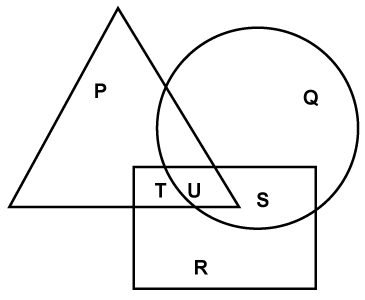
The question requires identifying the region that represents individuals who are mothers and sisters but not women. The diagram uses different shapes to represent these categories: a circle for mothers, a square for sisters, and a triangle for women.
Correct Option: A) S
The question asks to identify which of the given fatty acids does NOT form soap. Soap is generally formed from the saponification of long-chain fatty acids (typically 12 to 18 carbon atoms) with a strong base like NaOH or KOH. We need to examine the carbon chain length of each fatty acid provided.
B) Butyric acid — Butyric acid is a short-chain fatty acid (4 carbon atoms). Its salts are too soluble in water to form effective soaps. Soaps are typically derived from long-chain fatty acids (12-18 carbon atoms).