The problem asks for the Highest Common Factor (HCF) of two co-prime numbers whose product is 117. We need to understand the definition of co-prime numbers and the relationship between HCF, LCM, and the product of two numbers.
Correct Option: A) 1 is the correct answer because co-prime numbers, by definition, have an HCF of 1.
This problem involves understanding relative directions and turns. We need to determine Ravi's initial facing direction relative to Ram, and then apply the left turn to find his final facing direction.
A) South is the correct direction Ravi is facing after taking a left turn from West.
This is a circular seating arrangement puzzle. We need to deduce the positions of eight people (A, B, C, D, E, F, G, H) sitting around a circle facing the center based on the given clues. We will place individuals one by one using the clues and then determine the person to the immediate right of H.
Let's combine the clues and draw the arrangement:
Initial placement from Clue 1:
  _   _   _
 H       B
  _   F   _
Let's number the seats 1 to 8 clockwise, starting with F at 1:
1. F
2. _
3. _
4. B (3rd right of F)
5. _
6. _
7. H (3rd left of B, or 3rd right of B)
8. _
Now, let's use Clue 3: "A is not an immediate neighbour of F and B."
A cannot be at position 2, 8 (neighbours of F).
A cannot be at position 3, 5 (neighbours of B).
So, A must be at position 6. (The only remaining position not adjacent to F or B).
Now we have:
1. F
2. _
3. _
4. B
5. _
6. A
7. H
8. _
Now use Clue 2: "C is fourth to the left of A."
If A is at 6, then 1st left is 5, 2nd left is 4, 3rd left is 3, 4th left is 2. So, C is at position 2.
Current arrangement:
1. F
2. C
3. _
4. B
5. _
6. A
7. H
8. _
Now use Clue 4: "E is not an immediate neighbour of B."
B is at position 4. Its neighbours are 3 and 5. So E cannot be at 3 or 5.
The remaining empty positions are 3, 5, 8. Since E cannot be at 3 or 5, E must be at position 8.
Current arrangement:
1. F
2. C
3. _
4. B
5. _
6. A
7. H
8. E
The remaining empty positions are 3 and 5. The remaining people are D and G.
Now use Clue 5: "G is second to the right of D."
If D is at position 3, then 1st right is 4 (B), 2nd right is 5. So G must be at position 5.
This fits perfectly.
Final arrangement (clockwise):
1. F
2. C
3. D
4. B
5. G
6. A
7. H
8. E
The question asks: "Who is to the immediate right of H?"
Looking at the final arrangement, H is at position 7. The person immediately to its right (clockwise) is at position 8, which is E.
Correct Option: B) E
The question asks to identify the specific term for the volume of air exchanged during normal, quiet breathing. This requires knowledge of respiratory volumes and capacities.
D) Tidal volume is the volume of air inspired or expired during a normal, quiet respiratory cycle. This precisely matches the description in the question.
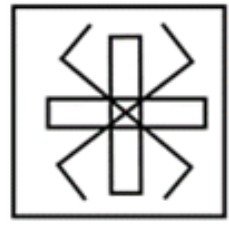
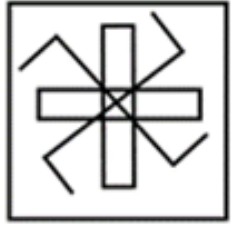
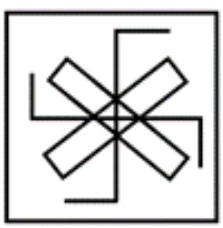
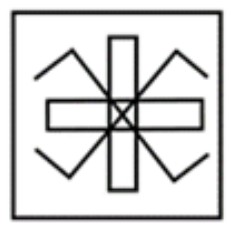
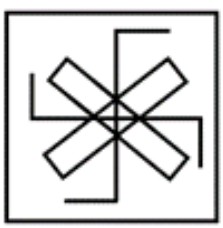
Find the ODD one out from the given options.
To find the odd one out, we need to identify the pattern or symmetry in the diagrams and see which one differs from the others.
Correct Option: C) The diagram in Option C breaks the symmetry pattern found in the other options.
The problem states that the given expression is a perfect square. This implies that it can be written in the form of \((a+b)^2 = a^2 + 2ab + b^2\) or \((a-b)^2 = a^2 - 2ab + b^2\). We need to identify the values of 'a' and 'b' from the given expression and then determine 'K' by comparing it with the middle term \(2ab\).
The given expression is:
\[ 10.98 \times 10.98 + 10.98K + 0.02 \times 0.02 \]We can rewrite this expression as:
\[ (10.98)^2 + 10.98K + (0.02)^2 \]For this expression to be a perfect square, it must match the form \((a+b)^2 = a^2 + 2ab + b^2\).
By comparing the given expression with the identity, we can identify:
The middle term in the perfect square expansion is \(2ab\). Comparing this with the middle term in the given expression, \(10.98K\), we get:
\[ 10.98K = 2ab \]Substitute the values of 'a' and 'b' into the equation:
\[ 10.98K = 2 \times 10.98 \times 0.02 \]Now, solve for 'K':
\[ K = \frac{2 \times 10.98 \times 0.02}{10.98} \]Cancel out \(10.98\) from the numerator and denominator:
\[ K = 2 \times 0.02 \]Calculate the value of 'K':
\[ K = 0.04 \]Correct Option: B) 0.04
How many triangles are there in the given figure?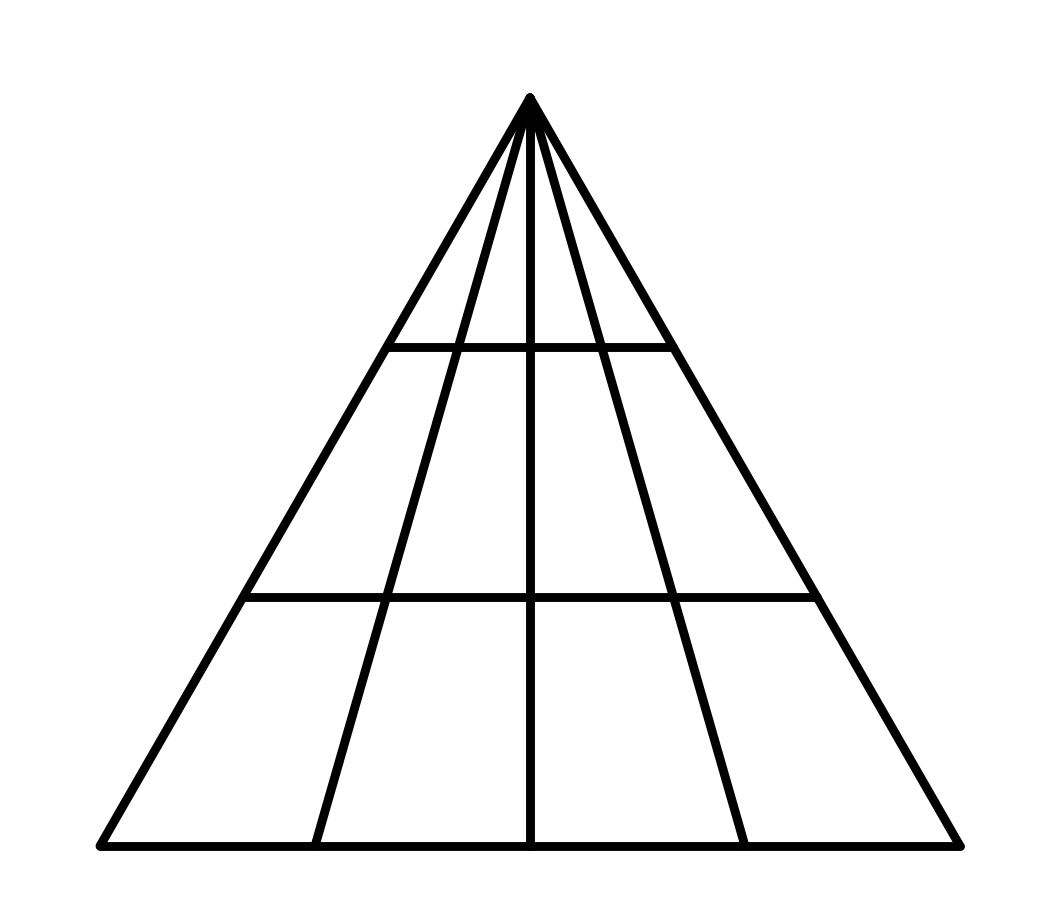
To determine the total number of triangles in the given figure, we need to systematically count all possible triangles, considering different combinations of lines and intersections.
Upon careful counting, the total number of triangles is found to be 30.
Correct Option: C) 30
The problem asks us to identify the odd one out from the given options. Each option consists of three letters. We need to find a pattern or rule that applies to most options and identify the one that does not follow that rule.
D) HTI is the odd one out. For options A, B, and C, the pattern is: (Numerical value of 1st letter) + (Numerical value of 3rd letter) + 1 = (Numerical value of 2nd letter).
To find the odd one out, we need to identify a common pattern or property among three of the given numbers and then find the number that does not fit this pattern.
Correct Option: C) 290
The relationship between the radius of curvature and the focal length of a spherical mirror (convex or concave) is a fundamental concept in optics. The focal length is always half the radius of curvature.
Correct Option: D) 12 cm