
The question asks about the term of office for the Governor of an Indian state. This is a direct question based on the provisions of the Indian Constitution.
A) Five years — As per Article 156(3) of the Indian Constitution, the Governor holds office for a term of five years from the date of assuming office.
The given series is a numerical sequence. To complete the series, we need to identify the pattern or rule that governs the progression of numbers. We will examine the relationship between consecutive terms to find this rule.
Correct Option: C) 2672
The question asks about the common transport form of sugar in plants. This involves understanding how sugars are synthesized and moved throughout the plant body.
Correct Option: D) Sucrose is the most common form of sugar transported in plants. Its non-reducing nature makes it stable and less reactive during long-distance transport in the phloem.
The question asks to identify which of the given options is rich in Vitamin A. This requires knowledge of common food sources for Vitamin A.
Correct Option: B) Carrot
Choose the alternative that best replaces the question mark(?) in the given figure.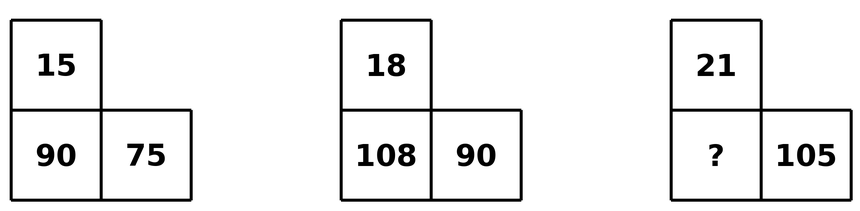
The problem involves identifying a pattern in the given figures to determine the missing number. Each figure consists of three numbers, and we need to find the relationship between these numbers to solve for the missing value.
Correct Option: B) 126
A 2 m broad pathway is to be constructed around a rectangular plot on the inside. The area of the plot is 96 m². The rate of construction is Rs.50 per m². Find the total cost of the construction.
To find the total cost of construction, we need to determine the area of the pathway. The area of the pathway is the difference between the area of the rectangular plot and the area of the inner rectangle (excluding the pathway). However, the dimensions of the rectangular plot are not fully provided, making it impossible to calculate the exact area of the pathway.
Correct Option: A) Data Inadequate
To solve this problem, we need to find a common ratio for all three numbers. We are given two separate ratios: the first to the second, and the second to the third. We will combine these ratios to find the ratio of the first, second, and third numbers. Once we have the combined ratio, we can represent the numbers as multiples of a common factor and use their sum to find the value of that factor, and subsequently, the second number.
Identify the given ratios:
Make the common term (second number) equal in both ratios:
The second number in the first ratio is 9, and in the second ratio, it is 3. To combine these, we need to find the least common multiple (LCM) of 9 and 3, which is 9.
Combine the ratios:
Now we have:
So, the combined ratio of the three numbers is \(1^{\text{st}} : 2^{\text{nd}} : 3^{\text{rd}} = 4 : 9 : 12\).
Represent the numbers using a common factor:
Let the three numbers be \(4x\), \(9x\), and \(12x\), where \(x\) is a common factor.
Use the sum of the numbers to find \(x\):
The sum of the three numbers is given as 100.\[ 4x + 9x + 12x = 100 \]\[ (4 + 9 + 12)x = 100 \]\[ 25x = 100 \]\[ x = \frac{100}{25} \]\[ x = 4 \]
Calculate the second number:
The second number is \(9x\). Substitute the value of \(x\):\[ \text{Second number} = 9 \times 4 = 36 \]
A) The second number is 36, which matches our calculation.
In a right triangle, the sides are in the ratio 1 : 1 : \(\sqrt{2}\).
Find cos A cos B - sin A sin B.
The problem asks us to find the value of \( \cos A \cos B - \sin A \sin B \) for a right triangle where the sides are in the ratio \( 1 : 1 : \sqrt{2} \). This expression is a trigonometric identity for \( \cos(A+B) \). We need to identify the angles A and B based on the given side ratio.
Identify the type of right triangle: The sides of the right triangle are in the ratio \( 1 : 1 : \sqrt{2} \). Let the sides be \( x, x, \text{and } x\sqrt{2} \). In a right triangle, the longest side is the hypotenuse. So, the hypotenuse is \( x\sqrt{2} \) and the other two sides (legs) are \( x \) each. This means the two legs are equal in length.
Determine the angles: A right triangle with two equal legs is an isosceles right triangle. The angles opposite to the equal sides must be equal. Since one angle is \( 90^\circ \) (it's a right triangle), the sum of the other two angles is \( 180^\circ - 90^\circ = 90^\circ \). If these two angles are equal, then each of them must be \( \frac{90^\circ}{2} = 45^\circ \).
Assign angles A and B: Let the two acute angles of the right triangle be A and B. From the previous step, we know that \( A = 45^\circ \) and \( B = 45^\circ \).
Evaluate the expression: We need to find \( \cos A \cos B - \sin A \sin B \). Substitute the values of A and B:
Recall the trigonometric values for \( 45^\circ \):
Substitute these values into the expression:
Alternatively, recognize the identity: The expression \( \cos A \cos B - \sin A \sin B \) is the expansion of \( \cos(A+B) \). Since \( A = 45^\circ \) and \( B = 45^\circ \), then \( A+B = 45^\circ + 45^\circ = 90^\circ \).
We know that \( \cos(90^\circ) = 0 \).
B) The value of the expression is 0.
Simplify: \(\sqrt{0.01+\sqrt{0.0225}}\)
To simplify the given expression, we need to evaluate the square roots from the innermost one outwards. First, calculate the square root of 0.0225, then add it to 0.01, and finally, take the square root of the resulting sum.
We need to find \(\sqrt{0.0225}\).
First, convert the decimal to a fraction:
\[ 0.0225 = \frac{225}{10000} \]Now, take the square root:
\[ \sqrt{0.0225} = \sqrt{\frac{225}{10000}} = \frac{\sqrt{225}}{\sqrt{10000}} \]We know that \(\sqrt{225} = 15\) and \(\sqrt{10000} = 100\).
So,
\[ \sqrt{0.0225} = \frac{15}{100} = 0.15 \]The expression becomes:
\[ \sqrt{0.01 + 0.15} \]Now we need to find \(\sqrt{0.16}\).
Convert the decimal to a fraction:
\[ 0.16 = \frac{16}{100} \]Take the square root:
\[ \sqrt{0.16} = \sqrt{\frac{16}{100}} = \frac{\sqrt{16}}{\sqrt{100}} \]We know that \(\sqrt{16} = 4\) and \(\sqrt{100} = 10\).
So,
\[ \sqrt{0.16} = \frac{4}{10} = 0.4 \]A) 0.4 is the correct simplification of the given expression.
The Simple Interest after 10 years at some rate will be Rs.600 on a certain sum. If the principal is trebled after 5 years, what will be the total interest at the end of tenth year?
The problem involves calculating simple interest under changing principal conditions. We will first determine the annual simple interest based on the initial information. Then, we will calculate the interest for the first 5 years. After 5 years, the principal is trebled, so we will calculate the interest for the remaining 5 years with the new principal and sum up the interests from both periods.
A) Rs.1,200 is the correct answer. The total interest accumulated over 10 years, with the principal trebled after 5 years, is Rs. 1,200.