
To find the current flowing in a circuit, we need to use the fundamental definition of electric current, which relates the amount of charge passing through a point to the time taken for that charge to pass. The formula for current is charge divided by time.
Electric current (\(I\)) is defined as the rate of flow of electric charge. Mathematically, it is given by:
\[ I = \frac{Q}{t} \]where \(I\) is current in Amperes (A), \(Q\) is charge in Coulombs (C), and \(t\) is time in seconds (s).
Correct Option: A) 20 Ampere
The calculation shows that when 20 Coulombs of charge pass in 1 second, the current is 20 Amperes.
This problem can be solved by calculating the work done by each pipe per minute (their filling rates). First, find the combined work done by both pipes in the initial 10 minutes. Then, determine the remaining work and the time taken by the sole working pipe to complete it.
Calculate the filling rate of each pipe:
Calculate the combined filling rate of P and Q:
When both pipes are open, their combined filling rate per minute is:
\[ \text{Rate}_{P+Q} = \frac{1}{40} + \frac{1}{30} = \frac{3 + 4}{120} = \frac{7}{120} \text{ tanks/minute} \]Calculate the amount of tank filled in the first 10 minutes:
Both pipes work together for 10 minutes. The fraction of the tank filled in 10 minutes is:
\[ \text{Filled in 10 min} = \text{Rate}_{P+Q} \times 10 = \frac{7}{120} \times 10 = \frac{7}{12} \text{ of the tank} \]Calculate the remaining amount of tank to be filled:
The total capacity of the tank is 1. So, the remaining fraction is:
\[ \text{Remaining capacity} = 1 - \frac{7}{12} = \frac{12 - 7}{12} = \frac{5}{12} \text{ of the tank} \]Calculate the time taken by pipe P to fill the remaining tank:
After 10 minutes, pipe Q is closed, and only pipe P continues to fill the tank. Pipe P's rate is \(\frac{1}{40}\) tank/minute. The time taken to fill the remaining \(\frac{5}{12}\) of the tank is:
\[ \text{Time} = \frac{\text{Remaining capacity}}{\text{Rate}_P} = \frac{\frac{5}{12}}{\frac{1}{40}} = \frac{5}{12} \times 40 = \frac{200}{12} = \frac{50}{3} \text{ minutes} \]Convert the time into minutes and seconds:
\[ \frac{50}{3} \text{ minutes} = 16 \frac{2}{3} \text{ minutes} \]To convert \(\frac{2}{3}\) minutes to seconds:
\[ \frac{2}{3} \times 60 \text{ seconds} = 40 \text{ seconds} \]So, the remaining time is 16 minutes and 40 seconds.
Correct Option: A) 16 minutes 40 seconds
This question tests general knowledge about prominent Indian sports personalities. To answer correctly, one needs to identify the sport associated with Manpreet Singh.
Correct Option: C) Hockey
The question asks for the total number of members nominated by the President to both the Lok Sabha and the Rajya Sabha as of 2019. This requires knowledge of the constitutional provisions regarding presidential nominations to both houses of the Indian Parliament.
Correct Option: C) 14
The question asks to identify the space agency responsible for the discovery of the exoplanet HD 21749b using the Transiting Exoplanet Survey Satellite (TESS) in 2019. This requires knowledge of major space agencies and their missions.
Correct Option: A) NASA
To find the area of cardboard required to make a box, we need to calculate the total surface area of the box. A box is a cuboid, and its dimensions are given as length, width, and height. The formula for the total surface area of a cuboid will be used.
Identify the dimensions of the box:
Given, length \(l = 10 \text{ cm}\)
Width \(w = 8 \text{ cm}\)
Height \(h = 4 \text{ cm}\)
Recall the formula for the total surface area of a cuboid:
The total surface area (\(TSA\)) of a cuboid is given by:
\[ TSA = 2(lw + wh + hl) \]Substitute the given dimensions into the formula:
\[ TSA = 2((10 \text{ cm} \times 8 \text{ cm}) + (8 \text{ cm} \times 4 \text{ cm}) + (4 \text{ cm} \times 10 \text{ cm})) \]Calculate the area of each pair of faces:
Area of top and bottom faces: \(10 \text{ cm} \times 8 \text{ cm} = 80 \text{ cm}^2\)
Area of front and back faces: \(8 \text{ cm} \times 4 \text{ cm} = 32 \text{ cm}^2\)
Area of side faces: \(4 \text{ cm} \times 10 \text{ cm} = 40 \text{ cm}^2\)
Sum these areas and multiply by 2:
\[ TSA = 2(80 \text{ cm}^2 + 32 \text{ cm}^2 + 40 \text{ cm}^2) \]\[ TSA = 2(152 \text{ cm}^2) \]\[ TSA = 304 \text{ cm}^2 \]Therefore, the area of the cardboard required is \(304 \text{ cm}^2\).
Correct Option: C) 304 cm²
This problem involves calculating the original cost of production by working backward from the retail price, considering successive percentage gains at each stage of the supply chain (manufacturer, wholesale dealer, and retailer).
The retail price is the cost for the customer, which includes the retailer's 25% gain. So, if \(P_R\) is the retail price and \(P_W\) is the price at which the retailer bought it from the wholesale dealer:
\[ P_R = P_W + 25\% \text{ of } P_W = P_W \left(1 + \frac{25}{100}\right) = P_W \left(\frac{125}{100}\right) \]\[ 1265 = P_W \times 1.25 \]\[ P_W = \frac{1265}{1.25} = 1012 \]Now, \(P_W\) (Rs. 1012) is the price at which the wholesale dealer sold the table, which includes the wholesale dealer's 15% gain. If \(P_M\) is the price at which the wholesale dealer bought it from the manufacturer:
\[ P_W = P_M + 15\% \text{ of } P_M = P_M \left(1 + \frac{15}{100}\right) = P_M \left(\frac{115}{100}\right) \]\[ 1012 = P_M \times 1.15 \]\[ P_M = \frac{1012}{1.15} = 880 \]Finally, \(P_M\) (Rs. 880) is the price at which the manufacturer sold the table, which includes the manufacturer's 10% gain. This price is based on the cost of production \(C_p\):
\[ P_M = C_p + 10\% \text{ of } C_p = C_p \left(1 + \frac{10}{100}\right) = C_p \left(\frac{110}{100}\right) \]\[ 880 = C_p \times 1.10 \]\[ C_p = \frac{880}{1.10} = 800 \]Thus, the cost of production of the table was Rs. 800.
A) Rs.800 is the correct cost of production calculated by working backward through the profit margins of the retailer, wholesale dealer, and manufacturer.
The question asks to identify a metalloid from the given options. To answer this, one needs to know the definition of metalloids and common examples of elements that fall into this category.
Correct Option: C) Germanium
This is a coding-decoding problem where we need to find the codes for individual words by comparing the given phrases and their coded forms. We will identify common words and their corresponding codes across different statements to deduce the code for 'new' and 'car'.
Compare Statement 1 ('gri chri' = 'brand new') and Statement 3 ('gri bur twoh' = 'old and new').
The common word is 'new'. The common code is 'gri'.
Therefore, 'new' = 'gri'.
First, let's find the code for 'old' and 'brand'.
Now, look at Statement 4: 'chri deh twoh' means 'old brand car'.
We know 'chri' = 'brand' and 'twoh' = 'old'.
So, 'deh' must be the code for 'car'.
Therefore, 'car' = 'deh'.
Since 'new' = 'gri' and 'car' = 'deh', the code for 'new car' is 'gri deh'.
Correct Option: D) gri deh — Based on our step-by-step deduction, 'new' is coded as 'gri' and 'car' is coded as 'deh'. Therefore, 'new car' is 'gri deh'.
How many triangles are there in the given figure? 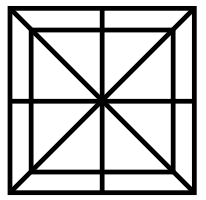
To find the number of triangles in the given figure, we need to systematically identify and count all possible triangles, including small, medium, and large ones formed by intersecting lines.
Correct Option: A) 32