The question asks for the number of gold medals won by India in the Special Olympics World Games 2019. This requires recalling specific factual information about India's performance in that event.
Therefore, the number of gold medals won by India was 85.
A) 85 — India won 85 gold medals at the Special Olympics World Games 2019 in Abu Dhabi.
To solve this problem, we need to use the formula for Simple Interest (SI). The problem states that a certain sum of money doubles itself. This means the Amount (A) will be twice the Principal (P). The Simple Interest accrued will therefore be equal to the Principal. We are given the rate of interest (R) and need to find the time (T) in years.
D) 20 — As calculated, the time required for the sum to double at 5% simple interest is 20 years.
To find the biggest measure that can exactly measure given quantities, we need to find the Highest Common Factor (HCF) of those quantities. In this case, we need to find the HCF of 36 litres, 45 litres, and 72 litres.
A) 9 litres — The HCF of 36, 45, and 72 is 9. This means a 9-litre measure can exactly measure 36 litres (4 times), 45 litres (5 times), and 72 litres (8 times).
This is a syllogism question. We need to evaluate the given conclusions based on the provided statements. We can use Venn diagrams to visualize the relationships between the categories (books, cars, boxes) and determine if the conclusions logically follow.
This means there is an overlap between the category of "books" and the category of "cars". We can represent this with two intersecting circles.
This means there is an overlap between the category of "cars" and the category of "boxes". We can represent this with two intersecting circles, where the "cars" circle also intersects with the "boxes" circle.
From the statements, we know that some books are cars, and some cars are boxes. However, this does not necessarily mean that some books are boxes. The overlap between "books" and "cars" might be entirely separate from the overlap between "cars" and "boxes". There is no direct or guaranteed connection established between "books" and "boxes".
Consider a scenario: If 10 books are cars, and 10 cars are boxes, it's possible that the cars that are books are not the same cars that are boxes. Therefore, we cannot conclude that some books are boxes.
The statement is "Some cars are boxes". This means only a part of the "cars" category is "boxes", or a part of the "boxes" category is "cars". It does not imply that *all* boxes are cars. For example, if there are 100 cars and 20 of them are boxes, it's true that some cars are boxes. But if there are 30 boxes in total, and only 20 of them are cars, then not all boxes are cars. The statement "Some cars are boxes" is a particular affirmative statement, and it cannot be converted into a universal affirmative statement like "All boxes are cars" without additional information.
Since neither conclusion I nor conclusion II can be logically derived from the given statements, both conclusions do not follow.
Correct Option: D) Neither conclusion I nor II follows
This problem involves setting up and solving a system of linear equations based on the given age relationships. We will define variables for the ages of the father, mother, and son, and then use the information provided to form equations. Finally, we will solve for the father's age.
Let's denote the current ages as follows:
From the first statement, "Sum of ages of father and son is 8 years more than the age of mother", we can write the equation:
\[ F + S = M + 8 \quad \text{(Equation 1)} \]From the second statement, "Son was born when the mother was 22 years", this means the mother is 22 years older than the son. So, the difference between their ages is 22 years.
\[ M - S = 22 \quad \text{(Equation 2)} \]We need to find the father's age, \(F\). We can use Equation 2 to express \(M\) in terms of \(S\):
\[ M = S + 22 \]Now, substitute this expression for \(M\) into Equation 1:
\[ F + S = (S + 22) + 8 \]Simplify the equation:
\[ F + S = S + 30 \]Subtract \(S\) from both sides of the equation:
\[ F = 30 \]Therefore, the father's age is 30 years.
D) 30 years is the correct answer, as calculated from the given conditions.
A) 36 years — This would be incorrect. If the father was 36, then \(36 + S = M + 8\). With \(M = S + 22\), we get \(36 + S = (S + 22) + 8\), which simplifies to \(36 + S = S + 30\), leading to \(36 = 30\), which is false.
B) 40 years — This is also incorrect. Following the same logic as above, \(40 + S = (S + 22) + 8\), which simplifies to \(40 + S = S + 30\), leading to \(40 = 30\), which is false.
C) 38 years — This is incorrect. If the father was 38, then \(38 + S = (S + 22) + 8\), which simplifies to \(38 + S = S + 30\), leading to \(38 = 30\), which is false.
In the given figure, the circle represents graduate, triangle represents working people, and square represents post graduate. Which region represents graduate and post graduate but not working people?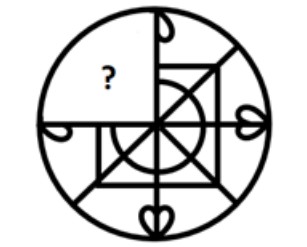
To solve this problem, we need to identify the region that represents graduates and postgraduates but excludes working people. This involves understanding the overlap and exclusion of the shapes in the diagram.
Correct Option: C) This region is the intersection of the circle and square, excluding the triangle.
Choose from the alternatives the figure that best completes the pattern given below.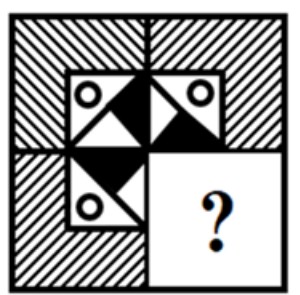
To solve the problem, we need to identify the pattern in the given diagram and choose the option that best completes it. The pattern involves analyzing the orientation and placement of shapes within the squares.
Correct Option: C) The triangle points to the top-left and the circle is near the bottom-right corner, completing the pattern correctly.
Simplify: \(\left(1+\frac{1}{10+\frac{1}{10}}\right)+\left(1-\frac{1}{10+\frac{1}{10}}\right)\)
\( \frac{91}{101} \)
2
\( \frac{3}{10} \)
\( \frac{101}{10} \)
The problem asks us to simplify an expression involving fractions. We can simplify the common fractional part first, or recognize the expression as a sum of the form \((1+x) + (1-x)\) which simplifies to \(2\).
B) The simplified value of the expression is \(2\).
The question asks about the characteristic thickness of simple epithelium. We need to recall the basic definition and structure of simple epithelial tissues.
Correct Option: C) One cell thick
Simple epithelium is characterized by having a single layer of cells, making it one cell thick. This allows for efficient diffusion, absorption, and secretion.
The question asks for the normal pulse rate of humans. This is a standard biological fact that competitive exam aspirants should know. The pulse rate is essentially the heart rate, indicating how many times the heart beats per minute.
D) 70-80 beats per minute
For most healthy adults, a normal resting heart rate (pulse rate) ranges from 60 to 100 beats per minute. However, a rate of 70-80 beats per minute is considered a very healthy and common range within that broader normal spectrum, especially for individuals who are moderately active and have good cardiovascular health. This option represents a typical and healthy pulse rate.