
Joana takes 4 hrs 30 minutes in walking a distance and riding back to the same place where she started. She could walk both ways in 5 hr. 40 minutes. The time taken by her to ride both ways is.
3 hr. 20 min
3 hr. 35 min
3 hr. 45 min
3 hr. 13 min
This problem involves calculating time taken for different modes of travel (walking and riding) over the same distance. We are given two scenarios: walking one way and riding back, and walking both ways. We need to find the time taken to ride both ways. We can set up equations based on the given information and solve for the unknown times.
Let \(W_1\) be the time taken to walk one way and \(R_1\) be the time taken to ride one way.
From the first statement, "Joana takes 4 hrs 30 minutes in walking a distance and riding back to the same place where she started." This means the time taken to walk one way and ride back one way is 4 hours 30 minutes.
\[ W_1 + R_1 = 4 \text{ hrs } 30 \text{ min} \]Convert 4 hours 30 minutes to minutes:
\[ 4 \times 60 + 30 = 240 + 30 = 270 \text{ minutes} \]So, we have our first equation:
\[ W_1 + R_1 = 270 \quad \text{(Equation 1)} \]From the second statement, "She could walk both ways in 5 hr. 40 minutes." This means the time taken to walk one way and walk back one way is 5 hours 40 minutes.
\[ W_1 + W_1 = 5 \text{ hrs } 40 \text{ min} \] \[ 2W_1 = 5 \text{ hrs } 40 \text{ min} \]Convert 5 hours 40 minutes to minutes:
\[ 5 \times 60 + 40 = 300 + 40 = 340 \text{ minutes} \]So, we have:
\[ 2W_1 = 340 \text{ minutes} \]From this, we can find the time to walk one way:
\[ W_1 = \frac{340}{2} = 170 \text{ minutes} \]Now substitute the value of \(W_1\) into Equation 1:
\[ 170 + R_1 = 270 \] \[ R_1 = 270 - 170 \] \[ R_1 = 100 \text{ minutes} \]The question asks for "The time taken by her to ride both ways." This means we need to find \(R_1 + R_1 = 2R_1\).
\[ 2R_1 = 2 \times 100 = 200 \text{ minutes} \]Convert 200 minutes back to hours and minutes:
\[ 200 \text{ minutes} = \frac{200}{60} \text{ hours} \] \[ 200 \text{ minutes} = 3 \text{ hours and } 20 \text{ minutes} \quad (3 \times 60 = 180, 200 - 180 = 20) \]A) 3 hr. 20 min is the correct answer, as calculated above.
The question asks about the composition of birth control pills. Birth control pills are hormonal contraceptives designed to prevent pregnancy. Understanding the hormones involved in regulating the female reproductive cycle is key to answering this question.
C) Mixture of progesterone and estrogen derivative. Most common and effective birth control pills are combination pills that contain synthetic forms (derivatives) of both estrogen and progesterone. This combination works synergistically to prevent ovulation, thicken cervical mucus, and alter the uterine lining.
Two cycles start from a house with a speed of 24 km/hr. at interval of 15 minutes. With how much more speed (km/hr.) the woman coming from the opposite direction towards the house has to travel to meet the cycles at an interval of 10 minutes?
This problem involves relative speed and the concept of meeting points. We need to determine the distance covered by the first cycle in the interval before the second cycle starts, and then use relative speed to find the woman's speed required to reduce the meeting interval.
Calculate the distance between two consecutive cycles:
The cycles start at an interval of 15 minutes. During this time, the first cycle covers a certain distance.
Speed of cycle (\(S_c\)) = 24 km/hr
Time interval (\(T_1\)) = 15 minutes = \(15/60\) hour = \(1/4\) hour
Distance between cycles (\(D\)) = \(S_c \times T_1\)
\[ D = 24 \text{ km/hr} \times \frac{1}{4} \text{ hr} = 6 \text{ km} \]So, when the second cycle starts, the first cycle is 6 km ahead.
Determine the effective time for the woman to cover this distance:
The woman meets the cycles at an interval of 10 minutes. This means that the relative distance of 6 km (between the two cycles) must be covered by the woman and the second cycle in 10 minutes.
New time interval (\(T_2\)) = 10 minutes = \(10/60\) hour = \(1/6\) hour
Calculate the relative speed required:
Let the speed of the woman be \(S_w\). Since the woman is coming from the opposite direction, her speed adds to the cycle's speed to form the relative speed.
Relative speed (\(S_{rel}\)) = \(S_c + S_w\)
The distance \(D\) (6 km) must be covered at this relative speed in time \(T_2\).
\[ D = S_{rel} \times T_2 \] \[ 6 \text{ km} = (24 \text{ km/hr} + S_w) \times \frac{1}{6} \text{ hr} \]Solve for the woman's speed (\(S_w\)):
Multiply both sides by 6:
\[ 6 \times 6 = 24 + S_w \] \[ 36 = 24 + S_w \] \[ S_w = 36 - 24 \] \[ S_w = 12 \text{ km/hr} \]This is the speed at which the woman is traveling.
Determine the additional speed:
The question asks for "how much more speed" the woman has to travel. This implies comparing her speed to some reference, but in this context, it's usually interpreted as her absolute speed. If it meant additional speed *above a previous speed*, that information is not given. Assuming it asks for her speed, it is 12 km/hr.
The phrasing "With how much more speed (km/hr.) the woman coming from the opposite direction towards the house has to travel to meet the cycles at an interval of 10 minutes?" is slightly ambiguous. However, in such problems, it typically refers to the speed of the woman herself. If it were asking for an *increase* in speed, it would imply she had an initial speed, which is not provided. Therefore, we calculate her required speed.
Correct Option: C) 12
The woman needs to travel at 12 km/hr to meet the cycles at an interval of 10 minutes.
The question asks to identify which deity was NOT worshipped by the Harappan people. To answer this, we need to recall the known religious practices and symbols associated with the Indus Valley Civilization (Harappan culture) based on archaeological findings.
B) Vishnu — There is no archaeological evidence to suggest that the Harappan people worshipped Vishnu. The major deities identified from Harappan sites are a Mother Goddess and a male deity often referred to as 'Proto-Shiva' or Pashupati.
The twinkling of stars is an atmospheric phenomenon caused by the Earth's atmosphere. We need to identify which property of the atmosphere leads to this effect.
Correct Option: A) The refractive index of the different layers of earth's atmosphere changes continuously; consequently the position of the star's image changes with time.
Complete the Figure X from the given alternatives 1,2,3,4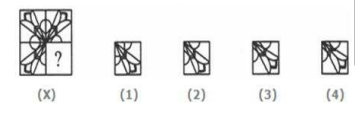
To solve this problem, we need to identify the pattern in Figure X and find the alternative that completes it correctly. The key is to observe the design elements and symmetry within the given options.
Correct Option: B) Option 2 completes the pattern in Figure X correctly.
The question asks to identify the recipient of the Harvard Humanitarian Award in 2015. This requires knowledge of significant awards and their recipients, a common topic in general awareness sections of competitive exams.
Correct Option: B) Kailash Satyarthi
Kailash Satyarthi, a renowned Indian social reformer who has campaigned against child labor in India and advocated for the universal right to education, was awarded the Harvard Humanitarian Award by Harvard University in 2015. He shared the Nobel Peace Prize with Malala Yousafzai in 2014.
Answer the next 3 Questions.
Comprehension:
In a class of 60 students:
42 like Maths,
32 like English,
12 like neither Maths nor English.
SubQuestion No: 1
Students who like only Maths forms what percentage of the total number of students in the class?
This problem can be solved using the principles of set theory, specifically Venn diagrams. We are given the total number of students, the number of students who like Maths, the number who like English, and the number who like neither. From this, we can find the number of students who like at least one subject, then the number who like both subjects, and finally the number who like only Maths.
A) 26.67% is the correct percentage of students who like only Maths.
SubQuestion No: 2
How many students like both Maths and English?
SubQuestion No: 3
How many students like exactly one subject?
To find the number of students who like exactly one subject, we need to identify the regions in the Venn diagram that represent students liking only one specific subject (e.g., only History, only Geography, or only Math) and then sum these values.
Therefore, 22 students like exactly one subject.
D) 22 is the correct answer because it represents the sum of students who like only History (6), only Geography (8), and only Math (8).