
Solve: 1000x - 5 = -6
\( \frac{1}{1000} \)
\( \frac{-1}{1000} \)
\( \frac{-11}{1000} \)
\( \frac{11}{1000} \)
To solve the given linear equation, we need to isolate the variable \(x\). This involves performing algebraic operations (addition, subtraction, multiplication, division) on both sides of the equation to move constant terms to one side and the term with \(x\) to the other side.
Correct Option: B) \( \frac{-1}{1000} \)
Find the odd one out.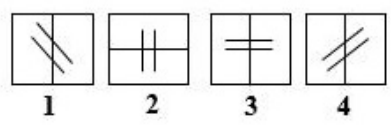
The task is to identify the pattern in each diagram and find the one that does not fit with the others.
Correct Option: B) 2
If the product of two numbers is 4056 and their LCM is 156 then their HCF is:
This problem can be solved using the fundamental relationship between the product of two numbers, their Least Common Multiple (LCM), and their Highest Common Factor (HCF). The relationship states that for any two positive integers, the product of the numbers is equal to the product of their LCM and HCF.
Therefore, the HCF of the two numbers is 26.
D) 26 is the correct answer because, by applying the formula \(\text{Product of numbers} = \text{LCM} \times \text{HCF}\), we find that \(\text{HCF} = \frac{4056}{156} = 26\).
Physical Research Laboratory was founded by ___.
S. K. Mitra
C. V. Raman
Homi Bhabha
Vikram Sarabhai
The question asks about the founder of the Physical Research Laboratory (PRL). This requires knowledge of prominent Indian scientists and their contributions to the establishment of scientific institutions.
Correct Option: D) Vikram Sarabhai was a renowned Indian physicist and astronomer who is considered the father of the Indian space program. He founded the Physical Research Laboratory (PRL) in Ahmedabad in 1947. PRL is a premier national research institution for space and allied sciences, supported by the Department of Space, Government of India.
Keerthana takes 9 hrs 20 minutes in walking a distance and riding back to the same place where she started. She could walk both ways in 11 hrs 15 minutes. The time taken by her to ride both ways is:
7 hrs 25 min
7 hrs 35 min
7 hrs 45 min
7 hrs 15 min
This problem involves calculating time taken for different modes of travel (walking and riding). We are given two scenarios and need to find the time taken to ride both ways. We can set up equations based on the given information and solve for the unknown time.
Let \(T_W\) be the time taken to walk a certain distance in one direction, and \(T_R\) be the time taken to ride the same distance in one direction.
From the first statement: "Keerthana takes 9 hrs 20 minutes in walking a distance and riding back to the same place where she started."
This means she walks one way and rides back the other way. So, the total time is:
\[ T_W + T_R = 9 \text{ hrs } 20 \text{ min} \]Convert 9 hrs 20 min to minutes:
\[ 9 \times 60 + 20 = 540 + 20 = 560 \text{ minutes} \]\[ T_W + T_R = 560 \text{ minutes \quad (Equation 1)} \]From the second statement: "She could walk both ways in 11 hrs 15 minutes."
This means she walks the distance in one direction and walks back the same distance. So, the total time is:
\[ T_W + T_W = 11 \text{ hrs } 15 \text{ min} \]\[ 2 T_W = 11 \text{ hrs } 15 \text{ min} \]Convert 11 hrs 15 min to minutes:
\[ 11 \times 60 + 15 = 660 + 15 = 675 \text{ minutes} \]\[ 2 T_W = 675 \text{ minutes} \]Now, find the time taken to walk one way (\(T_W\)):
\[ T_W = \frac{675}{2} = 337.5 \text{ minutes} \]Substitute the value of \(T_W\) into Equation 1 to find \(T_R\):
\[ 337.5 + T_R = 560 \]\[ T_R = 560 - 337.5 \]\[ T_R = 222.5 \text{ minutes} \]The question asks for the time taken by her to ride both ways. This would be \(2 T_R\).
\[ 2 T_R = 2 \times 222.5 = 445 \text{ minutes} \]Convert 445 minutes back to hours and minutes:
\[ 445 \text{ minutes} = \frac{445}{60} \text{ hours} \]\[ 445 \div 60 = 7 \text{ with a remainder of } 25 \]So, 445 minutes is 7 hours and 25 minutes.
Correct Option: A) 7 hrs 25 min
The mean of the data 2, 9, 9, 3, 6, 9, 4 is:
To find the mean (average) of a set of data, we sum all the values in the data set and then divide by the total number of values in the set.
Correct Option: B) The mean of the given data is 6.
This is a coding-decoding question where letters are assigned numerical values. We need to identify the pattern used to assign values to the given words and then apply the same pattern to find the value for the target word.
B) 34 is the correct answer, as calculated by summing the alphabetical positions of the letters in CAMEL.
The question asks to identify India's first satellite launched using an Indian-made launch vehicle. This requires knowledge of the history of India's space program, specifically which satellites were launched and by what means.
India's first satellite, Aryabhata, was launched in 1975 by the Soviet Union. Bhaskara-1 was also launched by the Soviet Union. INSAT-1A was an American-built satellite launched by the European Ariane rocket. Rohini was a series of satellites. The Rohini satellite RS-1 was India's first satellite successfully launched into orbit by an Indian-made launch vehicle, the SLV-3 (Satellite Launch Vehicle-3), on July 18, 1980.
Correct Option: B) Rohini was India's first satellite launched from an Indian-made launch vehicle (SLV-3) on July 18, 1980. The satellite was Rohini Satellite-1 (RS-1).
This problem involves arranging six students in a circular seating arrangement based on given conditions. We need to deduce the seating order and then answer a specific question about the arrangement after one student leaves. We will use a step-by-step approach to build the arrangement.
Correct Option: D) Cannot be determined