
A shopkeeper sold an article at a profit of 4%. If he had bought the article at 5% less and sold it at ₹30 more, then he would have made a profit of 12%. What is the cost price (in ₹) of the article?
The lowest terms of \(\frac{221}{488}\) is:
\(\frac{121}{488}\)
\(\frac{221}{488}\)
\(\frac{121}{288}\)
\(\frac{221}{288}\)
A spherical ball of iron is to be produced. If the radius of the ball is 3 cm and weight of iron per cm3 is 30 g, what would be the weight of the ball?
The given bar graph shows the marks obtained by five students in Exam I and Exam II. Study the bar graph carefully to answer the question that follows.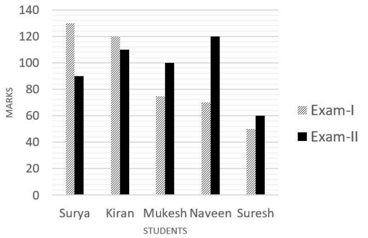
If the marks obtained by Suresh in Exam-I were increased by 14% of the original marks, what would be his new approximate percentage in Exam-I if the maximum marks in Exam-I were 140?
The following table shows the percentage of marks obtained by five students (A, B, C, D and E) in different subjects. (Maximum marks are given beside subjects)
| Students | Subjects | ||||
| Urdu (200) |
Sanskrit (200) |
Music (200) |
Hindi (200) |
English (200) |
|
| A | 60 | 80 | 90 | 60 | 90 |
| B | 90 | 70 | 80 | 70 | 40 |
| C | 70 | 90 | 90 | 80 | 70 |
| D | 80 | 60 | 70 | 80 | 80 |
| E | 90 | 50 | 80 | 80 | 80 |
How many more or fewer marks did Student A obtain in English, as compared to the marks obtained by Student E in the same subject?