
How many squares are there in the given figure?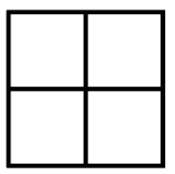
To find the total number of squares in the given figure, we need to consider both the smaller squares and any larger squares formed by combining smaller ones.
Correct Option: D) 5
The question asks for the Highest Common Factor (HCF) of a set of three coprime numbers. We need to understand the definition of coprime numbers and HCF to determine the correct answer.
B) 1. By the definition of coprime numbers, their highest common factor is always 1.
The question asks for the specific date when Neil Armstrong and Edwin "Buzz" Aldrin landed on the Moon. This is a historical fact related to space exploration. Recalling the details of the Apollo 11 mission is key to answering this question.
A) July 20, 1969 is the correct date when Neil Armstrong and Edwin Aldrin landed on the Moon as part of the Apollo 11 mission. This is one of the most significant events in human history.
To find what percentage one-eighth of a number is of the number itself, we need to express the fraction \(\frac{1}{8}\) as a percentage. This involves multiplying the fraction by 100.
Thus, one-eighth of a number is 12.5% of it.
Correct Option: C) 12.5%
If 2x = 64 and 4y = 256, then find the value of \( \frac{1}{x} \) + \( \frac{1}{y} \).
\( \frac{7}{12} \)
\( \frac{2}{5} \)
\( \frac{2}{3} \)
\( \frac{5}{12} \)
The problem requires us to find the value of an expression involving reciprocals of variables, given two exponential equations. We will first solve each exponential equation to find the values of \(x\) and \(y\). Then, we will substitute these values into the given expression and simplify.
The first equation is \(2^x = 64\).
We need to express \(64\) as a power of \(2\).
\[ 64 = 2 \times 2 \times 2 \times 2 \times 2 \times 2 = 2^6 \]So, the equation becomes:
\[ 2^x = 2^6 \]Since the bases are the same, the exponents must be equal:
\[ x = 6 \]The second equation is \(4^y = 256\).
We need to express \(256\) as a power of \(4\).
\[ 256 = 4 \times 4 \times 4 \times 4 = 4^4 \]So, the equation becomes:
\[ 4^y = 4^4 \]Since the bases are the same, the exponents must be equal:
\[ y = 4 \]Now that we have \(x=6\) and \(y=4\), we can find their reciprocals:
\[ \frac{1}{x} = \frac{1}{6} \]\[ \frac{1}{y} = \frac{1}{4} \]Substitute the values of \( \frac{1}{x} \) and \( \frac{1}{y} \) into the expression:
\[ \frac{1}{x} + \frac{1}{y} = \frac{1}{6} + \frac{1}{4} \]To add these fractions, find a common denominator. The least common multiple (LCM) of \(6\) and \(4\) is \(12\).
\[ \frac{1}{6} + \frac{1}{4} = \frac{1 \times 2}{6 \times 2} + \frac{1 \times 3}{4 \times 3} \]\[ = \frac{2}{12} + \frac{3}{12} \]\[ = \frac{2 + 3}{12} \]\[ = \frac{5}{12} \]D) \( \frac{5}{12} \) is the correct value obtained after solving the equations and summing the reciprocals.
The question asks to identify the common name for elements belonging to Group 17 of the periodic table. This requires knowledge of the classification of elements in the periodic table based on their group numbers and characteristic properties.
Correct Option: A) Halogens are the elements belonging to Group 17 of the periodic table. This group includes Fluorine (F), Chlorine (Cl), Bromine (Br), Iodine (I), and Astatine (At). They are highly reactive non-metals.
To find the volume of the second cylinder, we will use the formula for the volume of a cylinder, which is \(V = \pi r^2 h\). We are given the ratios of the radii and heights of two cylinders and the volume of one cylinder. We can set up a ratio of their volumes to find the unknown volume.
Let the radii of the two cylinders be \(r_1\) and \(r_2\), and their heights be \(h_1\) and \(h_2\).
Given the ratio of radii:
\[ \frac{r_1}{r_2} = \frac{2}{3} \]Given the ratio of heights:
\[ \frac{h_1}{h_2} = \frac{5}{3} \]The formula for the volume of a cylinder is \(V = \pi r^2 h\). So, the volumes of the two cylinders are:
\[ V_1 = \pi r_1^2 h_1 \]\[ V_2 = \pi r_2^2 h_2 \]Now, let's find the ratio of their volumes:
\[ \frac{V_1}{V_2} = \frac{\pi r_1^2 h_1}{\pi r_2^2 h_2} = \frac{r_1^2 h_1}{r_2^2 h_2} = \left(\frac{r_1}{r_2}\right)^2 \left(\frac{h_1}{h_2}\right) \]Substitute the given ratios into the volume ratio equation:
\[ \frac{V_1}{V_2} = \left(\frac{2}{3}\right)^2 \left(\frac{5}{3}\right) \]\[ \frac{V_1}{V_2} = \left(\frac{4}{9}\right) \left(\frac{5}{3}\right) \]\[ \frac{V_1}{V_2} = \frac{20}{27} \]We are given that one cylinder has a volume of 160 cubic units. Let's assume \(V_1 = 160\) cubic units.
\[ \frac{160}{V_2} = \frac{20}{27} \]Solve for \(V_2\):
\[ V_2 = \frac{160 \times 27}{20} \]\[ V_2 = 8 \times 27 \]\[ V_2 = 216 \]Therefore, the volume of the other cylinder is 216 cubic units.
Correct Option: C) 216 cubic units
This problem involves understanding relative directions. When two people are facing each other, the direction one person is facing is opposite to the direction the other person is facing.
Consider a standard compass with North at the top, South at the bottom, East to the right, and West to the left. If Mani is looking left (West), then for Raj to be facing Mani, Raj must be looking right (East).
C) East is the correct direction Raj is facing because it is opposite to West, the direction Mani is facing.
This problem can be solved by visualizing the path taken as a series of right-angle turns, which forms a rectangle. We need to find the straight-line distance between the starting point (A) and the ending point (B).
Imagine a coordinate system:
The distance between \(A = (0, 0)\) and \(B = (0, -3)\) is \( \sqrt{(0-0)^2 + (-3-0)^2} = \sqrt{0^2 + (-3)^2} = \sqrt{9} = 3 \text{ m} \).
D) 3 m is the correct distance between points A and B.
The question asks for the unit of measurement of the "Ecological Footprint". Understanding what an Ecological Footprint represents is key to identifying its correct unit.
A) Global Hectare is the standard unit used to measure the Ecological Footprint. It represents the average productivity of all biologically productive land and sea areas on Earth.