
The speed of sound depends on the properties of the medium through which it travels, specifically its elasticity (rigidity) and density. Sound waves are mechanical waves, meaning they require a medium to propagate. The speed of sound is generally higher in denser and more rigid media.
Understanding Sound Propagation: Sound travels by causing vibrations in the particles of a medium. The speed at which these vibrations are transmitted depends on how quickly particles can transfer energy to their neighbors.
Factors Affecting Speed of Sound: The general formula for the speed of sound \(v\) in a medium is given by:
\[ v = \sqrt{\frac{K}{\rho}} \]where \(K\) is the bulk modulus (a measure of the medium's elasticity or resistance to compression) and \(\rho\) is the density of the medium.
Comparing States of Matter:
Solids: Solids have the highest elasticity (high bulk modulus) and are generally quite dense. Their particles are tightly packed and strongly bonded, allowing vibrations to be transmitted very efficiently and quickly.
Liquids: Liquids are less elastic than solids (lower bulk modulus) and generally less dense than solids (though denser than gases). The particles are closer than in gases but can move past each other, making energy transfer less efficient than in solids.
Gases: Gases have the lowest elasticity (very low bulk modulus) and are the least dense. Their particles are far apart and interact less frequently, leading to much slower transmission of sound.
Conclusion: Due to their high elasticity and relatively high density, solids are the best medium for sound propagation, allowing sound to travel at the maximum speed compared to liquids and gases.
B) Solids — Sound travels fastest in solids because their particles are tightly packed and strongly bonded, allowing for efficient and rapid transmission of vibrations. The elasticity (bulk modulus) of solids is generally much higher than that of liquids or gases, which is the dominant factor in determining sound speed.
A) Liquids — Sound travels faster in liquids than in gases, but slower than in solids. This is because liquids are less elastic and their particles are not as rigidly fixed as in solids.
C) Same speed in gases and liquids — This is incorrect. Sound travels significantly faster in liquids than in gases due to the closer packing of particles and higher elasticity in liquids.
D) Gases — Sound travels slowest in gases. This is because gas particles are far apart and interact less frequently, making the transmission of vibrations less efficient and slower compared to liquids and solids.
The question asks to identify the enzyme present in gastric juice. To answer this, one needs to recall the primary digestive enzymes secreted in the stomach and their functions.
Correct Option: B) Pepsin is the primary proteolytic enzyme found in gastric juice. It initiates the digestion of proteins in the highly acidic environment of the stomach.
The dilution of concentrated acids is a highly exothermic process. To ensure safety and prevent accidents, it's crucial to manage the heat generated. The correct procedure involves adding the acid slowly to a larger volume of water, allowing the heat to dissipate safely.
Correct Option: A) Add acid to water. This method ensures that the heat generated during dilution is absorbed by a large volume of water, preventing violent boiling and splashing, thus making the process safer.
Choose the alternative that best replaces the question mark(?) in the given figure.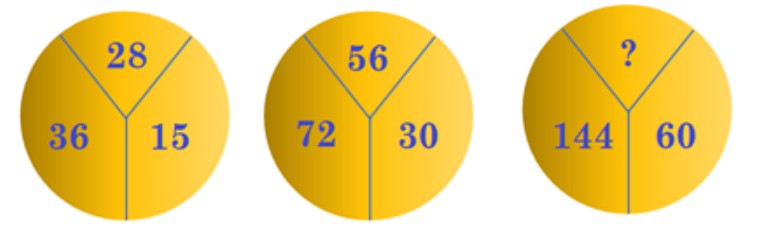
The problem involves identifying a pattern in the given figures to determine the missing number. Each circle is divided into three sections with numbers, and we need to find the relationship between these numbers.
Correct Option: C) 112
The problem involves solving an algebraic equation where a digit 'k' is missing in one of the numbers. The key is to align the decimal points of all numbers and perform addition. Then, by comparing the sum with the given total, we can deduce the value of 'k'.
Write down the given equation:
\[ 54.k3 + 543 + 5.43 = 603.26 \]To add these numbers, it's helpful to align them vertically by their decimal points. For whole numbers, the decimal point is implicitly at the end.
\[ \begin{array}{c} \phantom{0}54.k3 \\ 543.00 \\ \phantom{00}5.43 \\ \hline 603.26 \end{array} \]Now, let's add the numbers column by column, starting from the rightmost decimal place.
From the addition in the tenths place, we found that \(k=8\).
C) 8 — By aligning the numbers and performing addition column by column, specifically focusing on the tenths place, we find that \(k+0+4\) must result in a number ending in \(2\). This implies \(k+4 = 12\), which gives \(k=8\).
The problem involves decoding a pattern in a given word and applying the same pattern to another word. We need to identify the transformation rule from 'FASHION' to 'FOIHSAN' and then apply it to 'PROBLEM'.
A) PELBORM is the correct code based on the identified pattern.
The question asks about the traditional venue from which the Prime Minister of India addresses the nation on Independence Day (August 15th). This is a well-known historical and ceremonial practice.
Correct Option: C) Red Fort — The Prime Minister of India traditionally hoists the national flag and addresses the nation from the ramparts of the Red Fort in Delhi on August 15th, India's Independence Day. This tradition began with India's first Prime Minister, Jawaharlal Nehru, in 1947.
This question tests basic knowledge of SI unit prefixes, specifically the prefix "kilo". Understanding what "kilo" represents in terms of magnitude is key to converting kilowatts to watts.
Correct Option: A) 1000 Watts
This is a syllogism problem. We need to analyze the given statements and determine which of the conclusions logically follow. We can use Venn diagrams or logical deduction to solve this.
C) Only conclusion I follows