This problem can be solved by applying Ohm's Law, which relates potential difference (voltage), current, and resistance in an electrical circuit. We need to analyze how current changes when resistance is halved while the potential difference remains constant.
Recall Ohm's Law: Ohm's Law states that the current (\(I\)) flowing through a conductor between two points is directly proportional to the voltage (\(V\)) across the two points and inversely proportional to the resistance (\(R\)) between them. Mathematically, it is expressed as:
\[ V = IR \]This can be rearranged to find the current:
\[ I = \frac{V}{R} \]Identify the given conditions:
Calculate the initial current: Let the initial current be \(I_1\). Using Ohm's Law:
\[ I_1 = \frac{V}{R_1} \]Calculate the new current: Let the new current be \(I_2\). Substitute the new resistance \(R_2\) into Ohm's Law:
\[ I_2 = \frac{V}{R_2} \]Substitute \(R_2 = \frac{R_1}{2}\) into the equation for \(I_2\):
\[ I_2 = \frac{V}{\frac{R_1}{2}} \] \[ I_2 = \frac{2V}{R_1} \]Compare the new current with the initial current: We know that \(I_1 = \frac{V}{R_1}\). Therefore, we can write \(I_2\) in terms of \(I_1\):
\[ I_2 = 2 \times \left(\frac{V}{R_1}\right) \] \[ I_2 = 2 I_1 \]This shows that the new current \(I_2\) is double the initial current \(I_1\).
Correct Option: A) It gets doubled
The question asks for the total number of medals won by India in the Asian Airgun Championship, 2019. This is a factual recall question related to sports events and achievements.
Correct Option: B) 25. India won a total of 25 medals at the Asian Airgun Championship, 2019, which included 16 gold, 5 silver, and 4 bronze medals.
The question asks about the specific set of sign conventions used when dealing with the reflection of light by spherical mirrors. Understanding these conventions is crucial for applying mirror formulas and solving related problems in optics.
Correct Option: D) The set of sign conventions followed while dealing with reflection of light by spherical mirrors is the New Cartesian sign convention. This is the standard, internationally accepted system for optics calculations, ensuring consistency and accuracy.
Choose the figure that best represents the relationship among the classes given below.
Officers, Government employees, Men
To determine the best representation of the relationship among Officers, Government employees, and Men, we need to consider how these categories can overlap. Officers are typically a subset of Government employees, and both can include Men.
Correct Option: B) Option B correctly represents the relationship among Officers, Government employees, and Men with overlapping circles.
The question asks why a person falls when stepping on a banana peel. This phenomenon is directly related to the concept of friction, which is a force that opposes motion between two surfaces in contact. Understanding how friction works will help identify the correct reason.
C) The banana peel is smooth and friction on it is very less, that we don't get the grip to stand. This option accurately describes the physical reason for falling. The smoothness and lubricating properties of the banana peel significantly reduce the friction between the shoe and the peel, making it impossible to maintain grip and balance.
The question asks to identify which of the given banks were nationalised as of 2018. To answer this, we need to recall the history of bank nationalisation in India and the status of the listed banks around 2018.
Correct Option: A) All of the options
To find the length of the platform, we first need to convert the train's speed from km/h to m/s. Then, we can use the information about the train crossing a man to find the length of the train. Finally, using the train's length and the time it takes to cross the platform, we can calculate the platform's length.
The speed of the train is given as 54 km/h. To convert this to m/s, we multiply by \(\frac{5}{18}\).
\[ \text{Speed} = 54 \times \frac{5}{18} \text{ m/s} = 3 \times 5 \text{ m/s} = 15 \text{ m/s} \]When a train crosses a man (or a pole), the distance covered is equal to the length of the train. The time taken is 20 seconds.
\[ \text{Length of train} = \text{Speed} \times \text{Time} \]\[ \text{Length of train} = 15 \text{ m/s} \times 20 \text{ s} = 300 \text{ m} \]When a train crosses a platform, the distance covered is equal to the sum of the length of the train and the length of the platform. The time taken is 36 seconds.
\[ \text{Distance covered} = \text{Speed} \times \text{Time} \]\[ \text{Length of train} + \text{Length of platform} = 15 \text{ m/s} \times 36 \text{ s} \]\[ 300 \text{ m} + \text{Length of platform} = 540 \text{ m} \]\[ \text{Length of platform} = 540 \text{ m} - 300 \text{ m} \]\[ \text{Length of platform} = 240 \text{ m} \]Correct Option: B) 240 m
The question asks to identify the place in India famous for its diamond mines. This requires knowledge of the geographical distribution of mineral resources in India.
Correct Option: B) Panna is a city in the state of Madhya Pradesh, India, well-known for its diamond mines. It is one of the few active diamond mining areas in India and has a long history of diamond extraction.
Choose from the alternatives the figure that best completes the pattern given below. 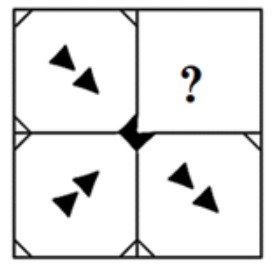
The problem requires identifying the pattern in the given diagrams and choosing the option that best completes the sequence.
Correct Option: A) The triangles are oriented correctly to maintain the pattern.
To complete the series, we need to identify the pattern or rule governing the sequence of numbers. We will look for differences between consecutive terms, squares, cubes, or combinations of arithmetic and geometric progressions.
A) 125 is the correct answer because the pattern of differences between consecutive terms is a geometric progression with a common ratio of 3. The next difference is \(27 \times 3 = 81\), and adding this to the last given term \(44\) gives \(44 + 81 = 125\).