
SubQuestion No: 3
By which number, the trained married lecturers in the college are represented?
The problem requires identifying a number that represents individuals possessing three specific characteristics: being trained, married, and lecturers. This is a Venn diagram problem where we need to find the region that is common to all three categories.
Correct Option: C) 5 is the number that lies in the intersection of the circle (trained), the triangle (married), and the rectangle (lecturers), thus representing trained married lecturers.
The question asks us to identify the pair of words that is different from the rest, based on a common relationship shared by the other three pairs. We need to analyze the relationship between the first word and the second word in each option.
Based on this analysis, options A, B, and C all show a relationship where the first word is a primary material used to make the second word (product). Option D does not follow this pattern as rails are not made of wood.
D) Wood : Rails — This pair is different because rails (railway tracks) are primarily made of steel, not wood. While wood is used for sleepers/ties, it is not the material for the rails themselves. The relationship is not "Material : Product" in the same direct sense as the other options.
To find the least number that must be subtracted from a given number to make it exactly divisible by another number, we need to perform division. The remainder obtained from this division will be the number that needs to be subtracted.
B) 478 is the remainder when 98534 is divided by 824. Subtracting this remainder will result in a number exactly divisible by 824.
To find the average price of a pen, we first need to calculate the total cost of the pencils. Then, we subtract the total cost of the pencils from the total purchase amount to find the total cost of the pens. Finally, we divide the total cost of the pens by the number of pens to get the average price per pen.
Correct Option: A) The average price of a pen is Rs. 6.
The question asks for the location of Belur Math. This is a factual question related to Indian geography and cultural institutions. To answer correctly, one needs to know the state where Belur Math is situated.
A) West Bengal: Belur Math is indeed located in Belur, Howrah district, West Bengal, India. It is a place of pilgrimage for people from all over the world and a significant architectural marvel.
The question asks about the material used for coating in galvanization, a process designed to prevent rusting of steel or iron. Rusting is an electrochemical process where iron reacts with oxygen and water to form iron oxides. Galvanization protects iron by providing a sacrificial layer.
D) Zinc
Zinc is the metal most commonly used for galvanizing steel or iron. It is more reactive than iron, meaning it will oxidize (corrode) before the iron does, thus protecting the iron even if the coating is scratched and the iron is exposed. This is known as sacrificial protection or cathodic protection.
This is a syllogism problem. We will use Venn diagrams to represent the given statements and then evaluate each conclusion based on these diagrams. The goal is to find conclusions that logically follow from the statements.


B) Only (1) is the correct conclusion that logically follows from the given statements.
Insert the missing character depicted by '?'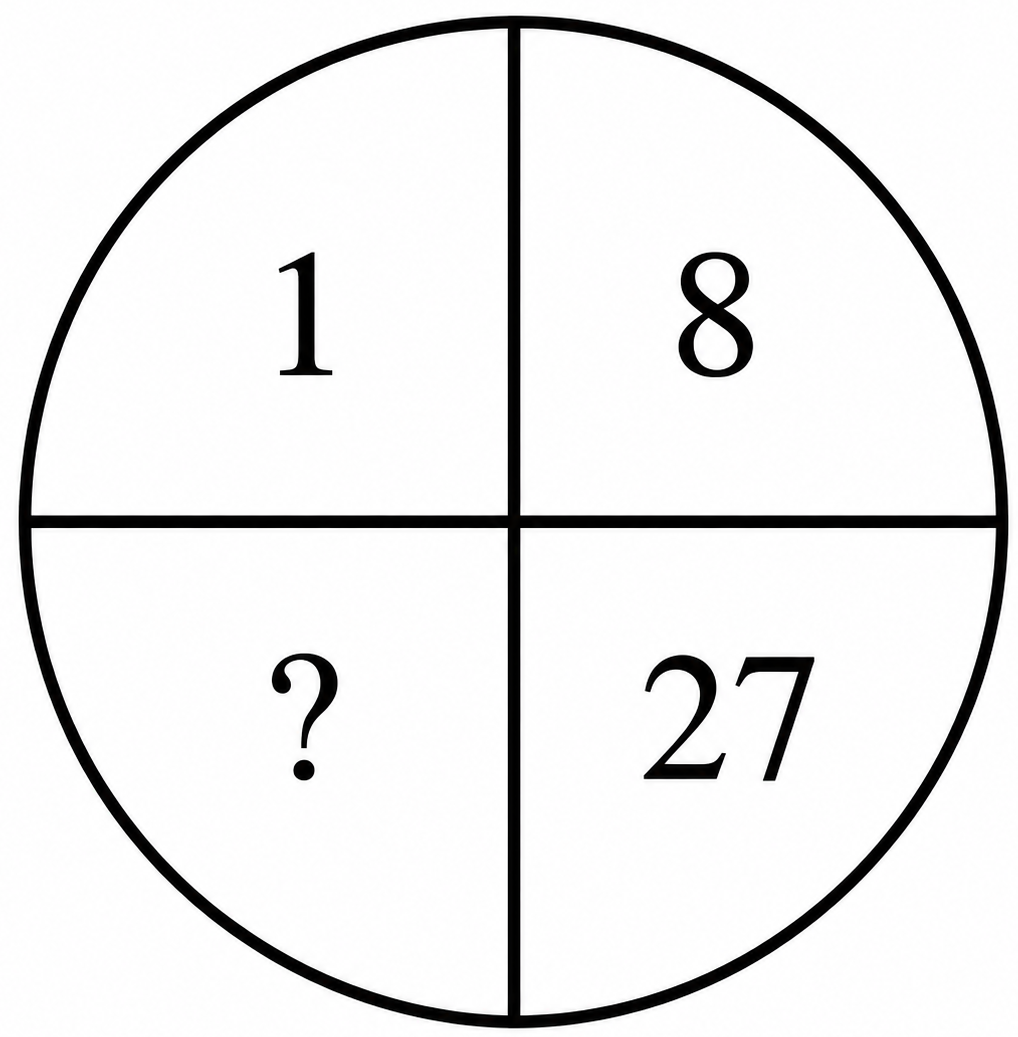
The diagram is divided into four sections with numbers: 1, 8, ?, and 27. The task is to find the missing number represented by '?'. The numbers appear to follow a pattern related to cubes.
Correct Option: B) 64
If \(\sqrt{5}\) = 2.236; then \(\frac{\sqrt{5}}{2}\) is
The problem provides the approximate value of \(\sqrt{5}\) and asks to calculate the value of \(\frac{\sqrt{5}}{2}\). This can be solved by direct substitution and division.
Correct Option: B) 1.118 is the correct answer because substituting the given value of \(\sqrt{5}\) and performing the division yields 1.118.
The question asks to identify the Indian state that is the largest producer of jute. This requires knowledge of agricultural geography in India, specifically the major jute-producing regions.
Correct Option: C) West Bengal is the leading state in India for jute production. Its geographical conditions, particularly the fertile deltaic plains and adequate rainfall, are ideal for jute cultivation.