
The question asks to identify a type of soil based on its characteristics: red color, unsuitability for agriculture, and specific geographical distribution in India (Tamil Nadu, Odisha, Chhotanagpur, Meghalaya). We will evaluate each option against these criteria.
C) Laterite Soil — Laterite soils are indeed red in color, formed under conditions of high temperature and heavy rainfall, leading to intense leaching. This process removes silica and leaves behind iron and aluminum compounds, making them generally poor in nutrients and thus unsuitable for agriculture without extensive treatment. They are found in the specified regions like Tamil Nadu, Odisha, Chhotanagpur, and Meghalaya.
Complete the Figure X from the given alternatives 1, 2, 3, 4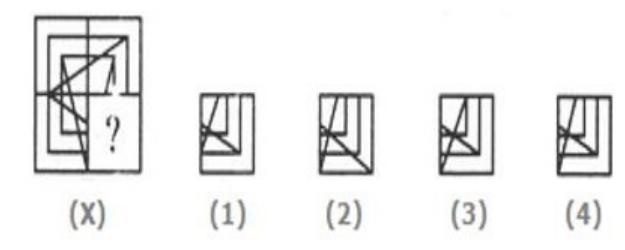
To solve this question, we need to identify the pattern and symmetry in the given figure (X) and choose the correct alternative that completes it.
Correct Option: D) Option 4
Which of the following is not true about the Chief Minister of a state?
The position of the Chief Minister at the state level is similar to that of the Prime Minister at the Centre.
The Governor appoints as ministers only those persons who are recommended by the Chief Minister.
The Chief Minister is the Chairman of the State Planning Board.
The Governor can dismiss the Chief Minister at any time, even when he enjoys majority support in the Legislative Assembly.
The question asks to identify the statement that is NOT true regarding the Chief Minister of a state in India. We need to evaluate each option based on the constitutional provisions and established practices related to the Chief Minister's office.
Correct Option: D) The Governor can dismiss the Chief Minister at any time, even when he enjoys majority support in the Legislative Assembly. This statement is incorrect because the Governor's power to dismiss the Chief Minister is not arbitrary. The Chief Minister holds office as long as they command the confidence of the Legislative Assembly.
The question asks for a device that connects computers for communication specifically via telephone lines. This implies a need to convert digital signals from a computer into analog signals suitable for telephone lines and vice-versa. We need to identify which of the given networking devices performs this function.
D) MODEM — A MODEM (Modulator-Demodulator) is the device specifically designed to convert digital signals from a computer into analog signals for transmission over telephone lines, and to convert analog signals received from telephone lines back into digital signals for the computer. This enables computers to communicate over the public switched telephone network.
To find the factors of a quadratic expression of the form \(ax^2 + bx + c\), we use the splitting the middle term method. We need to find two numbers whose product is \(ac\) and whose sum is \(b\). Once these numbers are found, the middle term \(bx\) is split into two terms using these numbers, and then the expression is factored by grouping.
B) \((x+5)(x+2)\) is the correct factorization of \(x^2+7x+10\), as derived through the splitting the middle term method.
The question asks to identify the historical figure known as the "Father of Civil Services in India." This requires knowledge of the contributions of various Governor-Generals and their administrative reforms during British rule in India.
Lord Cornwallis is widely credited with reforming and modernizing the civil services in India. He introduced several measures to curb corruption and professionalize the administration, including increasing salaries, prohibiting private trade by company servants, and introducing promotion based on seniority. He also established the Covenanted Civil Service, which laid the foundation for the modern Indian Civil Service (ICS).
A) Lord Cornwallis is known as the Father of Civil Services in India due to his significant reforms in the late 18th century. He systematized the administration, separated the commercial and administrative branches of the East India Company, and introduced measures to reduce corruption and ensure efficiency among civil servants.
The question asks for the full form of "CER" in the context of environmental studies. This requires knowledge of common acronyms used in climate change and carbon markets.
A) Certified Emission Reductions: This is the correct full form of CER. CERs are units issued for greenhouse gas emission reductions achieved by projects under the Clean Development Mechanism (CDM) of the Kyoto Protocol. Each CER represents one tonne of carbon dioxide equivalent (\(\text{CO}_2\text{e}\)) reduced or sequestered.
The question asks for the location where the World Climate Conference, popularly known as COP-21, was held in 2015. This is a factual question related to international environmental agreements and conferences. Candidates should recall the major UN climate conferences and their venues.
Correct Option: C) The 21st Conference of the Parties (COP-21) to the UNFCCC was held in Paris, France, from November 30 to December 12, 2015. This conference was historically significant as it led to the adoption of the Paris Agreement, a global accord on climate change mitigation, adaptation, and finance.
Gitesh took a loan for 4 years at 5% Compound Interest. If the total interest paid was Rs. 431.01, Calculate the principal.
The problem involves calculating the principal amount given the compound interest, rate, and time. We will use the formula for compound interest, which relates the amount, principal, rate, and time. The total interest paid is the difference between the Amount and the Principal. We can set up an equation and solve for the Principal.
The formula for the Amount (\(A\)) after \(t\) years with compound interest is:
\[ A = P \left(1 + \frac{R}{100}\right)^t \]where \(P\) is the Principal, \(R\) is the rate of interest per annum, and \(t\) is the time in years.
The Compound Interest (\(CI\)) is the difference between the Amount and the Principal:
\[ CI = A - P \]Substituting the formula for \(A\):
\[ CI = P \left(1 + \frac{R}{100}\right)^t - P \]We can factor out \(P\):
\[ CI = P \left[ \left(1 + \frac{R}{100}\right)^t - 1 \right] \]Given:
Substitute these values into the interest equation:
\[ 431.01 = P \left[ \left(1 + \frac{5}{100}\right)^4 - 1 \right] \]Calculate \((1.05)^4\):
\[ (1.05)^2 = 1.1025 \]\[ (1.05)^4 = (1.1025)^2 = 1.21550625 \]Now substitute this back:
\[ 431.01 = P \left[ 1.21550625 - 1 \right] \]\[ 431.01 = P \left[ 0.21550625 \right] \]Performing the division:
\[ P \approx 2000 \]So, the principal amount is approximately Rs. 2,000.
A) Rs. 2,000
To find the share of A, we first need to determine the individual work rates of A, B, and C. The wages received by individuals are proportional to the amount of work they do or their efficiency (work rate). We will calculate the ratio of their efficiencies and then distribute the total wages according to this ratio.
If a person completes a work in 't' hours, their work rate is \(1/t\) part of the work per hour.
The ratio of their efficiencies is the ratio of their work rates:
\[ \text{Ratio of efficiencies} = \text{A} : \text{B} : \text{C} = \frac{1}{4} : \frac{1}{5} : \frac{1}{6} \]To simplify this ratio, find the Least Common Multiple (LCM) of the denominators (4, 5, 6). The LCM of 4, 5, and 6 is 60.
Multiply each fraction by 60:
\[ \text{A} : \text{B} : \text{C} = \left(\frac{1}{4} \times 60\right) : \left(\frac{1}{5} \times 60\right) : \left(\frac{1}{6} \times 60\right) \] \[ \text{A} : \text{B} : \text{C} = 15 : 12 : 10 \]The total wages received are Rs. 777. The share of A will be its ratio part divided by the total sum of ratio parts, multiplied by the total wages.
\[ \text{Share of A} = \left(\frac{\text{Ratio part of A}}{\text{Total sum of ratio parts}}\right) \times \text{Total wages} \] \[ \text{Share of A} = \left(\frac{15}{37}\right) \times 777 \] \[ \text{Share of A} = 15 \times \frac{777}{37} \]Since \(777 \div 37 = 21\),
\[ \text{Share of A} = 15 \times 21 \] \[ \text{Share of A} = \text{Rs. } 315 \]Correct Option: B) Rs. 315