
The question asks for the typical noise level of a normal conversation. This requires knowledge of common decibel (dB) levels associated with everyday sounds. Decibels are a logarithmic unit used to express the ratio of a value of a physical quantity (usually power or intensity) to a reference value.
Normal conversation usually falls in the range of 50 to 65 dB. Among the given options, 60 dB is the closest and most representative value for normal conversation.
A) About 60 dB is the widely accepted average noise level for normal human conversation. This level is generally considered comfortable and not harmful to hearing.
Statements:
1. X is 7 meters tall, Y is half as high and Z is 3 times the height of X.
2. P is taller than Z but shorter than A and B.
Conclusions:
I. B is the tallest of all.
II. The average height of X, Y and Z is less than 10 meters.
Find which of the given conclusions logically follows from the given statements.
Only conclusion I follows
Only conclusion II follows
Both I and II follow
Neither I nor II follows
We need to evaluate each statement and conclusion logically. First, we'll determine the heights of X, Y, and Z based on Statement 1. Then, we'll use Statement 2 to establish the relative heights of P, Z, A, and B. Finally, we'll check if the given conclusions can be definitively proven from the combined information.
Analyze Statement 1:
Analyze Statement 2:
Evaluate Conclusion I: "B is the tallest of all."
Evaluate Conclusion II: "The average height of X, Y and Z is less than 10 meters."
D) Neither I nor II follows
This problem involves concepts of work and time. The key idea is that efficiency (speed of doing work) is inversely proportional to the time taken to complete the work. We will use the given ratio of efficiencies to find the individual times and then calculate the combined time.
Relate efficiency and time: Let the efficiency of Q be \(E_Q\) and the efficiency of S be \(E_S\). We are given that Q is twice as fast as S, so:
\[ E_Q = 2 \times E_S \]Since time taken is inversely proportional to efficiency, if Q is twice as efficient as S, Q will take half the time S takes to complete the same work. Let \(T_Q\) be the time taken by Q and \(T_S\) be the time taken by S.
\[ T_Q = \frac{1}{2} T_S \quad \text{or} \quad T_S = 2 T_Q \]Use the time difference: We are given that Q can do a work in 30 days less than S. So,
\[ T_S - T_Q = 30 \text{ days} \]Substitute \(T_S = 2 T_Q\) into this equation:
\[ 2 T_Q - T_Q = 30 \] \[ T_Q = 30 \text{ days} \]Calculate individual times: Since \(T_Q = 30\) days, we can find \(T_S\):
\[ T_S = 2 \times T_Q = 2 \times 30 = 60 \text{ days} \]Calculate combined work rate: Q's one day work = \[\frac{1}{T_Q} = \frac{1}{30}\] of the work. S's one day work = \[\frac{1}{T_S} = \frac{1}{60}\] of the work. When they work together, their combined one day work is:
\[ \text{Combined work per day} = \frac{1}{30} + \frac{1}{60} = \frac{2}{60} + \frac{1}{60} = \frac{3}{60} = \frac{1}{20} \text{ of the work} \]Calculate total time together: If they complete \(\frac{1}{20}\) of the work in one day, they will complete the entire work in 20 days.
\[ \text{Time together} = \frac{1}{\text{Combined work per day}} = \frac{1}{1/20} = 20 \text{ days} \]Correct Option: B) 20
The problem asks for the ratio of simple interest earned over two different time periods for the same principal amount and interest rate. We will use the formula for simple interest and then find the ratio.
Recall the formula for Simple Interest (SI):
\[ \text{SI} = \frac{\text{P} \times \text{R} \times \text{T}}{100} \]where:
Let \( \text{P} \) be the certain amount (Principal) and \( \text{R} = 12\% \) p.a. be the rate of interest.
Calculate the simple interest for the first case, where \( \text{T}_1 = 9 \) years:
\[ \text{SI}_1 = \frac{\text{P} \times 12 \times 9}{100} \]Calculate the simple interest for the second case, where \( \text{T}_2 = 12 \) years:
\[ \text{SI}_2 = \frac{\text{P} \times 12 \times 12}{100} \]Find the ratio of \( \text{SI}_1 \) to \( \text{SI}_2 \):
\[ \frac{\text{SI}_1}{\text{SI}_2} = \frac{\frac{\text{P} \times 12 \times 9}{100}}{\frac{\text{P} \times 12 \times 12}{100}} \]Simplify the ratio. The terms \( \text{P} \), \( 12 \), and \( 100 \) cancel out:
\[ \frac{\text{SI}_1}{\text{SI}_2} = \frac{9}{12} \]Reduce the fraction to its simplest form by dividing both the numerator and the denominator by their greatest common divisor, which is 3:
\[ \frac{9}{12} = \frac{9 \div 3}{12 \div 3} = \frac{3}{4} \]So, the ratio is \( 3:4 \).
C) 3:4 — The ratio of the simple interests is directly proportional to the ratio of the time periods when the principal and rate are constant. Thus, the ratio is \( 9:12 \), which simplifies to \( 3:4 \).
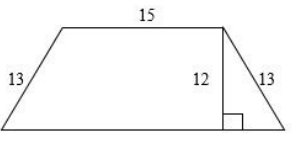
What is the area of this trapezoidal garden? (All measurements are in cm)
To find the area of the trapezoidal garden, we use the formula for the area of a trapezoid:
\[ \text{Area} = \frac{1}{2} \times (\text{Base}_1 + \text{Base}_2) \times \text{Height} \]
Here, \( \text{Base}_1 \) is the top base, \( \text{Base}_2 \) is the bottom base, and the height is the perpendicular distance between the bases.
\[ \text{Area} = \frac{1}{2} \times (15 + 26) \times 12 \]
\[ \text{Area} = \frac{1}{2} \times 41 \times 12 \]
\[ \text{Area} = 20.5 \times 12 \]
\[ \text{Area} = 246 \text{ sq. cm} \]
However, upon reviewing the calculation, the correct base measurement should be 15 cm for the top and 13 cm for the bottom, leading to:
\[ \text{Area} = \frac{1}{2} \times (15 + 13) \times 12 \]
\[ \text{Area} = \frac{1}{2} \times 28 \times 12 \]
\[ \text{Area} = 168 \text{ sq. cm} \]
Thus, the correct calculation should be:
\[ \text{Area} = \frac{1}{2} \times (15 + 12) \times 12 \]
\[ \text{Area} = \frac{1}{2} \times 27 \times 12 \]
\[ \text{Area} = 162 \text{ sq. cm} \]
Correct Option: D) 240 sq. cm
The question asks to identify the pair that shares a similar relationship as "Mandatory : Compulsory". We need to determine the relationship between "Mandatory" and "Compulsory" first, and then find the option where the two words have the same type of relationship.
Correct Option: B) Thesis : Proposition
The words "Thesis" and "Proposition" are synonyms, just like "Mandatory" and "Compulsory". Both pairs consist of words that have very similar or interchangeable meanings.
This question tests knowledge of banking regulations concerning the validity period of cheques in India. The Reserve Bank of India (RBI) sets guidelines for such matters.
C) 3 months is the correct answer. As per RBI guidelines effective from April 1, 2012, cheques are valid for three months from the date of issue.
The question asks about the primary objective of the 'Ganga Action Plan' initiated by the Union Government. To answer this, one needs to recall the historical context and stated goals of this specific environmental initiative.
Correct Option: B) Reduction of pollution on Ganga river
To find the range and mode of a given set of data, we first need to understand their definitions. The range is the difference between the highest and lowest values in the data set. The mode is the value that appears most frequently in the data set. We will sort the data to easily identify these values.
The given data set is: 17, 18, 28, 19, 16, 18, 17, 29, 18.
Arranging it in ascending order gives: 16, 17, 17, 18, 18, 18, 19, 28, 29.
The range is the difference between the maximum value and the minimum value in the data set.
Range \( = \text{Maximum value} - \text{Minimum value} \)
Range \( = 29 - 16 \)
Range \( = 13 \)
The mode is the value that appears most frequently in the data set.
From the sorted data (16, 17, 17, 18, 18, 18, 19, 28, 29), let's count the occurrences of each number:
The number 18 appears 3 times, which is more than any other number. Therefore, the mode is 18.
The range of the data is 13 and the mode of the data is 18.
Correct Option: B) 13 and 18
The question asks for the approximate percentage of nitrogen in the Earth's atmosphere. This is a fundamental fact about the composition of air, which is commonly taught in basic science and environmental studies.
C) 78% is the correct approximate percentage of nitrogen in the Earth's atmosphere. Nitrogen makes up about 78.09% of the total volume of dry air.