What is the missing term in the following?
ACPQ:BESU :: MNGI: ?
UPSC - 2022
This is an analogy question based on letter series. We need to find the pattern of transformation from the first term (ACPQ) to the second term (BESU) and then apply the same pattern to the third term (MNGI) to find the missing fourth term.
The pattern is an increment of +1, +2, +3, +4 for the respective letters.
The missing term is NPJM.
Correct Option: D) NPJM
What is the missing term in the following?
BLACK : DXBFV : : CAGE : ?
The problem states that BLACK is coded as DXBFV, and asks for the code for CAGE using the same rule. This means that we must find how each letter of BLACK changes into the matching letter of DXBFV, and then apply that rule to CAGE. We will compare the alphabet positions of the letters to find the rule.
Write the alphabet positions of BLACK and DXBFV:
Find the rule: In every case, the position of the coded letter is double the position of the original letter:
\[ 2 \times 2 = 4,\quad 12 \times 2 = 24,\quad 1 \times 2 = 2,\quad 3 \times 2 = 6,\quad 11 \times 2 = 22 \]Apply the rule to CAGE:
Write the code: CAGE is coded as FBNJ.
Correct Option: D) FBNJ — Each letter of BLACK is replaced by the letter at double its alphabet position, and applying the same rule to C, A, G and E gives F, B, N and J.
What is the missing term in the following?
54 : 20 : : 72 : ?
This is a number analogy question where we need to find the relationship between the first pair of numbers and apply the same relationship to the second pair to find the missing term. We will analyze the given pair (54 : 20) to deduce the pattern.
Correct Option: C) 14 — The pattern is that the second number is the product of the digits of the first number. For 54:20, \(5 \times 4 = 20\). Applying this to 72, we get \(7 \times 2 = 14\).
What is the missing term in the following?
TIGER : QDFHS : : FISH :
This is a coding-decoding question. We need to identify the pattern or rule applied to transform "TIGER" into "QDFHS" and then apply the same rule to "FISH" to find the missing term.
D) GRHE is the result obtained by applying the identified pattern: shift each letter back by 1, then reverse the order of the resulting letters.
Three words are given in the following questions. Four options are given below these questions, one of which is representative of the three words. Find that word
Cheetah, Lion, Tiger
The question asks to identify a common characteristic or category that best describes the three given words: Cheetah, Lion, and Tiger. We need to analyze each word and then evaluate the given options to find the most appropriate one.
Correct Option: A) Carnivorous — Cheetahs, Lions, and Tigers are all predators that primarily consume meat, making them carnivorous animals.
What is the missing term in the following?
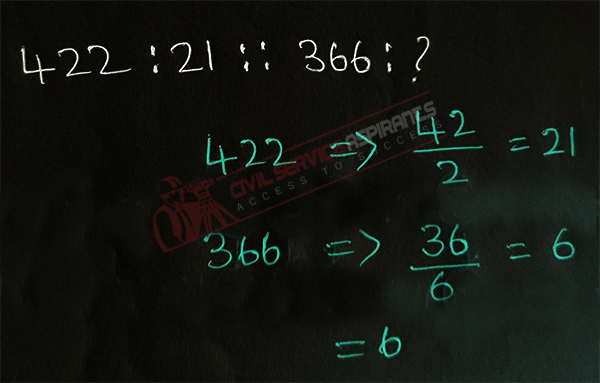
422 : 21 : : 366 : ?
The problem states that 422 is related to 21, and asks for the number related to 366 by the same rule. This means that we must find how 21 is formed from the digits of 422, and then apply the same rule to 366. We will split each number into its first two digits and its last digit, and test a simple operation between them.
Split 422: The first two digits form 42, and the last digit is 2.
Find the rule: Dividing the number formed by the first two digits by the last digit gives:
\[ 42 \div 2 = 21 \]This matches the given pair 422 : 21.
Split 366: The first two digits form 36, and the last digit is 6.
Apply the same rule:
\[ 36 \div 6 = 6 \]Correct Option: C) 6 — In 422, the first two digits 42 divided by the last digit 2 give 21. In the same way, 36 divided by 6 gives 6.