One morning Saranya and Saravanan were talking to each other face to face at a crossing. If Vishal's shadow was exactly to the left of Saranya, which direction was Saranya facing?
This is a direction and shadow-based reasoning question. The key information is the time of day ("One morning") and the relative position of Vishal's shadow ("exactly to the left of Saranya"). We need to determine Saranya's facing direction based on these clues.
C) North is the correct direction. If Saranya is facing North, her left will be West, and her right will be East. Since the sun is in the East in the morning, shadows fall to the West, which aligns with Vishal's shadow being to Saranya's left.
Directions for the next two questions are given below:
Kalki, Kumar, Karthik, Sri and Tej are standing facing to the North in a playground such as given below:
1. Kumar is at 40 m to the right of Sri.
2. Kalki is are 60 m in the south of Kumar.
3. Karthik is at a distance of 25 m in the west of Sri.
4. Tej is at a distance of 90 m in the North of Kalki.
Which one is in the North-East of the person who is to the left of Kumar?
This problem involves determining the relative positions of five people based on given distance and direction clues. We need to visualize their positions on a 2D plane and then identify the person in the North-East direction relative to a specific individual.
Therefore, Tej is in the North-East of the person who is to the left of Kumar (Sri).
D) Tej is at \((40,30)\). Relative to Sri \((0,0)\), Tej is in the North-East direction (positive X, positive Y).
If a boy starting from Karthik, met to Sri and then to Kumar and after this he to Kalki and then to Tej and whole the time he walked in a straight line, then how much total distance did he cover?
To find the total distance covered, we need to sum up the distances walked between each consecutive point. The problem describes a path from Karthik to Sri, then to Kumar, then to Kalki, and finally to Tej. We will add the length of each segment of this path.
The total distance covered is the sum of the distances of all these segments.
\[ \text{Total Distance} = \text{Distance}(\text{Karthik} \to \text{Sri}) + \text{Distance}(\text{Sri} \to \text{Kumar}) + \text{Distance}(\text{Kumar} \to \text{Kalki}) + \text{Distance}(\text{Kalki} \to \text{Tej}) \]D) 215 m — The sum of all individual distances covered is \(25 + 40 + 75 + 75 = 215 \text{ m}\).
Town A is to the West of Town B. Town P is to the South of Town A. Town Q is to the East of Town P. Then Town Q is towards which direction of Town A?
This problem involves determining relative directions. We can solve it by visualizing the positions of the towns on a coordinate plane or by drawing a simple diagram based on the given directional information. We will place Town B as a reference point and then locate other towns relative to it.
Locate Town A relative to Town B: The problem states, "Town A is to the West of Town B." If we place Town B at the center, Town A would be to its left.
A <--- B
Locate Town P relative to Town A: The problem states, "Town P is to the South of Town A." This means Town P is directly below Town A.
A
|
v South
P
Locate Town Q relative to Town P: The problem states, "Town Q is to the East of Town P." This means Town Q is to the right of Town P.
P ---> Q
Combine the positions: Let's put all this together. Imagine Town B at the origin \((0,0)\).
A simpler way to visualize this:
  A ----- B
  |       |
  |       |
  P ----- Q
From this diagram, we can see the relative positions.
Determine the direction of Town Q from Town A: Now, we need to find the direction of Town Q with respect to Town A. Looking at our combined diagram:
Therefore, Town Q is both to the South and to the East of Town A. This combination of directions is South East.
D) South East. As derived in the step-by-step explanation, Town Q is located to the South and East relative to Town A.
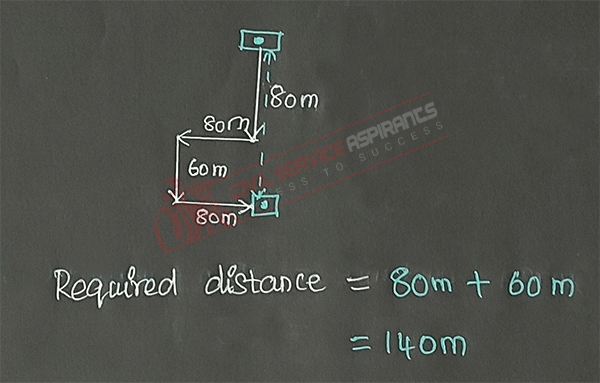
Sankar walks 80 m towards south. Then, turns to his right & starts walking straight till he completes another 80 m. Then, again turning to his left he walks for 60 m. He then turns to his left & walks for 80 m. How far is he from his initial position?
The question involves direction and distance. Sankar walks in different directions, making right and left turns. To find his shortest distance from the initial position, we need to track his movements, calculate his net displacement along the north-south and east-west directions, and apply the Pythagorean theorem.
Identify the given movements:
Determine the direction of each movement:
First Movement: Sankar walks 80 m towards the south.
Second Movement: While facing south, a right turn makes him face west. Therefore, he walks 80 m towards the west.
Third Movement: While facing west, a left turn makes him face south. Therefore, he walks 60 m towards the south.
Fourth Movement: While facing south, another left turn makes him face east. Therefore, he walks 80 m towards the east.
Calculate the net east-west displacement:
Sankar walks 80 m towards the west and later 80 m towards the east.
These two movements cancel each other.
\[ \text{Net East-West Displacement}=80-80=0\ \text{m} \]Therefore, there is no net displacement in the east-west direction.
Calculate the net north-south displacement:
Sankar walks 80 m towards the south initially and another 60 m towards the south after his second turn.
Both movements are in the same direction, so their distances are added.
\[ \text{Net Southward Displacement}=80+60 \] \[ =140\ \text{m} \]Therefore, Sankar is 140 m south of his initial position.
Calculate the shortest distance from the starting point:
The shortest distance between the initial and final positions is the magnitude of the net displacement.
Using the Pythagorean theorem:
\[ d=\sqrt{x^2+y^2} \]Where:
Substituting the values:
\[ d=\sqrt{0^2+140^2} \] \[ d=\sqrt{19600} \] \[ d=140\ \text{m} \]Therefore, Sankar is 140 m away from his initial position.
Correct Option: D) 140 m — Sankar's westward and eastward movements of 80 m each cancel each other. His total southward displacement is:
\[ 80+60=140\ \text{m} \]
Therefore, he is 140 m south of his starting point, and the shortest distance from his initial position is 140 m. Hence, Option D is the correct answer.
A) 60 m: This is incorrect because 60 m represents only the distance travelled during the third movement. It does not include the initial 80 m southward movement.
B) 100 m: This is incorrect because the net displacement is entirely southward and equals 140 m. The correct distance is not 100 m.
C) 120 m: This is incorrect because the total southward displacement is 80 + 60 = 140 m, while the east-west movements cancel each other.
K is 40 m South-West of L. If M is 40 m South-East of L, then M is in which direction of K?
This problem involves determining the relative direction of one point with respect to another, given their positions relative to a third point. We can visualize the positions using a standard compass rose (North, South, East, West, and intermediate directions).
A) East — From K's perspective, M is located directly to its right, which corresponds to the East direction.