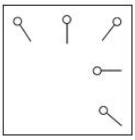
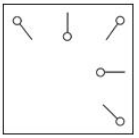
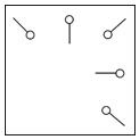
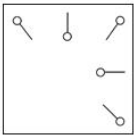
A, B, C, D, E, F, and G, are sitting around a circular table facing the centre (but not necessarily in the same order). Only 2 people sit between A and B when counted from the left of A. Both G and F are immediate neighbours of A. C sits immediate to the left of E. Only 2 people sit between D and G when counted from the right of D. How many people sit between E and F when counted from the left of F?
Read the given statement(s) and conclusions carefully. Assuming that the information given in the statements is true, even if it appears to be at variance with commonly known facts, decide which of the given conclusions logically follow(s) from the statement(s).
Statements:
Some gums are candies.
No candy is a ball.
Conclusions:
(I) Atleast some candies are gums.
(II) No ball is a gum.
4 is related to 15 following a certain logic. Following the same logic, 15 is related to 48. To which of the following is 7 related following the same logic?
(NOTE: Operations should be performed on the whole numbers, without breaking down the numbersinto its constituent digits. E.g. 13 โ Operations on 13 such as adding /subtracting /multiplying etc. to 13can be performed. Breaking down 13 into 1 and 3 and then performing mathematical operations on 1and 3 is not allowed)
OGMI is related to LDJF in a certain way based on the English alphabetical order. In the same way, SKQM is related to PHNJ. To which of the following is VNTP related, following the same logic?
In a certain code language, โsaroj learns taxesโ is written as โvi ti uiโ and โpriya paid taxesโ is written as โpi vi wiโ. How is โtaxesโ written in the given language?
OD 11 is related to KH 15 in a certain way. In the same way, ID 5 is related to EH 9. To which of the following is LK 3 related, following the same logic?