Three Statements are given followed by two conclusions numbered I and II. Assuming the statements to be true, even if they seem to be at variance with commonly known facts, decide which of the conclusions logically follow(s) from the statements.
Statement I: All mathematicians are logical thinkers.
Statement II: Some logical thinkers are scientists.
Statement III: Some scientists are fool.
Conclusion I: Some scientists are not fool.
Conclusion II: Some logical thinkers are not scientists.
Neither conclusion I nor II follows
Both conclusions I and II follow
Only conclusion I follows
Only conclusion II follows
If A + B means A is the wife of B,
A × B means A is the father of B,
A ÷ B means A is the mother of B,
A $ B means A is the brother of B,
and A − B means A is the sister of B.
If P + D $ B + H × T – M, then how is H related to D?
Three different positions of the same dice are given below. Find the number opposite of 2. 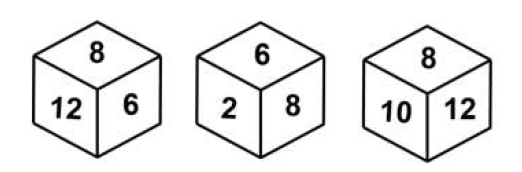
Select the figure that will replace the question mark (?) in the following figure series.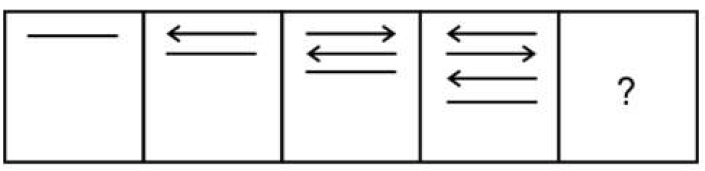
Eight teachers Jatin, Abhi, Gopal, Heena, Ishaa, Rohit, Kajal and Leela are sitting around a circular table facing opposite to the centre (not necessarily in the same order). Abhi is second to the left of Heena. Rohit is third to the right of Heena. Gopal is second to the right of Jatin. Rohit is second to the left of Jatin. Kajal is third to the left of Ishaa. Who is sitting to the immediate left of Gopal?
Arrange the given words in the sequence in which they occur in the dictionary.
1. Liberal
2. Libra
3. Library
4. Libel
5. Liability
Which two signs should be interchanged to make the given equation correct?
10 - 2 ÷ 4 + 6 × 3 = 19