
To find the average weight of the family members, we need to sum up all their individual weights and then divide by the total number of family members. This is the standard formula for calculating the arithmetic mean.
\[ \text{Sum of weights} = 257 \text{ kg} \]
\[ \text{Average weight} = \frac{257}{5} \text{ kg} \]
\[ \text{Average weight} = 51.4 \text{ kg} \]
Correct Option: C) 51.4
To find the average of the first \(n\) even numbers, we can use the property that the average of an arithmetic progression is the average of its first and last terms. Alternatively, we can use the formula for the sum of the first \(n\) even numbers and then divide by \(n\).
Alternative Method: Using the sum formula
Correct Option: A) 175
Pipe A can fill a tank in 13 hours, Pipe B in 27 hours, and Pipe C in 19 hours. What is the time (in hours) taken to fill the tank when all three pipes are opened together?
5 \(\frac{3}{1111}\)
4 \(\frac{3}{1111}\)
6 \(\frac{3}{1111}\)
7 \(\frac{3}{1111}\)
To find the time taken to fill the tank when all three pipes are opened together, we first calculate the individual filling rates of each pipe. Then, we sum these rates to find the combined filling rate. Finally, the total time is the reciprocal of the combined rate.
Calculate the filling rate of Pipe A:
Pipe A fills the tank in 13 hours. So, in one hour, Pipe A fills \(\frac{1}{13}\) of the tank.
Calculate the filling rate of Pipe B:
Pipe B fills the tank in 27 hours. So, in one hour, Pipe B fills \(\frac{1}{27}\) of the tank.
Calculate the filling rate of Pipe C:
Pipe C fills the tank in 19 hours. So, in one hour, Pipe C fills \(\frac{1}{19}\) of the tank.
Calculate the combined filling rate of all three pipes:
When all three pipes are opened together, their individual rates add up.
\[ \text{Combined rate} = \frac{1}{13} + \frac{1}{27} + \frac{1}{19} \]Find a common denominator for the fractions:
The least common multiple (LCM) of 13, 27, and 19 is \(13 \times 27 \times 19 = 6669\).
So, the combined rate is:
\[ \text{Combined rate} = \frac{27 \times 19 + 13 \times 19 + 13 \times 27}{13 \times 27 \times 19} \]\[ \text{Combined rate} = \frac{513 + 247 + 351}{6669} \]\[ \text{Combined rate} = \frac{1111}{6669} \]Calculate the total time taken:
The time taken to fill the tank is the reciprocal of the combined rate.
\[ \text{Time} = \frac{1}{\text{Combined rate}} = \frac{6669}{1111} \text{ hours} \]Convert the improper fraction to a mixed fraction:
Divide 6669 by 1111:
\[ 6669 \div 1111 = 6 \text{ with a remainder of } 3 \]\[ \text{Time} = 6 \frac{3}{1111} \text{ hours} \]C) \(6 \frac{3}{1111}\) is the correct answer, as calculated above.
Two cubes each of volume 125 cm³ are joined end to end. The total surface area of the resulting cuboid is: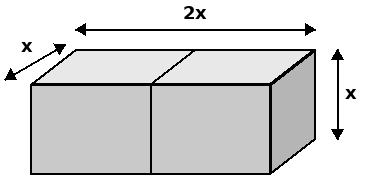
To find the total surface area of the resulting cuboid formed by joining two cubes, we need to first determine the side length of each cube and then use the formula for the surface area of a cuboid.
where \(x\) is the side length of the cube. Therefore,
\[ x^3 = 125 \]Taking the cube root of both sides, we find:
\[ x = \sqrt[3]{125} = 5 \, \text{cm} \]Substituting the dimensions of the cuboid:
\[ \text{Surface Area} = 2(10 \times 5 + 10 \times 5 + 5 \times 5) \] \[ = 2(50 + 50 + 25) \] \[ = 2 \times 125 \] \[ = 250 \, \text{cm}^2 \]Thus, the total surface area of the resulting cuboid is \(250 \, \text{cm}^2\).
Correct Option: D) 250 cm2
This problem involves calculating the actual profit percentage when a vendor claims to sell at a loss but also uses fraudulent weights. We need to account for both the claimed loss and the cheating in weight to find the effective cost price and selling price for a given quantity.
Correct Option: D) 16.67%
To find the final price, we need to apply the discounts sequentially. First, calculate the price after the trade discount. Then, apply the scheme discount to this new price.
The original price of the product is ₹8,000.
The trade discount is 15%.
Amount of trade discount:
\[ \text{Trade Discount Amount} = 15\% \text{ of } \text{₹}8,000 = \frac{15}{100} \times 8000 = \text{₹}1,200 \]Price after trade discount:
\[ \text{Price after Trade Discount} = \text{₹}8,000 - \text{₹}1,200 = \text{₹}6,800 \]The scheme discount is 5% on the already discounted price (₹6,800).
Amount of scheme discount:
\[ \text{Scheme Discount Amount} = 5\% \text{ of } \text{₹}6,800 = \frac{5}{100} \times 6800 = \text{₹}340 \]Final price the customer has to pay:
\[ \text{Final Price} = \text{₹}6,800 - \text{₹}340 = \text{₹}6,460 \]Correct Option: C) ₹6,460
This problem involves profit sharing in a partnership, where profit is distributed in proportion to the product of the capital invested and the time for which it was invested. We are given information about the difference in investments, the duration of investments, the difference in shares, and the total profit. We need to find the capital contributed by M.
Let N's investment be \(\text{₹}x\). Then M's investment is \(\text{₹}(x + 69,000)\).
M invested for 5 months, and N invested for 3 months.
The ratio of profits is equal to the ratio of (investment \(\times\) time).
M's share : N's share \( = (x + 69,000) \times 5 : x \times 3 \)
M's share : N's share \( = (5x + 345,000) : 3x \)
Let M's share be \(S_M\) and N's share be \(S_N\).
We are given that \(S_M - S_N = \text{₹}720\).
The total profit is \(\text{₹}2,160\).
So, \(S_M + S_N = \text{₹}2,160\).
We can solve these two equations to find \(S_M\) and \(S_N\):
Adding the two equations:
\[ (S_M - S_N) + (S_M + S_N) = 720 + 2160 \]\[ 2S_M = 2880 \]\[ S_M = \frac{2880}{2} = \text{₹}1440 \]Substitute \(S_M\) back into \(S_M + S_N = 2160\):
\[ 1440 + S_N = 2160 \]\[ S_N = 2160 - 1440 = \text{₹}720 \]Now, we use the profit ratio:
\[ \frac{S_M}{S_N} = \frac{5x + 345,000}{3x} \]\[ \frac{1440}{720} = \frac{5x + 345,000}{3x} \]\[ 2 = \frac{5x + 345,000}{3x} \]Solve for \(x\):
\[ 2 \times 3x = 5x + 345,000 \]\[ 6x = 5x + 345,000 \]\[ 6x - 5x = 345,000 \]\[ x = 345,000 \]This is N's investment. M's investment is \(x + 69,000\).
M's investment \( = 345,000 + 69,000 = \text{₹}414,000 \).
B) ₹4,14,000
To calculate the simple interest, we need to determine the principal amount, the annual rate of interest, and the time period for which the interest is calculated. The time period must be expressed in years. Since the deposit and withdrawal dates are given, we will first calculate the exact number of days the money was deposited and then convert it into years.
First, determine if 2024 is a leap year. A year is a leap year if it is divisible by 4, unless it is a century year not divisible by 400. Since 2024 is divisible by 4, it is a leap year, meaning February has 29 days.
Total number of days = \(26 + 31 + 4 = 61\) days.
Since there are 366 days in a leap year (2024), the time (T) in years is:
\[ T = \frac{\text{Number of days}}{\text{Days in a leap year}} = \frac{61}{366} \text{ years} \]The formula for simple interest is:
\[ \text{SI} = \frac{P \times R \times T}{100} \]\[ \text{SI} = \frac{4000 \times 7.5 \times \frac{61}{366}}{100} \]\[ \text{SI} = \frac{4000 \times 7.5 \times 61}{100 \times 366} \]\[ \text{SI} = \frac{40 \times 7.5 \times 61}{366} \]\[ \text{SI} = \frac{300 \times 61}{366} \]\[ \text{SI} = \frac{18300}{366} \]\[ \text{SI} = 50 \]The simple interest is ₹50.
C) ₹50 is the correct simple interest calculated based on the principal, rate, and the exact number of days in a leap year.
To find the average speed for a journey where the distance traveled in each direction is the same but the speeds are different, we can use the formula for average speed for equal distances. Alternatively, we can assume a convenient distance and calculate the total distance and total time.
Average speed is defined as the total distance traveled divided by the total time taken.
\[ \text{Average Speed} = \frac{\text{Total Distance}}{\text{Total Time}} \]When an object travels a certain distance at speed \(S_1\) and returns the same distance at speed \(S_2\), the average speed is given by the formula:
\[ \text{Average Speed} = \frac{2 S_1 S_2}{S_1 + S_2} \]Substitute the given values:
\[ \text{Average Speed} = \frac{2 \times 36 \times 45}{36 + 45} \] \[ \text{Average Speed} = \frac{2 \times 36 \times 45}{81} \]Simplify the expression:
\[ \text{Average Speed} = \frac{3240}{81} \] \[ \text{Average Speed} = 40 \text{ km/hr} \]Let the distance between Kanpur and Lucknow be \(D\) km. A convenient distance to assume is the Least Common Multiple (LCM) of the speeds (36 and 45). The LCM of 36 and 45 is 180.
So, let \(D = 180 \text{ km}\).
Correct Option: D) 40
By how much is 65% of 65 greater than \( \frac{3}{5} \) of 15?
To solve this problem, we need to calculate two values: first, 65% of 65, and second, \( \frac{3}{5} \) of 15. Once both values are calculated, we will find the difference between the first value and the second value.
Percentage can be expressed as a fraction out of 100. So, 65% can be written as \( \frac{65}{100} \).
\[ 65\% \text{ of } 65 = \frac{65}{100} \times 65 \]\[ = \frac{65 \times 65}{100} \]\[ = \frac{4225}{100} \]\[ = 42.25 \]This is a straightforward multiplication of a fraction by an integer.
\[ \frac{3}{5} \text{ of } 15 = \frac{3}{5} \times 15 \]\[ = 3 \times \frac{15}{5} \]\[ = 3 \times 3 \]\[ = 9 \]The question asks by how much the first value is greater than the second value. So, we subtract the second value from the first value.
\[ \text{Difference} = 42.25 - 9 \]\[ = 33.25 \]Thus, 65% of 65 is 33.25 greater than \( \frac{3}{5} \) of 15.
Correct Option: A) 33.25