
The question asks to identify which of the given metals is stored in kerosene oil. This is a common practice for highly reactive metals to prevent their reaction with atmospheric oxygen and moisture.
Correct Option: B) Sodium is a highly reactive alkali metal that reacts vigorously with oxygen and moisture in the air. Storing it in kerosene oil prevents its contact with air and water, thus preventing undesirable reactions.
The below figure is embedded in one of the answer figures. Choose the correct figure containing the below figure.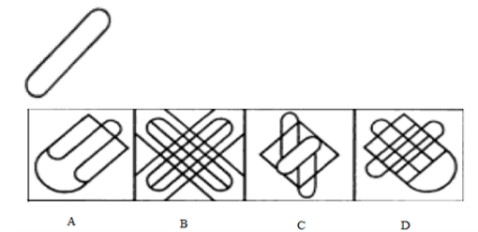
To solve this problem, we need to identify which of the given figures contains the embedded figure shown at the top. This involves visually inspecting each option to check for the presence of the specific shape and orientation of the embedded figure.
Correct Option: D) Option D contains the elongated oval shape, matching the embedded figure.
Two pipes, when working one at a time, can fill a cistern in 3 hours and 4 hours, respectively while a third pipe can drain the cistern empty in 8 hours. All the three pipes were opened together when the cistern was \( \frac{1}{12} \) full. How long did it take for the cistern to be completely full?
2 hours 10 minutes
2 hours
1 hour 45 minutes
2 hours 11 minutes
This problem involves calculating the combined work rate of pipes filling and emptying a cistern. We will first determine the individual rates of filling and emptying, then find the net filling rate when all pipes are open. Finally, we will calculate the time required to fill the remaining portion of the cistern.
Correct Option: B) 2 hours
The relationship between the focal length (\(f\)) and the radius of curvature (\(R\)) of a spherical mirror (concave or convex) is a fundamental concept in optics. For spherical mirrors, the focal length is always half of its radius of curvature.
C) 10 cm — The focal length is half the radius of curvature, so \(20 \text{ cm} / 2 = 10 \text{ cm}\).
To find the kinetic energy of an object, we use the formula for kinetic energy, which relates the object's mass and velocity. We will substitute the given values into this formula and calculate the result.
The kinetic energy (\(KE\)) of an object is given by the formula:
\[ KE = \frac{1}{2}mv^2 \]where \(m\) is the mass and \(v\) is the velocity.
The unit for kinetic energy is Joules (J).
Thus, the kinetic energy of the object is 275 J.
The question asks to identify the type of mirror that produces an image smaller than the object. This requires understanding the image formation properties of different types of mirrors, specifically their magnification characteristics.
B) convex mirror. A convex mirror always forms a virtual, erect, and diminished image, meaning the image (reflection) will always appear smaller than the actual object.
The question asks to identify the deity who converses with Nachiketas in the Kathopanishad. This requires knowledge of the central narrative of the Kathopanishad, a key Upanishad in Hindu philosophy.
Correct Option: A) Lord Yama is the god who converses with Nachiketas in the Kathopanishad, imparting profound spiritual knowledge about life, death, and the nature of reality.
This problem involves properties of circles and tangents. When two tangents are drawn from an external point to a circle, the quadrilateral formed by the center of the circle, the points of tangency, and the external point has specific angle relationships. Specifically, the angle between the two radii to the points of tangency and the angle between the two tangents are supplementary.
A) 105° is the correct answer. The angle between the two radii is \(105^\circ\), which is supplementary to the angle between the tangents (\(75^\circ\)).
The question asks about the relationship between the resistance of a conductor and various physical properties. We need to recall the formula for the resistance of a conductor and analyze its dependence on each given option.
A) area of cross section — As derived from the formula \(R = \rho \frac{L}{A}\), resistance \(R\) is inversely proportional to the area of cross-section \(A\). This means if the area increases, resistance decreases, and if the area decreases, resistance increases.
This problem involves ratios and proportions. We are given the total number of saplings and the ratio of Mango tree saplings to Neem tree saplings. We need to find the number of Neem tree saplings. The approach is to first find the total number of parts in the ratio, then determine the value of one part, and finally calculate the number of Neem tree saplings.
Understand the given information:
Calculate the sum of the ratio parts:
The ratio is 8 : 11. This means for every 8 parts of Mango trees, there are 11 parts of Neem trees.
\[ \text{Sum of ratio parts} = 8 + 11 = 19 \]Determine the value of one ratio part:
The total number of saplings (361) corresponds to the total sum of the ratio parts (19).
\[ \text{Value of one part} = \frac{\text{Total number of saplings}}{\text{Sum of ratio parts}} = \frac{361}{19} \]\[ \text{Value of one part} = 19 \]Calculate the number of Neem tree saplings:
The ratio for Neem tree saplings is 11 parts. Multiply the value of one part by the Neem tree ratio part.
\[ \text{Number of Neem tree saplings} = \text{Neem tree ratio part} \times \text{Value of one part} \]\[ \text{Number of Neem tree saplings} = 11 \times 19 \]\[ \text{Number of Neem tree saplings} = 209 \]B) 209 — As calculated in the step-by-step explanation, there are 209 Neem tree saplings in the garden.