
The below figure is embedded in one of the four answer figures. Which of the figures contain the below problem figure?
Problem Figure: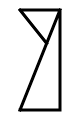
Answer Figure: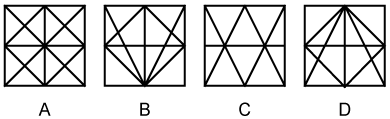
The task is to identify which of the answer figures contains the problem figure as an embedded part. This involves visually matching the shapes and lines of the problem figure with each of the answer figures.
Correct Option: D) The problem figure is embedded in this option.
The question asks to identify the Indian gymnast who received the Padma Shri Award in 2017. This requires knowledge of prominent Indian sports personalities and the awards they have received.
Dipa Karmakar is an Indian artistic gymnast. She created history by becoming the first Indian female gymnast to qualify for the Olympics, doing so at the 2016 Rio Olympics. For her outstanding achievements in gymnastics, she was awarded the prestigious Padma Shri by the Government of India in 2017.
Students are sitting in a row in which the position of X is 17th from the left and that of Y is 14th from the right. If they interchange their positions, X's position becomes 7th from the left. How many students are there in the row?
This problem involves finding the total number of students in a row based on their initial and final positions after interchanging places. We can determine the total number of students by finding the position of one person from both ends of the row after the interchange.
When X moves to Y's original position, X's position becomes 7th from the left. This means Y's original position was 7th from the left.
We now know Y's original position from both ends:
The formula to find the total number of people in a row when the position of one person from both ends is known is:
\[ \text{Total students} = (\text{Position from left} + \text{Position from right}) - 1 \]Substitute the values for Y's original position:
\[ \text{Total students} = (7 + 14) - 1 \] \[ \text{Total students} = 21 - 1 \] \[ \text{Total students} = 20 \]D) 20
The problem asks us to identify the option that does not follow the same pattern as the others, based on the given sequence: RB75E%M3W48Q9#B2A$MS. We need to analyze the position and type of characters in each option relative to the sequence.
From the analysis, Options A, C, and D follow the pattern of selecting elements with 3 characters skipped in between. Option B does not follow this pattern for the second skip.
Correct Option: B) 4#M
The problem asks us to find X's rank from the top in a class of 50 students. We need to determine if Statement 1, Statement 2, or both, are sufficient to answer this question. We will analyze each statement independently.
The total number of students in the class is 50.
The formula to convert rank from the bottom to rank from the top (or vice-versa) is:
\[ \text{Rank from top} + \text{Rank from bottom} - 1 = \text{Total number of students} \]Let's analyze Statement 1:
Let's analyze Statement 2:
C) Either 1 or 2 is sufficient to answer the given question. Both statements independently provide enough information to determine X's rank from the top.
This is a blood relation problem. We need to deduce the relationship between the girl in the portrait and the man's wife by breaking down the statement made by the man.
A) Daughter — The girl in the portrait is the man's daughter, which means she is also his wife's daughter.
The given Problem Figure is embedded in one of the given Answer Figures. Which is that Answer Figure?
Problem Figure: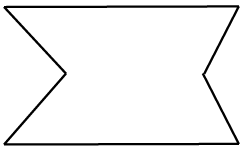
Answer Figures: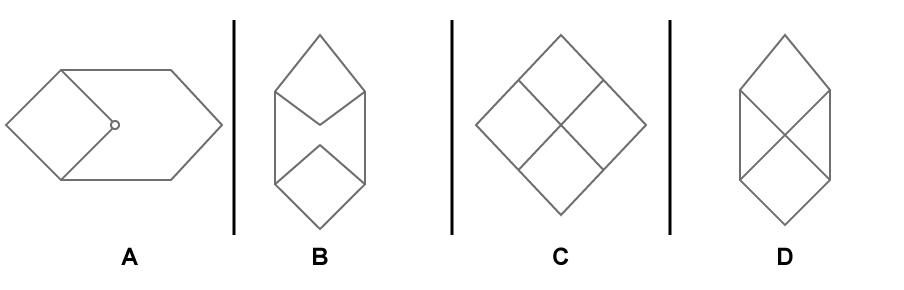
To solve this problem, we need to identify which of the given answer figures contains the problem figure embedded within it. This involves visually comparing the shapes and patterns of the problem figure with those of the answer figures.
Correct Option: B) The hourglass shape is clearly visible in this figure.
The problem states that the given equation has only one (repeated) solution. This implies that the equation, when rearranged into a standard quadratic form \(Ax^2 + Bx + C = 0\), must have its discriminant equal to zero. The discriminant of a quadratic equation \(Ax^2 + Bx + C = 0\) is given by \(\Delta = B^2 - 4AC\). Setting \(\Delta = 0\) will allow us to solve for the value of 'a'. We then need to select the positive integral solution for 'a'.
The given equation is:
\[ 3x^2 - ax + 6 = ax^2 + 2x + 2 \]Rearrange the terms to one side to get a standard quadratic equation \(Ax^2 + Bx + C = 0\):\[ 3x^2 - ax^2 - ax - 2x + 6 - 2 = 0 \]Combine like terms:\[ (3 - a)x^2 + (-a - 2)x + (6 - 2) = 0 \]\[ (3 - a)x^2 - (a + 2)x + 4 = 0 \]From the standard form \(Ax^2 + Bx + C = 0\), we have:
For a quadratic equation to have only one (repeated) solution, its discriminant must be zero. The discriminant is \(\Delta = B^2 - 4AC\).
\[ B^2 - 4AC = 0 \]Substitute the values of A, B, and C:\[ (-(a + 2))^2 - 4(3 - a)(4) = 0 \]\[ (a + 2)^2 - 16(3 - a) = 0 \]Expand and simplify the equation:
\[ (a^2 + 4a + 4) - (48 - 16a) = 0 \]\[ a^2 + 4a + 4 - 48 + 16a = 0 \]\[ a^2 + 20a - 44 = 0 \]This is a quadratic equation in 'a'. We can solve it by factoring or using the quadratic formula. Let's try factoring:\[ a^2 + 22a - 2a - 44 = 0 \]\[ a(a + 22) - 2(a + 22) = 0 \]\[ (a - 2)(a + 22) = 0 \]This gives two possible solutions for 'a':\[ a - 2 = 0 \implies a = 2 \]or\[ a + 22 = 0 \implies a = -22 \]The problem asks for the positive integral solution of 'a'. Between \(a = 2\) and \(a = -22\), the positive integral solution is \(a = 2\).
A) 2 is the positive integral solution for 'a' that results in the original equation having only one (repeated) solution.
The question asks for X's age on a specific date. We need to determine if the given statements provide enough information to calculate X's exact age. This is a data sufficiency problem.
B) Neither 1 nor 2 is sufficient to answer the given question
As determined in the step-by-step analysis, neither statement alone, nor both statements combined, provide enough information to calculate X's exact age. We only get relative age differences, but no absolute age reference point.
This question deals with the concepts of potential energy and kinetic energy, and their interconversion as a body falls under gravity. The principle of conservation of mechanical energy (in the absence of non-conservative forces like air resistance) is key to understanding this phenomenon.
D) Its Potential energy decreases while its Kinetic energy increases
As explained above, when a body falls from a height, its height decreases, leading to a decrease in its potential energy. Simultaneously, its speed increases due to gravity, leading to an increase in its kinetic energy. This is a direct application of the conservation of mechanical energy.